 Menu
Menu
On this page
- Is Oneleet the Right Tool for Your SOC 2?
- The Security-First Model (What You Actually Get)
- Who Audits You? The Independence Question
- Oneleet Pricing and Total Cost (2026)
- Is Oneleet or Vanta the Better Fit?
- How Does Oneleet Compare with Vanta and Drata?
- Real User Sentiment (2026)
- Decision Framework: Should You Pick Oneleet?
- Oneleet FAQ
- Final Verdict
Oneleet is the strongest fit for startups and growth-stage SaaS teams that want their SOC 2 program to produce real security, not just a report. Built by penetration testers, it bundles in-house pentesting, code scanning, vCISO guidance, and compliance automation into one contract, and it holds the highest G2 rating in this shortlist (4.9/5 across 138 reviews). It is not the right call for teams that need maximum integration breadth, parallel multi-framework programs, published pricing, or inspectable/self-hosted code. Vanta and Drata cover breadth and multi-framework support; Comp AI is the inspectable or self-hosted comparison.
How we reviewed this: Oneleet documentation, YC and press coverage, G2, third-party pricing estimates, and the dated, sourced Oneleet record.
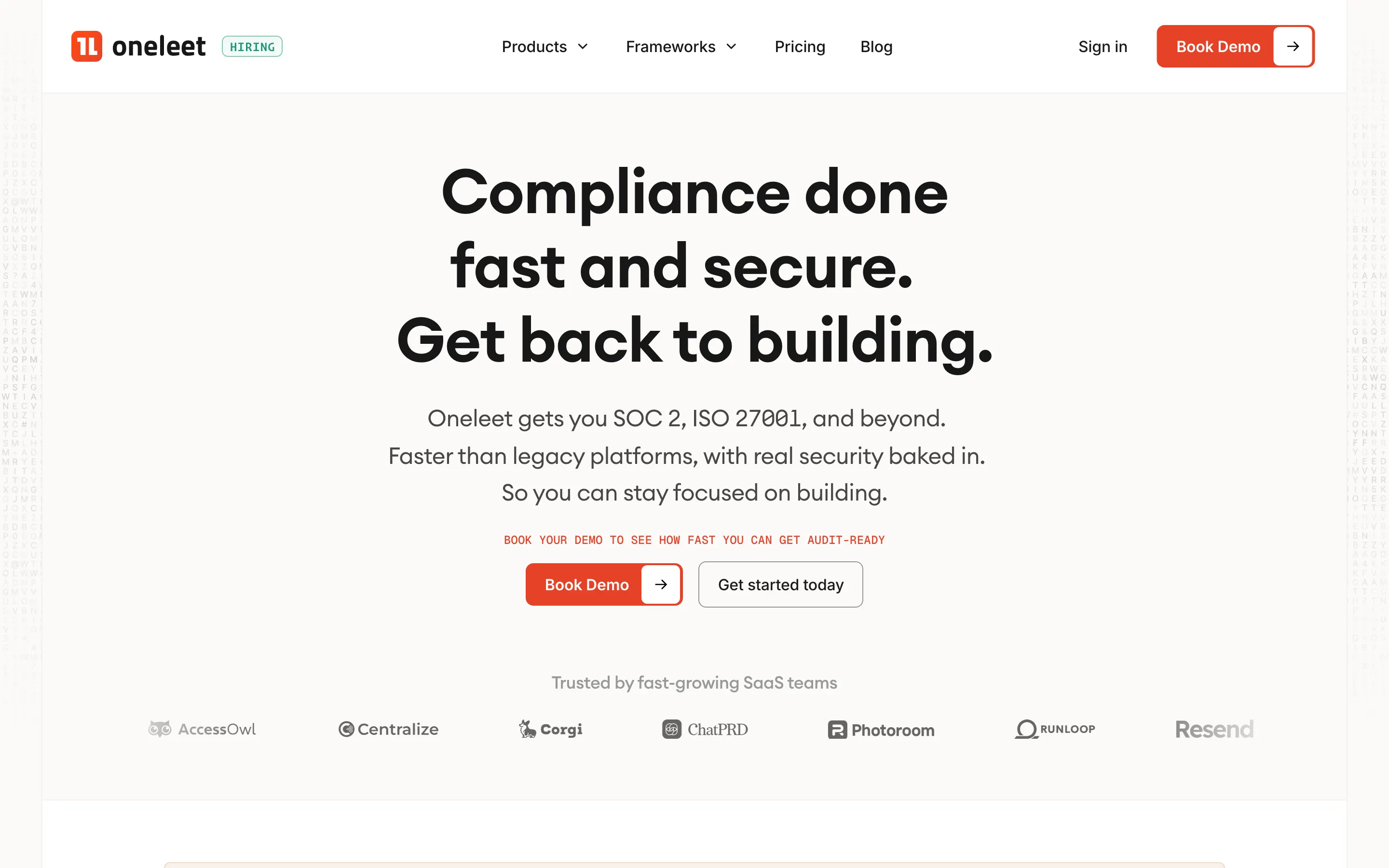
Oneleet raised a $33M Series A in October 2025 (led by Dawn Capital, with Y Combinator, Dropbox co-founder Arash Ferdowsi, and Frank Slootman participating) on the back of $9M in annual recurring revenue, per TechCrunch. Its pitch is a direct shot at what founder Bryan Onel calls “compliance theater”: companies that pass their audits while remaining easy to break into. Onel spent roughly a decade running penetration tests against 150+ companies before starting Oneleet, and the platform is built around that experience. This review covers what that security-first posture means in practice, what Oneleet actually costs, who performs the audit, and when a competitor is the better pick.
Is Oneleet the Right Tool for Your SOC 2?
Oneleet is a compliance automation platform founded in 2022 by Bryan Onel, Ora Onel, and Erik Vogelzang, and a Y Combinator Summer 2022 alum. Like Vanta or Drata, it connects to your cloud infrastructure, identity provider, and code repositories, runs automated tests against the AICPA Trust Services Criteria, and collects evidence for your auditor. The difference is what surrounds that core: an in-house, OSCE-certified penetration testing team, code security scanning, attack surface management, dark web monitoring, an MDM agent, and a dedicated vCISO who guides the program. Compliance is framed as the by-product of an actual security program rather than the goal.
One thing Oneleet is not: an auditor. Your SOC 2 report is issued by external, third-party CPA firms that Oneleet has vetted and coordinates on your behalf. We cover the independence implications of that structure below, because it is one of the most common points of confusion about the platform.
Oneleet at a Glance
| Attribute | Detail |
|---|---|
| Founded | 2022 (Y Combinator S22) |
| Founders | Bryan Onel, Ora Onel, Erik Vogelzang |
| Funding | ~$35M total (last: $33M Series A, Dawn Capital, Oct 2025) |
| Revenue signal | $9M ARR at Series A (Oct 2025, TechCrunch) |
| Customers | 1,000+ teams (vendor claim, oneleet.com) |
| Frameworks | SOC 2, ISO 27001, HIPAA, GDPR, PCI DSS, CIS IG1, EU DORA, NIST 800-171, custom |
| Audit model | External partner CPA firms, coordinated by Oneleet |
| Pentest | In-house, OSCE-certified (bundled) |
| G2 Rating | 4.9 / 5 (138 reviews) |
| Pricing | Quote-only; estimated ~$8K–$60K/yr in the sourced record (not a public rate card) |
| Best For | Startups selling to enterprise; teams that want security and compliance in one program |
Full evidence and dates: our Oneleet record. Observed price is an estimate from a third-party listing, not Oneleet-confirmed. Detailed quote mechanics live on the Oneleet pricing guide.
The buying question is whether the bundled pentest and vCISO replace services you would buy anyway, and whether 22 documented integrations cover the in-scope stack. Comp AI sits on the alternatives list because it changes a different constraint — inspectable code and self-hosting — not because it matches Oneleet’s in-house pentest.
| Buying fact | Oneleet | Vanta | Drata | Comp AI |
|---|---|---|---|---|
| In-house pentest | Yes, bundled (vendor docs) | Buy separately | Buy separately | Optional in a quote; not an in-house pentest origin |
| Onboarding model | Bundled expert | Guided | Guided | Guided |
| Published integrations | 22 (docs) | 400 | 300 | 590 catalog (GitHub) |
| Native SCIM | Unknown | Yes; may be an add-on | Unknown | Unknown |
| Open-core / self-host | No | No | No | Yes (AGPLv3 core; /ee is commercial) |
| Who selects the CPA | Oneleet-coordinated partners | Buyer | Buyer | Buyer (pre-vetted firms are unnamed) |
Capability values from sourced directory records (Oneleet, Vanta, Drata, and Comp AI). Unknown means current public evidence does not establish the feature. Comp AI’s 590 is a repository catalog count, not evidence that every connector runs the same checks.
Oneleet fit by company profile
| Company Profile | Fit | Why |
|---|---|---|
| Early-Stage Startup (Seed–Series A) | Strong fit | The core ICP. Bundled pentest + vCISO replaces tools and consultants a small team would otherwise buy separately. Strong YC-network adoption. |
| Growth-Stage Company (Series B–C) | Good fit | Security depth scales well; sequential framework approach and integration gaps start to matter at this stage. |
| Mid-Market / Enterprise | Conditional fit | Fewer integrations than Vanta/Drata and no published pricing add procurement friction; strong if security posture is the priority. |
| Heavily Regulated (FinTech, HealthTech) | Good fit | HIPAA, PCI DSS, and EU DORA coverage plus real pentesting fit regulated buyers; parallel multi-framework programs fit less well. |
| Bootstrapped / Low Budget | Weak fit | Reported ~$12K entry plus audit fees is a real commitment; the bundle only pays off if you would have bought the pentest anyway. |
Oneleet Pros and Cons
Oneleet Pros
- Security-first by construction: founded and staffed by penetration testers; the program is designed around what attackers exploit, not around checklist completion.
- In-house penetration testing bundled: OSCE-certified pentesting included in the offering rather than referred out; competitors make you procure this separately at $8K–$25K.
- Highest G2 rating in this shortlist: 4.9/5 across 138 reviews, with consistent praise that it “actually improves our security.”
- One contract for the security stack: evidence automation, code scanning, MDM, dark web monitoring, trust center, and vCISO guidance in a single vendor relationship.
- Auditor handling: Oneleet vets external CPA firms and manages the auditor interaction, so your team is not translating technical evidence for a financial auditor.
- Strong momentum: $9M ARR, $33M Series A, and (by its own account) two-thirds of new YC portfolio companies as clients.
Oneleet Cons
- No public pricing: every quote requires a demo; budgeting and internal approvals take longer. The most consistent critique in third-party reviews.
- Fewer integrations than Vanta or Drata: Oneleet’s docs list 22 integrations, versus Vanta’s published 400 and Drata’s 300. Reviewers repeatedly cite the smaller library as the main functional gap.
- One framework at a time: the methodology favors sequential certifications with control reuse; a poor fit if you need SOC 2 + ISO 27001 + HIPAA in parallel.
- Onboarding can feel slower: some G2 reviewers describe a heavier lift up front, a by-product of building real controls rather than templating past them.
- Young company: founded 2022; a shorter track record than Vanta (2018) and a smaller ecosystem of auditors fluent in its exports.
The Security-First Model (What You Actually Get)
Oneleet’s product surface is wider than a standard GRC tool. Beyond the usual continuous control monitoring and automated evidence collection, the platform and service bundle includes:
- Penetration testing: performed by Oneleet’s in-house, OSCE-certified team. This is the company’s origin: it began as a pentest shop serving companies pursuing SOC 2 and expanded into the platform. For most SOC 2 programs a pentest is expected by enterprise buyers even though the framework does not strictly mandate one (see our guide on SOC 2 penetration testing requirements).
- Code security scanning and attack surface management: repository scanning and external surface monitoring feed findings into the same dashboard as compliance controls, so a fix produces audit evidence.
- Dark web monitoring: alerts when credentials, keys, or internal documents tied to your company surface in breach data (reported by third-party reviews of the platform).
- MDM and employee portal: a device agent for macOS, Windows, and Linux covers the endpoint controls auditors ask about.
- vCISO guidance: a named security expert shapes the program, prepares you for the audit, and talks to the auditor in their language.
The honest framing: this is a heavier, more opinionated product than a pure evidence-collection tool. Teams that want a minimal checklist to satisfy one customer’s security review may find the posture more than they need. Teams whose buyers probe (real security questionnaires, technical due diligence, pentest report requests) get more of that work covered by one vendor. If the constraint you want to change is inspectable collectors or a self-hosted deployment rather than an in-house pentest, Comp AI is the comparison on this shortlist.
Who Audits You? The Independence Question
Oneleet does not issue your SOC 2 report. A SOC 2 attestation can only be signed by a licensed CPA firm, and Oneleet is not one. Its model, stated on its Y Combinator profile, is “third-party auditing with external auditors who get security”: Oneleet vets partner CPA firms for technical competence, and its team “deals with external auditors, so you don’t have to.” The company’s own writing on auditor selection confirms the structure: “Oneleet has scoured the globe to find some of the best auditors out there,” described explicitly as auditing partners.
That structure is worth understanding relative to the alternatives:
- Vanta, Drata, Secureframe: you choose and contract your own CPA firm separately. Maximum buyer control, more coordination work.
- Thoropass: owns a legally separate in-house audit entity (Laika Compliance, LLC). Tightest bundling, and the arrangement some procurement teams flag (see our Thoropass review).
- Oneleet: sits in between. The audit firm is external and independent, but Oneleet selects it and runs the relationship.
Because the signing firm is a third party, the AICPA independence question is structurally cleaner than an in-house arm: the CPA firm is not auditing controls its own company built, even though Oneleet performs your pentest. Two things still belong on your diligence list. First, ask which CPA firm will actually sign your report, and check its standing (our guide on AICPA peer review and SOC 2 auditor quality explains how). Second, if your enterprise customers or procurement policy require you to select the auditor yourself, confirm Oneleet supports bringing your own firm before you sign; the default motion is clearly their partner network.
A Platform Prepares You. An Auditor Certifies You.
Whichever platform you pick, a licensed CPA firm signs your SOC 2 report. We match you with vetted audit firms that fit your stack, timeline, and budget, with real pricing up front.
Oneleet Pricing and Total Cost (2026)
What Is Published: Nothing
Oneleet’s pricing page publishes no numbers. It states that pricing “depends on a few factors specific to your needs” and routes every buyer to a demo for a custom quote. Treat any specific figure you see elsewhere as an estimate, including ours below. Our sourced record’s estimated annual band is $8,000–$60,000 (SoftwareFinder, confidence: estimate). That is not a public rate card. The Oneleet pricing guide owns the quote-normalization checklist.
Reported Bands (Third-Party Estimates, Not Vendor-Confirmed)
- ~$12K/yr entry for small teams, per ComplyJet’s 2026 analysis based on customer reports and market data.
- $12K–$18K/yr for 1–10 employees, rising to $60K–$80K+/yr for 100+ employees, per the same analysis.
- $50K+/yr for mid-sized companies with multiple frameworks (ComplyJet).
- Sprinto’s review likewise reports no public pricing, with quotes varying by company size, frameworks, and support level.
These are our best reading of third-party sources, not Oneleet-confirmed numbers. The bundle logic matters more than the sticker: if your program would have bought a pentest ($8K–$25K market rate), an MDM tool, and fractional security leadership anyway, the effective platform premium shrinks. If you only need evidence automation, cheaper single-purpose platforms exist.
What to Pin Down in the Sales Process
Three questions determine whether an Oneleet quote is actually comparable to a Vanta-plus-auditor quote: exactly which pentest scope is included (web app only, or infrastructure too, and how many retests), whether the external CPA firm’s audit fee is inside or outside the quoted number, and what the renewal looks like when you add a second framework. Model the all-in scenario with our SOC 2 cost tool and SOC 2 audit cost guide before the call.
Is Oneleet or Vanta the Better Fit?
Vanta is the stronger fit for buyers prioritizing integration breadth and a lower observed price floor. Oneleet is stronger for security-first startups that want compliance automation, pentesting, code scanning, and vCISO guidance together.
| Data-scored criterion | Rule | Oneleet | Vanta |
|---|---|---|---|
| Lower estimated price floor | 2 points to lower, 1 to higher | 1 | 2 |
| Listed framework breadth | 2 points to longer dataset list, 1 to shorter | 2 | 1 |
| Published integration count | Unknown stays unscored, never zero | Not scored | 2 |
| Bundled security depth | 2 when dataset notes pentesting, code scanning, and vCISO guidance | 2 | 0 |
The score is intentionally not totaled because Oneleet’s integration count is unknown. Vanta wins when broad connectivity is mandatory. Oneleet wins when the security bundle replaces services the buyer would otherwise purchase separately. A paid relationship never supplies missing evidence or moves either vendor above the better fit.
| Dataset comparison | Oneleet | Vanta |
|---|---|---|
| Observed annual range | $12,000-$60,000, estimated | $10,000-$250,000, estimated |
| Framework families | 8 | 6 |
| Integrations | Not published | 400 |
| Auditor model | External CPA partners coordinated by Oneleet | External CPA firm through marketplace workflows |
| Best fit | Security-first startups wanting a combined service bundle | Scaling teams wanting integration and auditor-marketplace breadth |
How Does Oneleet Compare with Vanta and Drata?
| Dimension | Oneleet | Vanta | Drata |
|---|---|---|---|
| Founded | 2022 | 2018 | 2020 |
| Customers | 1,000+ teams (vendor claim) | 15,000+ | 8,000+ |
| Integrations | Not published (reported: fewer) | 400+ | 300+ |
| G2 Rating | 4.9 (138) | 4.6 (2,665) | 4.7 (1,331) |
| Pentest included | Yes, in-house | No | No |
| Auditor | External partner firms, Oneleet-coordinated | Bring your own | Bring your own |
| Base Price | Not published (reported ~$12K+) | $10K–$15K | $7.5K–$15K |
| Best For | Security-first startups; one vendor for security + compliance | Cloud-native SaaS, first SOC 2 | Growth-stage, multi-framework |
G2 figures from sourced directory records (Oneleet, Vanta, and Drata). Confirm current counts on g2.com/products/oneleet/reviews before a major decision.
Vanta wins on ecosystem maturity: more integrations, more customers, and more CPA firms fluent in its exports. Drata wins for support-sensitive, multi-framework growth programs. Oneleet wins when the buyer wants the compliance budget to buy actual security, when a bundled pentest is needed anyway, or when a young team wants one accountable vendor instead of a platform, a pentest shop, and a consultant. Comp AI wins when inspectable code or self-hosting is the constraint you want to change. For the broader field, see our Vanta alternatives hub and Vanta vs Drata.
Real User Sentiment (2026)
What G2 Says
Oneleet holds a 4.9 out of 5 across 138 reviews on G2 — the highest rating among the platforms on this page. The 4.9 badge also appears on Oneleet’s homepage. The dominant praise theme is unusual for the category: reviewers describe the product as genuinely improving their security, not just organizing evidence, and repeatedly cite the personal service. Critical reviews cluster around onboarding pace and wanting more integrations.
What Third-Party Reviewers Say
Independent analyses (including from competitors Sprinto and ComplyJet, so weigh accordingly) converge on the same read: strongest for 5–50 person teams without a dedicated compliance function that value a human expert on call, weakest on pricing transparency, integration breadth, and parallel multi-framework programs. A homepage testimonial from a founder captures the positioning: choosing Oneleet to “build a genuinely secure program without the burden of SOC2 security theater.”
The Founder Story as Signal
Bryan Onel told TechCrunch he spent a decade breaking into companies that had passed their security checks, and warns that AI now lets companies generate fake documentation that makes them look more secure than they are. Whether or not you buy the product, that critique of checkbox compliance is directionally correct, and it explains both what users love (real controls) and what some find heavy (real controls take work).
Decision Framework: Should You Pick Oneleet?
1. Do you need real security outcomes, or just the report?
If your only driver is one customer asking for a SOC 2 and your stack is simple, a lighter platform gets you there with less effort and a knowable price. If your buyers run technical due diligence, ask for pentest reports, and probe your posture, Oneleet’s bundle covers more of that surface with one vendor.
2. Would you have bought a pentest anyway?
Most enterprise-bound SOC 2 programs end up commissioning a penetration test. If that is you, price Oneleet against platform-plus-pentest-plus-consultant, not against platform alone. If it is not, the bundle premium is harder to justify.
3. How many frameworks, and in what order?
Sequential programs (SOC 2 now, ISO 27001 next year) fit Oneleet’s methodology. Teams needing three certifications in parallel this year should evaluate Drata or Secureframe instead.
4. Can you live with quote-only pricing?
If procurement needs public list prices or fast budget approval, the demo-gated pricing is real friction. Get the pentest scope, audit fee treatment, and renewal terms in writing during the sales process.
Oneleet FAQ
How much does Oneleet cost per year?
Oneleet does not publish pricing; every quote is custom. Based on third-party estimates, packages reportedly start around $12K per year for small teams and can exceed $50K–$60K for mid-sized companies with multiple frameworks. These are reported figures, not vendor-confirmed. Model your all-in scenario (platform + pentest + audit) with our SOC 2 cost tool.
Is Oneleet an auditor? Who issues the SOC 2 report?
No. Oneleet is not a CPA firm and does not sign your report. External partner CPA firms perform the audit; Oneleet vets them and manages the interaction. Ask which firm will sign your report and verify its AICPA standing before you commit.
Does Oneleet include penetration testing?
Yes, and it is in-house rather than referred out. Oneleet began as a penetration testing company, and its YC profile lists OSCE-certified pentesting as part of the offering. Confirm the exact scope included in your quote.
What frameworks does Oneleet support?
SOC 2, ISO 27001, HIPAA, GDPR, PCI DSS, CIS IG1, EU DORA, NIST 800-171, and other or custom frameworks, per its pricing page. Reviewers note the methodology favors one framework at a time with control reuse across them.
Is Oneleet better than Vanta?
Different strengths. Vanta wins on integrations (400+), customer scale (15,000+), and auditor familiarity. Oneleet wins on security depth (bundled pentest, code scanning, vCISO) and holds a higher G2 rating (4.9 vs 4.6). See our Vanta review and Vanta alternatives for the full field.
Who founded Oneleet and how well funded is it?
Founded in 2022 by Bryan Onel (a former penetration tester), Ora Onel, and Erik Vogelzang; Y Combinator S22. It raised a $33M Series A led by Dawn Capital in October 2025 (with YC, Arash Ferdowsi, and Frank Slootman participating), bringing total funding to about $35M, at $9M ARR.
What do users criticize about Oneleet?
Pricing opacity, fewer integrations than Vanta or Drata, onboarding that can feel heavy for checklist-minded teams, and the sequential framework approach when parallel certifications are needed.
Final Verdict
Oneleet is the right choice for startups and growth-stage companies that want one vendor to make them both compliant and genuinely harder to breach. The 4.9/5 G2 rating, the bundled in-house pentest, and the vCISO layer are real differentiators, and the funding and ARR trajectory suggest the company will be around to support a multi-year program. The security-first framing is not marketing garnish; it is visibly how the product is built, down to the founder’s decade of breaking into “compliant” companies.
It is not the right choice if you need published pricing, the broadest integration library, parallel multi-framework certification, inspectable or self-hosted collectors, or full control over auditor selection. In those cases, Vanta or Drata plus an independently chosen CPA firm, or Comp AI when code access is the constraint, is the more appropriate path. Thoropass remains the comparison when the question is an in-house audit entity rather than a partner CPA.
The caveat that applies to every platform in this series applies here too, with one twist: Oneleet accelerates your security program, but a licensed CPA firm still certifies it. With Oneleet that firm comes from their partner network, which is convenient, and worth one extra diligence step: know who is signing your report.
Ready to find the right audit partner for your compliance program? At SOC2Auditors, we match you with vetted firms with real pricing and timelines. Get three tailored matches in 24 hours.
Comparing SOC 2 software? See our side-by-side breakdown of all compliance platforms — pricing, best-for, and what each one gets wrong.