 Menu
Menu
On this page
- Which Vanta alternative fits each buyer type?
- Should you replace Vanta?
- How did we evaluate these Vanta alternatives?
- Which products are not true Vanta replacements?
- Drata
- Secureframe
- Sprinto
- ComplyJet
- Oneleet
- Comp AI
- Delve
- Strike Graph
- TrustCloud
- Scrut Automation
- Thoropass
- Hyperproof
- Other Vanta alternatives worth considering
- How do you switch from Vanta without disrupting an audit?
- What should you verify before signing with a Vanta competitor?
Which Vanta alternative is the best fit?
Drata is the strongest all-round replacement for growth-stage and multi-framework teams. Sprinto and ComplyJet fit price-sensitive first-audit startups; Secureframe adds hands-on guidance; Oneleet bundles a penetration test; Thoropass connects software and audit; and Hyperproof fits mature GRC programs.
Compare 12 Vanta replacements at a glance
These products can replace Vanta for SOC 2 automation. Prices are sourced annual ranges rather than binding quotes, and the framework labels distinguish confirmed support from vendor claims.
| Platform | Best fit | Poor fit | Sourced annual pricing | Relevant frameworks | Advantage over Vanta |
|---|---|---|---|---|---|
| Drata | A growing SaaS company that wants deep, well-documented connectors on a mainstream stack, values interface polish and G2-rated support experience, and plans to run more… | A buyer who wants price certainty at renewal or fully automated identity lifecycle management out of the box: independent sources (G2 reviews, Reddit, multiple… | Quote-based (reported $9.6K–$60K/yr) estimated; source checked 2026-07-24 |
| A higher recorded G2 rating and a fit profile centered on growing multi-framework SaaS teams. |
| Secureframe | A team with an internal implementation owner that wants compliance-expert guidance and a published starting price for Fundamentals; higher plans suit more complex risk,… | A startup whose total budget cannot cover the software starting price plus implementation and audit costs, or that needs SSO and SCIM at the Fundamentals price: those… | Published, from $7K/yr confirmed; source checked 2026-08-31 |
| Native per-framework control sets and CMMC coverage, where Vanta is recorded as cross-mapped and has no established CMMC claim. |
| Sprinto | Startups running one or two frameworks (e.g. SOC 2 plus HIPAA or ISO 27001) that want the fastest guided path to a first audit without per-user pricing or a large… | Larger or more complex organizations needing deep enterprise access controls (no confirmed SCIM/automated provisioning at any tier) or highly customized, non-standard… | Quote-based (reported $6K–$25K/yr) estimated; source checked 2026-07-24 |
| A lower observed price floor and a higher recorded G2 rating for startup buyers. |
| ComplyJet | A small SaaS startup that wants one flat-fee vendor to own evidence collection, policy setup, and hands-on audit coordination through a first SOC 2 (optionally plus one… | Companies above roughly 50 employees, multi-entity or enterprise buyers that need confirmed SSO/SCIM/RBAC governance, or teams that already run a mature GRC program and… | Published, $5K–$8K/yr confirmed; source checked 2026-07-24 |
| A published flat-fee band and hands-on first-audit coordination instead of Vanta’s quote-only sale. |
| Oneleet | A pre-Series-B startup pursuing its first SOC 2 (or ISO 27001) report that values a hands-on, security-first vendor which also runs its penetration test, over the widest… | A company that wants the broadest connector catalog or needs to run multiple frameworks in parallel from day one. Oneleet's own docs list roughly two dozen native… | Quote-based (reported $8K–$60K/yr) estimated; source checked 2026-07-24 |
| Compliance automation, penetration testing, and light vCISO guidance under one vendor. |
| Comp AI | An engineering-led company that values an inspectable, self-hostable compliance platform and wants one vendor scope that can include guided implementation, a trust… | A buyer who needs a published rate card before speaking with sales, requires confirmed SCIM-based provisioning, or expects every managed-cloud enterprise control to… | Quote-based estimated; source checked 2026-08-11 |
| An inspectable open-source compliance engine for engineering-led teams that prefer code access. |
| Delve | An early-stage startup pursuing its first SOC 2 attestation on a tight budget and timeline that will independently vet Delve's recommended audit firm. | Companies that need a compliance vendor whose evidence pipeline and auditor relationships are beyond public dispute, or that cannot absorb reputational risk from an… | Quote-based (reported $10K–$30K/yr) estimated; source checked 2026-07-24 |
| An early-stage focus and guided first-audit process; pricing is quote-only, so compare the written scope with Vanta’s. |
| Strike Graph | A company that wants to see real dollar figures before a sales call: Strike Graph is one of the few vendors in this set that puts specific starting prices ($10,000 /… | A pre-revenue or bootstrapped startup with no live deal forcing SOC 2 right now should not commit to a paid plan yet -- the cheapest published tier (Certify) still… | Published, $10K–$35K/yr confirmed; source checked 2026-08-11 |
| A public tiered price structure where Vanta requires a sales quote. |
| TrustCloud | A company fielding a high volume of inbound security questionnaires and enterprise trust reviews, where TrustShare's AI pre-fill and live trust portal reduce sales-cycle… | A buyer who wants to compare real numbers before ever talking to sales should look elsewhere -- the pricing page has no published tiers, plans, or price ranges at all… | Quote-based estimated; source checked 2026-07-24 |
| A trust-operations focus for teams where questionnaires and enterprise reviews drive the buying decision. |
| Scrut Automation | A company juggling multiple overlapping frameworks that wants one platform for evidence collection, a trust portal, and questionnaire automation instead of point tools… | A very small startup on a tight budget: the only publicly disclosed price point (AWS Marketplace, <=20 employees) is $15,000/year for the platform alone, and third-party… | Quote-based (reported from $15K/yr) confirmed; source checked 2026-07-24 |
| A higher recorded G2 rating and a unified evidence, trust-center, and questionnaire workflow. |
| Thoropass | A company pursuing multiple related certifications (e.g. SOC 2 plus ISO 27001 or HITRUST) that wants one connected provider relationship instead of coordinating separate… | A company whose procurement policy requires the audit firm to carry no common ownership with the software vendor, which is a stricter bar than the AICPA sets and a… | Quote-based (reported from $15K/yr) estimated; source checked 2026-08-24 |
| A connected platform-and-audit process, plus native framework control sets rather than Vanta’s recorded cross-mapping model. |
| Hyperproof | A company already managing multiple frameworks (for example SOC 2 plus ISO 27001 or NIST) that wants one shared-control system instead of separate point tools for each… | A first-time SOC 2 buyer with a single framework and a small team. Hyperproof's own FAQ explicitly contrasts itself with vendors 'solely focused on SOC 2 requirements,'… | Quote-based (reported $22K–$70K/yr) estimated; source checked 2026-08-30 |
| A shared-control system designed for mature teams managing several frameworks at once. |
Use these ranges to build a shortlist, then ask each vendor to quote the same frameworks, integrations, support, and contract term.
Vanta is a strong default for a cloud-native company pursuing its first SOC 2. It also has the largest disclosed scale in this category: $300M+ ARR and 16,000+ organizations, per a BusinessWire release dated 29 April 2026. Replacing Vanta makes sense only when another platform solves a specific problem better — total cost, integration coverage, support, framework depth, or the way software, security services, and the audit are packaged.
One important distinction before diving in: most of these platforms — including Vanta — automate evidence collection and control monitoring to prepare you for an audit; they do not issue SOC 2 reports. The actual report is issued by a licensed CPA firm, so platform and audit costs are usually separate line items. Thoropass is the notable exception here: its affiliated CPA firm can perform the audit under the connected-audit model described below.
If you are still building a baseline understanding of the process, the best SOC 2 compliance software guide covers how evidence-collection tools fit into the broader audit workflow. For Vanta’s capability matrix, pricing evidence, and sources, see the Vanta platform profile.
Which Vanta alternative fits each buyer type?
The best shortlist follows the reason Vanta does not fit. Price-sensitive first-audit teams should start with ComplyJet, Sprinto, or Strike Graph; buyers who need deeper automation should start with Drata; buyers who want software packaged with security or audit services should start with Oneleet or Thoropass.
| Your primary need | Start with | Why these options belong on the shortlist |
|---|---|---|
| Lowest published entry price | ComplyJet, Strike Graph | Both publish usable annual figures; ComplyJet records the lowest published band on this page. |
| Guided first SOC 2 | Secureframe, Sprinto, Scytale | These platforms pair automation with a prescriptive onboarding or named-expert model. |
| Deep automation and broad integrations | Drata | Drata records 300 integrations and a strong fit for growth-stage, multi-framework teams. |
| Compliance plus an in-house penetration test | Oneleet | Oneleet packages its own penetration test with the compliance workflow. |
| Inspectable or self-hosted software | Comp AI | Comp AI publishes its compliance engine under AGPLv3. |
| Software and the SOC 2 audit in one relationship | Thoropass | Thoropass combines the platform with an affiliated, peer-reviewed CPA firm. |
| Mature multi-framework GRC operations | Hyperproof, Scrut Automation, TrustCloud | These platforms emphasize program management, risk, or trust operations beyond a first SOC 2. |
Delve requires a separate risk decision. The public credibility dispute summarized below remains unresolved, so buyers should independently vet both the evidence workflow and the assigned audit firm before signing.
Should you replace Vanta?
Replace Vanta when another platform fixes a defined operating problem: an unacceptable renewal quote, important evidence sources that remain manual, a support model that does not fit your team, or the need to bundle compliance software with a penetration test, advisory support, or the audit itself. Do not switch for a longer feature list alone.
Stay with Vanta when its 400+ recorded integrations cover the systems in your audit scope, your auditor works comfortably with its evidence export, and the complete renewal proposal fits your budget. Changing platforms near an active audit can create control-mapping and evidence-continuity work without improving the outcome.
Compare replacements when Vanta leaves material evidence work outside its integrations, when support or administration gates slow the program, when you need a published price instead of another bespoke quote, or when your compliance program has outgrown a first-audit platform. The independent Vanta review owns the detailed G2 and Reddit evidence; the Vanta pricing guide breaks down the observed $7,500–$56,781 annual contract range and renewal questions.
The decision should start with the problem, then test every vendor against the same systems, frameworks, service scope, auditor workflow, and three-year cost. Otherwise, a cheaper first-year quote can hide a worse operational fit.
How did we evaluate these Vanta alternatives?
We evaluated each platform on the attributes that determine replacement fit: observed price and transparency, framework coverage, integration breadth, support model, auditor workflow, and evidence from independent users. Sources include vendor documentation, software marketplaces, procurement data, and review platforms. Unknown values receive no positive claim, and estimated prices remain labeled as estimates.
To qualify for the main shortlist, a product must treat SOC 2 evidence automation and continuous control monitoring as a core use case. We distinguish documented capabilities from our fit judgment and label vendor claims, third-party estimates, and unknowns where they matter.
Which products are not true Vanta replacements?
Enterprise internal-audit suites, trust-center tools, cloud-security posture management products, and CPA firms solve adjacent problems; they do not replace Vanta’s evidence collection and continuous control monitoring. Excluding them prevents a buyer from comparing products that perform different jobs.
Enterprise internal-audit and risk suites. Optro — renamed from AuditBoard on 9 March 2026 — and OneTrust both support SOC 2, but neither is a SOC 2 point tool. Optro is an enterprise internal-audit, SOX, and risk-management system with SOC 2 folded in as one framework among many; Vendr’s transaction data puts the median deal at $45,895/year (range $21,180–$110,551). OneTrust Certification Automation is a licensed module inside OneTrust’s much larger Tech Risk & Compliance suite (privacy, consent, third-party risk); it genuinely works for a company already standardized on OneTrust, and a license on the UK G-Cloud marketplace runs £36,180/year — but it isn’t a standalone purchase for a company that only needs SOC 2. Both are worth evaluating if you’re already running that kind of program. Neither is the right first stop for a company whose only requirement is a SOC 2 report. Compare: OneTrust Certification Automation.
Trust-center and questionnaire tools. SafeBase (acquired by Drata for $250M in a deal announced 11 February 2025, now marketed as Drata’s own Trust Center), Whistic, and Conveyor answer inbound security questionnaires and publish a public trust page. None of them collect evidence, run continuous control tests, or give an auditor a workspace — they sit downstream of a SOC 2 report you already have, not upstream of one. If you have no SOC 2 yet, there’s nothing to buy here. Compare: SafeBase, Whistic, Conveyor.
Cloud security posture management (CSPM) tools. Wiz, Orca Security, and Prisma Cloud scan cloud infrastructure for misconfigurations and vulnerabilities. Some compliance platforms ingest their findings as one evidence source among several, but none of the three collects the rest of a SOC 2 evidence set — HR attestations, access reviews, policy sign-off — or gives an auditor a workspace to work from. They solve a real, adjacent problem. It isn’t this one.
The platforms below are direct SOC 2 compliance-automation substitutes: evidence automation and continuous control monitoring are part of their core product, not a module bolted onto something larger.
Drata
Drata is the platform most GRC teams benchmark against when comparing Vanta alternatives. Its core product is continuous compliance monitoring — evidence collection runs always-on rather than as a periodic manual process. Drata documents direct SOC 2 support, and its integration library listed 300 connections spanning cloud infrastructure, identity providers, HR systems, and developer tools.
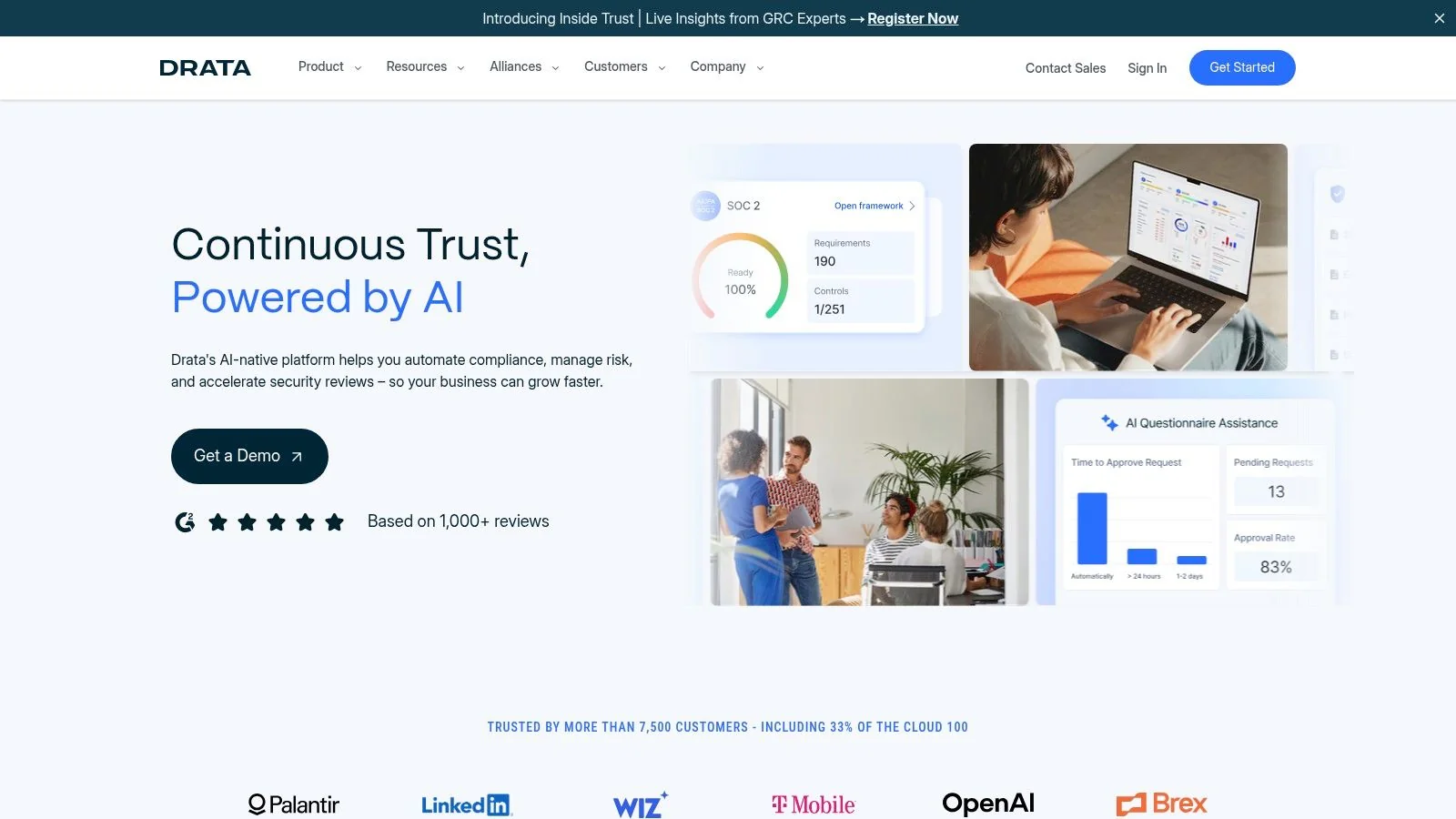
Recent platform releases have moved beyond evidence collection. A major 2026 update introduced a redesigned multi-workspace experience for large programs, a centralized Test Library with over 1,000 infrastructure tests across AWS, Azure, and GCP, and native support for internal audits. The platform added TISAX, NYDFS, and ISO/IEC 27018:2025 to its framework list, with DORA and NIS2 support already live for European regulatory exposure.
Key differentiators
- Continuous control monitoring with MTTR dashboard. Drata tests controls and collects evidence on an always-on basis. A mean-time-to-resolution (MTTR) dashboard tracks how quickly teams close failed tests — a useful metric for GRC leads beyond raw compliance percentage.
- AI across the workflow. The AI suite covers policy-to-control mapping, vendor SOC 2 report summarization, AI-generated cloud tests for AWS/Azure/GCP, and a Slack/Teams integration for employee compliance questions. The platform also ships an MCP integration for teams connecting AI assistants directly to their compliance workspace.
- No-code workflow automation. Custom workflows trigger across 26 event types — failed controls, personnel changes, and more — replacing manual follow-up tasks with system-driven actions.
Pricing: Quote-only. Vendr’s anonymized transaction data puts the range at $9,649–$60,000/year (estimate); startups under 50 employees typically land in the lower half of that band, mid-sized companies (50–200 employees) pursuing SOC 2 Type II land in the middle, and enterprise organizations with multiple frameworks push toward the top. Audit fees are separate.
Weakness: Can be more platform than a small startup needs for a straightforward first SOC 2. It is also not the platform for buyers who want price certainty at renewal: independent sources (G2 reviews, Reddit, and multiple pricing-comparison sites) repeatedly describe year-two renewal increases in the 10–40% range as a recurring complaint. We do not have sufficient current primary evidence to state Drata’s native-SCIM position as a firm limitation, so buyers who need automated lifecycle management should verify their identity-provider and tier requirements in writing.
G2 showed Drata at 4.7/5 across 1,331 reviews. See the Drata platform profile for its capability matrix and source links, and our Drata review for the fit analysis.
Secureframe
Secureframe is one of the more accessible Vanta alternatives for companies tackling their first major audit. It automates evidence collection across 300 cloud services and business tools (secureframe.com/integrations), and pairs that automation with guided onboarding from in-house compliance experts — a combination that reduces the learning curve for teams without a dedicated GRC function.
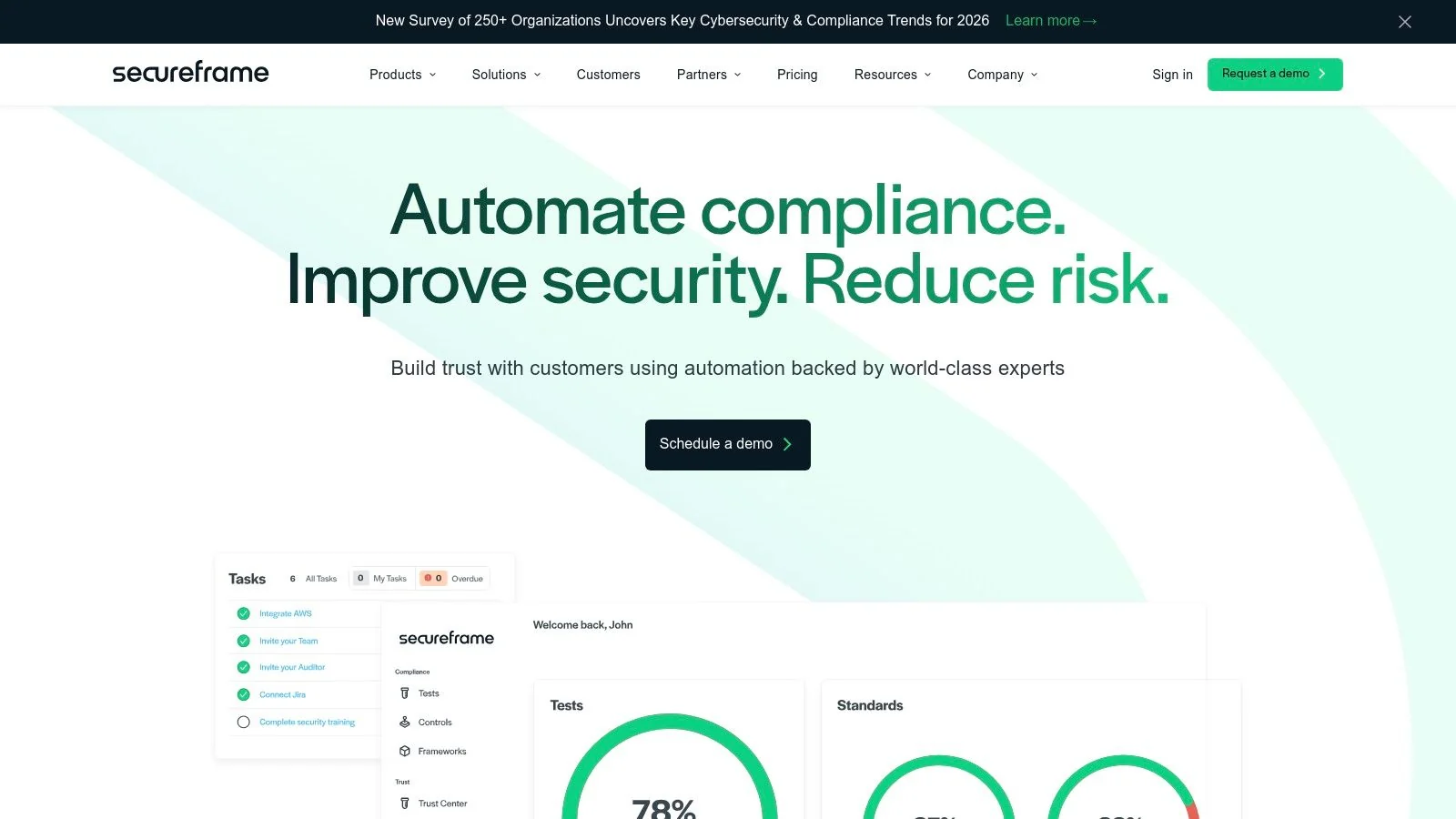
The platform supports 40+ frameworks including SOC 2, ISO 27001, HIPAA, and PCI DSS, with continuous monitoring and dedicated auditor assistance built into the workflow. If you are thinking through how platform costs relate to your total audit budget, the SOC 2 audit cost breakdown covers what to expect from the auditor side of the equation.
Key differentiators
- Guided onboarding with in-house experts. Secureframe’s compliance team is available throughout implementation to help map controls and prepare for audit — more hands-on than most self-serve platforms.
- Comprehensive policy library. A large set of pre-built, customizable policy templates reduces documentation time significantly.
- Integrated security training. Employee security awareness training is built directly into the platform with attestation tracking for audit evidence.
Pricing: Quote-only. Vendr’s transaction data puts the range at $7,500–$80,000/year (estimate); the median buyer lands around $20K/year, and enterprise deals with unlimited frameworks have been reported near $45K in year one. Discounts of 10–20% are common with multi-year commitments or competitive quotes.
Weakness: Framework depth is narrower than enterprise GRC platforms — teams running complex multi-framework programs may outgrow it. It’s also worth flagging for EU-data-residency buyers: Secureframe’s advertised “EU” data center runs on AWS eu-west-2 in London, UK, not in the EU itself.
G2 showed Secureframe at 4.7/5 across 809 reviews. See the Secureframe platform profile and our Secureframe review.
Sprinto
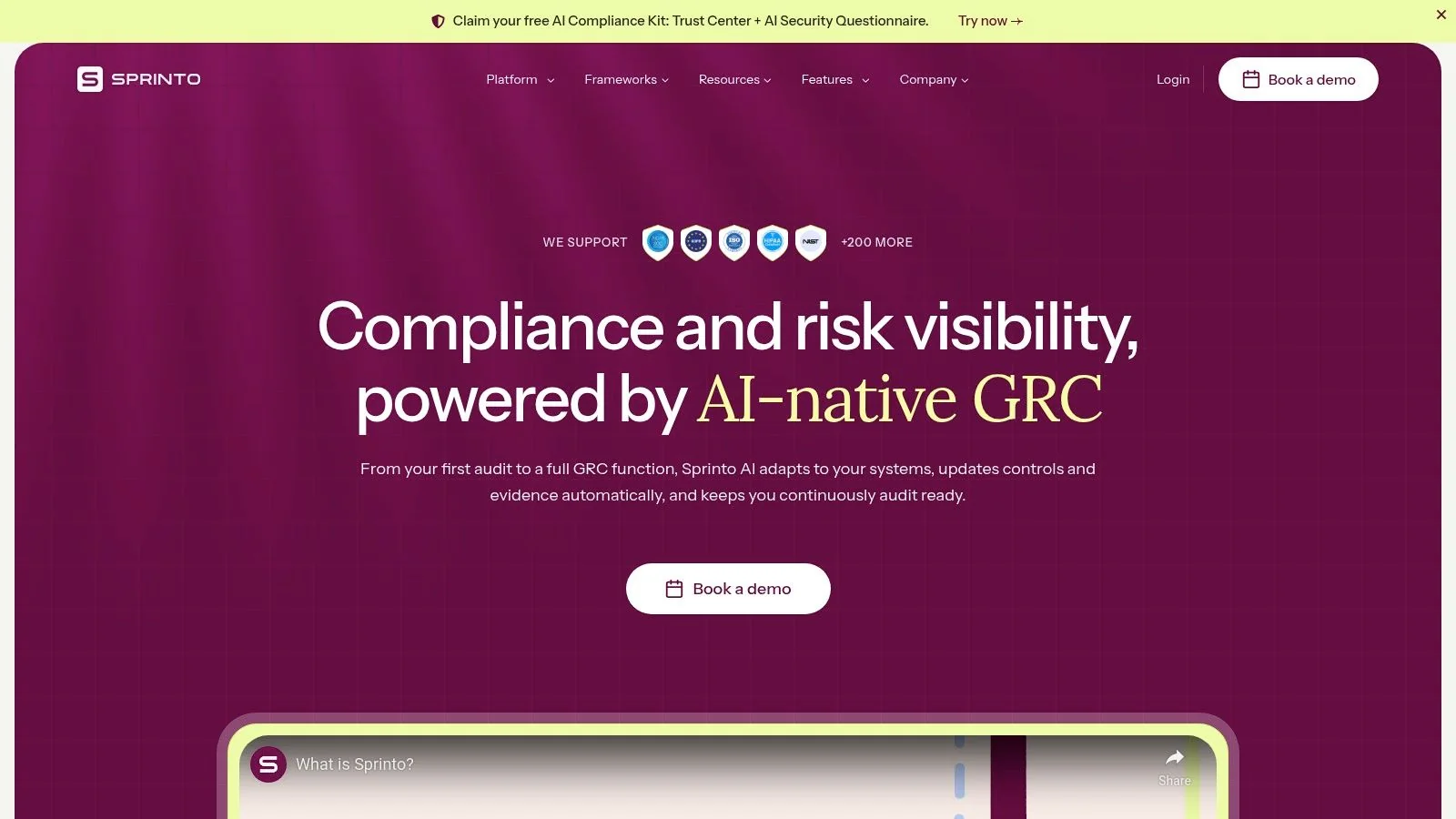
Sprinto is built for cloud-native startups and mid-market companies that need to get audit-ready fast — often without a dedicated security team. Its core value proposition is speed: pre-configured compliance programs, automated evidence collection via cloud integrations, and guided implementation designed to compress time-to-audit-ready into weeks rather than months.
Key differentiators
- Speed to audit-ready. Sprinto’s structured implementation process and pre-configured programs are designed specifically to reduce time-to-first-audit for startups and SMBs.
- Auditor-agnostic. The platform works with any CPA firm of your choosing, providing a single dashboard to manage evidence and collaborate directly with your auditor.
- Integrated risk assessment. Risk assessments run inside the platform and link identified risks to specific controls — useful for teams that want GRC cohesion from day one.
Pricing: Quote-only. Sprinto uses no seat-based pricing and no paid add-ons — one quote covers the full program. A third-party pricing review puts smaller startups with simple cloud setups at $6K–$8K/yr and most startups in the $8K–$10K/yr range, with more complex multi-region setups or multiple frameworks pushing toward the top of the reported $6,000–$25,000/year band (estimate). Sprinto generally comes in below Vanta and Drata at equivalent scope.
Weakness: Framework breadth and enterprise GRC features are thinner than mid-market GRC platforms like Hyperproof’s; not ideal for large organizations managing complex multi-framework programs. No confirmed SCIM/automated provisioning at any tier, and no native data-loss-prevention or DSPM tooling, so data-security-heavy buyers must bring their own DLP.
G2 showed Sprinto at 4.8/5 across 1,400 reviews. See the Sprinto platform profile and our Sprinto review.
ComplyJet
ComplyJet is a low-cost platform built specifically for a company doing its first SOC 2 with no dedicated compliance hire. It bundles evidence automation, an audit workspace, and a trust center behind a single flat annual fee rather than a scoped enterprise quote.
Key differentiators
- Flat published pricing. ComplyJet publishes a $5,000–$8,000/year band covering the platform plus hands-on audit coordination — the lowest published band in this comparison, Vanta and Drata included.
- Hands-on guidance, not pure self-serve. ComplyJet positions itself as owning evidence collection, policy setup, and audit coordination directly — closer to Carbide’s or Scytale’s advisory model than to a pure automation tool.
- 350 integrations claimed on its own pricing page — in the range of far larger, better-funded competitors.
Pricing: Published. $5,000–$8,000/year (confirmed, complyjet.com/pricing) — the cheapest published band of any platform on this page.
Weakness: ComplyJet is a very small, recently founded, unfunded team — about 8 employees as of Tracxn’s May 2026 count — and it hasn’t published enterprise-admin details (SSO/SCIM/RBAC). Companies above roughly 50 employees, multi-entity buyers, or teams that already run a mature GRC program and just want a monitoring layer should look elsewhere on this list.
G2 showed ComplyJet at 4.8/5 across 17 reviews. See the ComplyJet platform profile for its capability matrix and source links.
Oneleet
Oneleet bundles SOC 2 (or ISO 27001) compliance automation with an in-house penetration test and light vCISO guidance, aimed at security-conscious early-stage startups — notably the YC network — that want one vendor covering both the technical and paperwork sides of a first audit.
Key differentiators
- Compliance plus pentest under one vendor. The penetration test most SOC 2 Type II audits require is run by Oneleet’s own team rather than a separate vendor you’d otherwise have to coordinate.
- Highest G2 rating on this page: 4.9/5 across 138 reviews.
- Security-first posture. Reviewers describe Oneleet as more hands-on and security-led than pure automation platforms, with the compliance-automation product wrapped around a security-services core.
Pricing: Quote-only. Reported deals run $8,000–$60,000/year (estimate, softwarefinder.com).
Weakness: Oneleet’s own docs list roughly two dozen native integrations — far below Vanta’s 400+ or Drata’s 300+ — and reviewers describe its framework rollout as sequential (SOC 2 first, additional frameworks after) rather than parallel. A company that wants the broadest connector catalog or needs to run multiple frameworks in parallel from day one should look elsewhere.
See the Oneleet platform profile and our Oneleet review.
Comp AI
Comp AI uses an open-core model: its repository describes a 99% AGPLv3 core plus a commercially licensed /ee Enterprise Edition. A technical team can inspect and self-host the public core, but buyers should confirm which required features and support terms sit inside the commercial edition. The company behind Comp AI is legally Bubba AI, Inc.
Key differentiators
- Open-core and self-hostable. The public AGPLv3 core is unusual in a category dominated by closed SaaS products.
- 580+ integrations claimed on Comp AI’s site. The count is vendor-reported rather than independently corroborated.
- Scope-flexible quote. Comp AI says frameworks, headcount, timeline, audit needs, penetration testing, and trust-center work can change what the commercial offer includes.
Pricing: Quote-only. Comp AI publishes no current numeric rate card. Public terms set a 12-month minimum commitment and annual renewal unless either party gives at least 30 days’ notice; the Order Form controls the actual fees, scope, and term. See the Comp AI pricing guide for the source table and quote checklist.
For buyers comparing code-access models rather than Vanta-like SaaS alone, the open-source GRC tools evaluated for SOC 2 page compares Comp AI with CISO Assistant and SimpleRisk.
Weakness: There is no published self-serve rate card for the paid tiers, so budgeting before a sales call isn’t possible, and we could not confirm SSO/SCIM support anywhere in vendor documentation — a gap for any buyer that needs confirmed enterprise-admin controls out of the box.
G2 showed Comp AI at 4.7/5 across 68 reviews. See the Comp AI platform profile and our Comp AI review.
Delve
Delve is a SOC 2 compliance automation platform that markets AI agents for evidence collection. Insight Partners led a reported $32M Series A at a $300M valuation, announced 22 July 2025. Delve markets SOC 2, HIPAA, GDPR, ISO 27001, PCI DSS, and ISO 42001 workflows; the directory records those framework claims as vendor-claimed rather than independently confirmed.
Delve uses quote-based pricing. AWS Marketplace lists the Foundation Package from $12,000 for 1–20 employees on a 12-month contract; the canonical record also carries a broader $10,000–$30,000 annual third-party estimate, retrieved 24 July 2026. The same record marks SSO, SCIM, and RBAC as not established, so a buyer that needs enterprise administration should confirm those controls directly.
On 22 March 2026, TechCrunch reported anonymous allegations of fabricated audit evidence and weak auditor independence. Delve denied them. Its 24 March and 3 April posts announced complimentary re-audits and penetration tests, direct auditor communications, a rebuilt auditor network, and a halt to automation that interacts with audit workflows (TechCrunch report; 24 March; 3 April). TechCrunch reported that Delve and Y Combinator parted ways on 4 April 2026. The allegations remain unresolved. We have not independently verified the whistleblower’s claims or Delve’s account.
Key differentiators
- Automated evidence collection. Delve says its agents collect and organize evidence; our directory records this as a vendor-claimed capability.
- Auditor handoff. Delve says independent licensed auditors issue the reports; the quote should name the firm and separate its fee from the platform scope.
- Scoped marketplace price. AWS Marketplace lists a $12,000 starting price for 1–20 employees; Delve’s website does not publish a universal rate card.
- G2 snapshot. A third-party source reports a 4.7/5 rating across 135 G2 reviews, retrieved 24 July 2026; G2’s page was not directly crawlable for verification.
Pricing: AWS Marketplace starts at $12,000 for the scoped Foundation Package. The directory record also carries a third-party $10,000–$30,000/year estimate, retrieved 24 July 2026. Ask whether a quote includes the independent audit, penetration testing, additional frameworks, and renewal terms.
Weakness: The unresolved dispute creates reputational and procurement risk. Independently vet the audit firm and evidence workflow before selecting Delve.
See the Delve platform profile for the full source list behind this summary.
Strike Graph
Strike Graph is the most transparent on pricing of any platform in this category. Rather than requiring a sales conversation to see any numbers, it publishes its tiers directly on its site — a genuine differentiator in a market where almost everyone hides pricing behind a demo request.
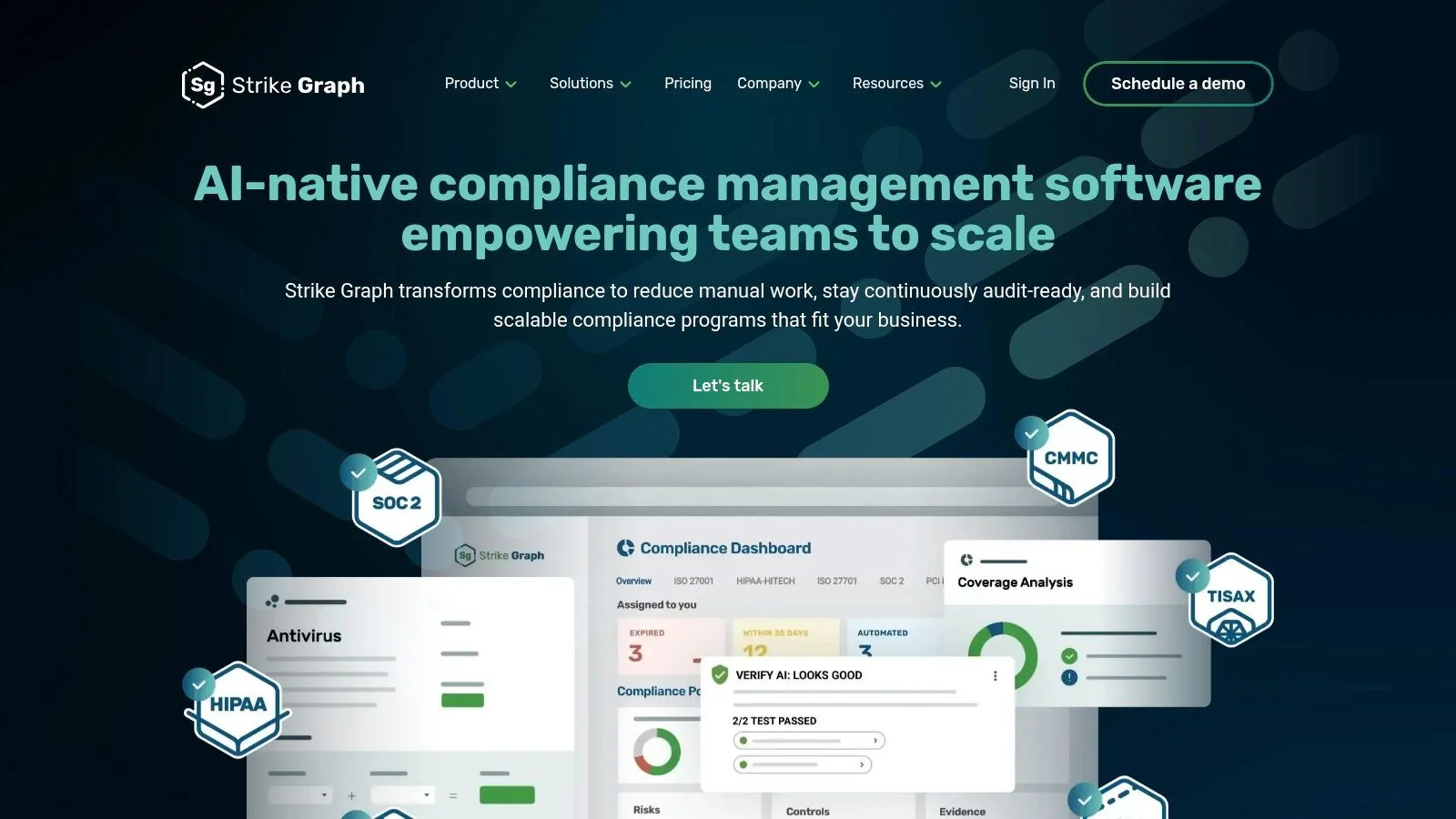
The platform supports SOC 2, ISO 27001, HIPAA, GDPR, PCI DSS, CMMC, DORA, NIST, HITRUST, and TISAX, with intelligent control cross-mapping across frameworks to avoid redundant evidence collection. An a la carte add-on model lets companies bolt on penetration testing and vulnerability scanning without switching tools.
Key differentiators
- Published pricing with a limited start-free option. The vendor’s lead-form-gated option lets teams explore the platform before committing to a paid plan; it is not a standing free tier of the paid product.
- AI Security Assistant. Built-in AI helps teams draft security policies, respond to security questionnaires, and validate evidence — accelerating manual tasks without requiring a separate tool.
- Modular add-on services. Pen tests, vulnerability scans, and other services can be bundled directly through the platform or handled separately, giving teams flexibility over their vendor stack.
Pricing: The paid tiers are published at $10,000–$35,000/year (strikegraph.com/pricing): Certify starts at $10,000/year for one framework, Scale runs $21,500/year, and Enterprise runs $35,000/year. Additional frameworks cost $2,000–$8,000 each. Strike Graph is one of the few vendors here where you can meaningfully budget before ever talking to sales.
Weakness: Framework add-on costs accumulate quickly for multi-framework programs, and several AI/questionnaire features are reserved for the Scale tier and above.
G2 showed Strike Graph at 4.7/5 across 193 reviews. See the Strike Graph platform profile.
TrustCloud
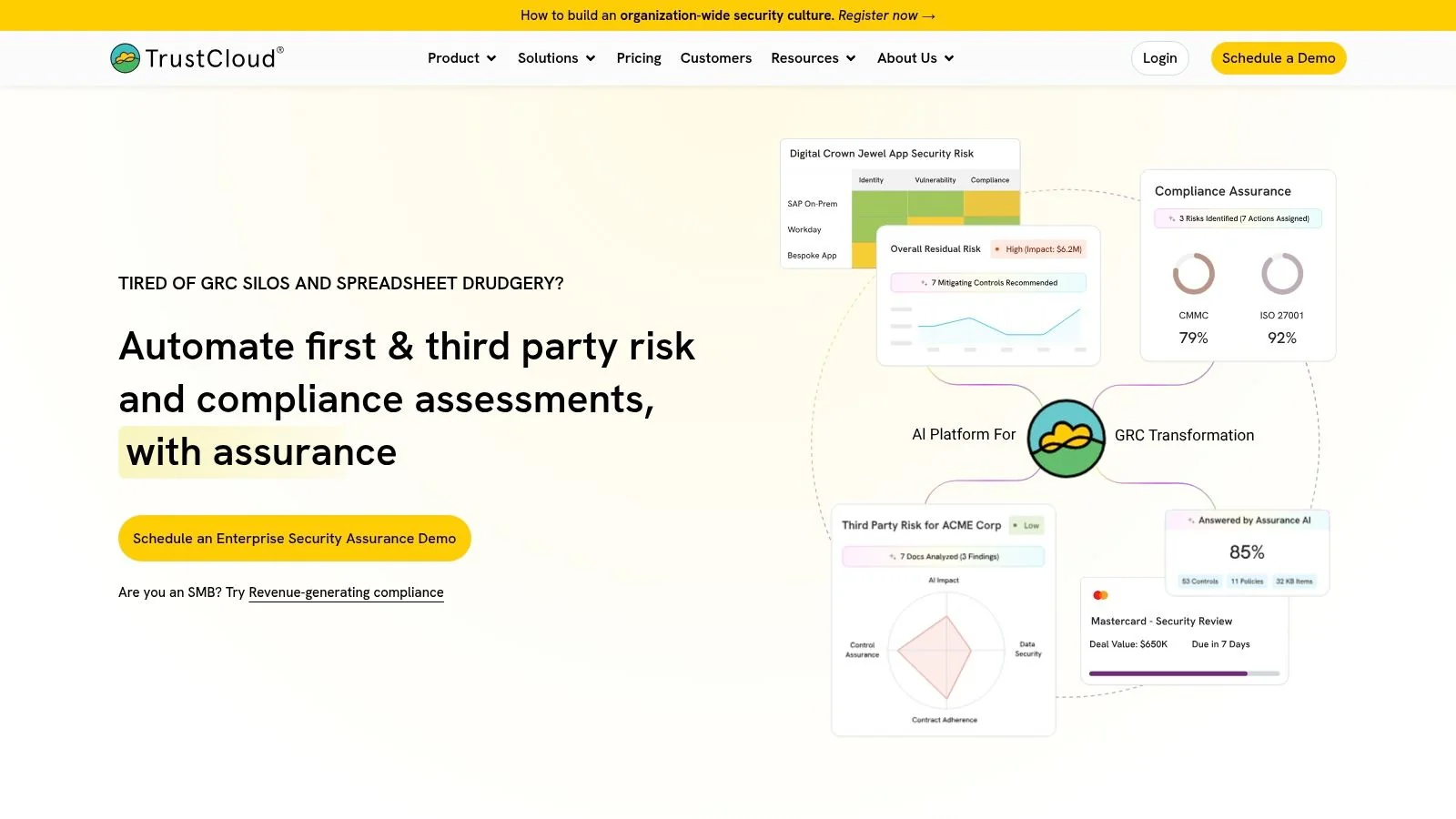
TrustCloud — known as Kintent until a 27 February 2023 rename (same company, same founder and CEO Sravish Sridhar) — leans into the sales side of compliance. Its platform is built partly around proving your security posture to prospects and customers, not just satisfying auditors. The customer-facing TrustShare portal lets companies publish a public security page that proactively shares compliance documentation, reducing back-and-forth with enterprise buyers running vendor assessments.
Key differentiators
- TrustOps evidence engine. Continuous control monitoring and an auditor workspace (AuditLens) sit underneath the customer-facing brand, so the core compliance-automation function is still a full SOC 2 point tool, not just a trust portal.
- TrustShare portal. A public-facing security portal lets businesses proactively share compliance documentation and AI governance disclosures with customers and partners — useful for shortening enterprise sales cycles.
- AI questionnaire assistant. Built-in AI helps teams respond to lengthy security questionnaires from enterprise buyers, cutting significant manual effort from a task most compliance teams spend disproportionate time on.
Pricing: Quote-only, with no published tiers or price ranges anywhere on the site (trustcloud.ai/pricing: “Tell us about yours and we’ll put together a proposal that fits,”) — unlike several competitors here that publish starting prices.
Weakness: A buyer who wants to compare real numbers before ever talking to sales should look elsewhere; TrustCloud gives you none until a sales call.
G2 showed TrustCloud at 4.6/5 across 49 reviews. See the TrustCloud platform profile and our TrustCloud review.
Scrut Automation
Scrut positions itself as a risk-first compliance platform — meaning it tries to connect compliance activities to underlying security risks rather than treating them as separate programs. This makes it a better fit for organizations that see SOC 2 as part of a broader security posture effort rather than a pure checkbox exercise.
The platform supports SOC 2, ISO 27001, GDPR, HIPAA, and other frameworks with cross-mapping to reduce duplicate evidence across certifications.
Key differentiators
- Risk-first architecture. Risk management is wired into compliance workflows rather than bolted on separately. Identified risks link directly to specific controls, giving GRC teams a more coherent picture.
- Multi-framework cross-mapping. Controls and evidence reuse across frameworks — a meaningful time saver for mid-market teams pursuing more than one certification simultaneously.
- Highest G2 rating on this page: 4.9/5 across 1,313 reviews — also the largest review base among the platforms compared here.
Pricing: Quote-only. AWS Marketplace confirms Scrut from $15,000/year for companies up to 20 employees (confirmed); third-party analysts report real first-year cost, with audit and pentest fees included, reaching $40,000–$70,000.
Weakness: Scrut’s own FAQ lists roughly 80 integrations — well under Drata’s 300+ — so teams with very large or unusual cloud infrastructure footprints may find fewer pre-built connectors.
See the Scrut Automation platform profile and our Scrut review.
Thoropass
Thoropass takes a different approach from most Vanta alternatives: it combines compliance automation software with in-house audit services under one roof. The company operates as an AICPA peer-reviewed CPA firm, a PCI QSAC, and a HITRUST Accredited Assessor, which means it can issue your SOC 2 report directly rather than handing off to a separate audit firm. Thoropass rebranded from Laika on 29 March 2023; the underlying CPA entity is still legally named Laika Compliance, LLC, doing business as Thoropass Assurance.
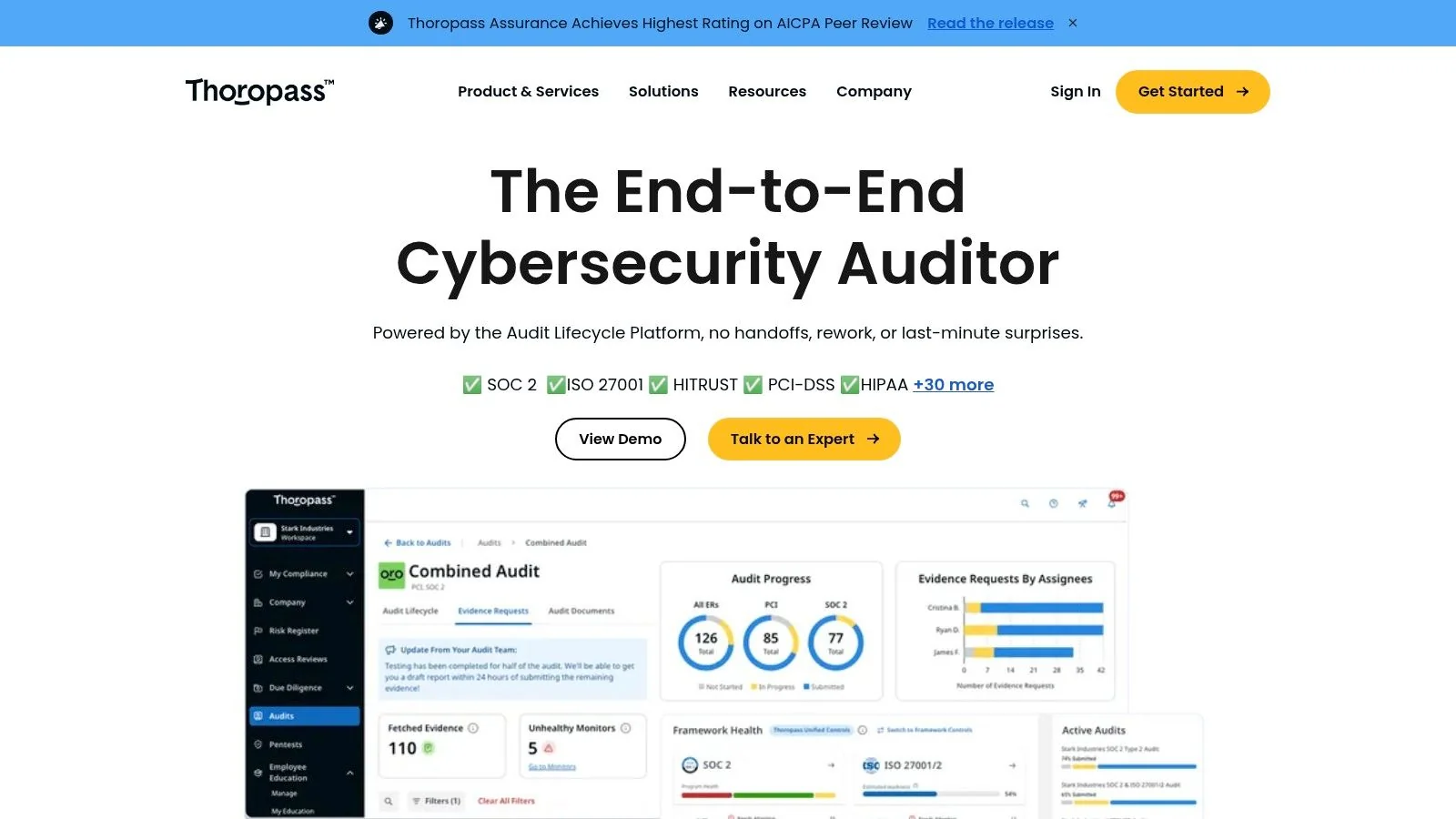
Thoropass supports 30+ frameworks with controls mapped across them to eliminate redundant evidence gathering. Their 2026 State of Audit and Compliance Report (500+ compliance professionals surveyed) found 69% say AI adoption is outpacing their security and compliance controls, and 57% believe AI-related incidents are the most likely to trigger regulatory action in 2026.
Key differentiators
- Connected audit model. Thoropass is both the software vendor and the auditor. In-platform auditors run readiness checks alongside the compliance team, eliminating coordination friction between a SaaS tool and a separate CPA firm.
- First Pass AI. An AI-driven evidence verification layer reviews submissions before they reach a human auditor, catching formatting issues and coverage gaps before they become findings. Thoropass reports that it cut audit timelines from 73 days to 29, a 60% reduction.
- Multi-framework cross-mapping. Evidence and control activities can be reused across frameworks. Multi-workspace support covers different business units or regions in a single program.
Pricing: Thoropass does not publish list rates. AWS Marketplace lists two subscriptions, $8,700/year for the platform and $5,800/year for the SOC 2 audit, about $14,500/year combined at the floor. Real quotes usually land above that once size and scope are added. The company claims customers save 25–50% compared to buying a separate platform and engaging a traditional audit firm.
Weakness: On the bundled contract you are committing to Thoropass for the audit as well as the software, so both renewals arrive together. Teams that want to keep shopping the audit year to year should price the audit-first path instead, where Thoropass Assurance is your CPA firm and the platform you already run stays where it is.
G2 showed Thoropass at 4.7/5 across 600 reviews. See the Thoropass platform profile, and for a deeper breakdown of the connected-audit model, our full Thoropass review.
Hyperproof
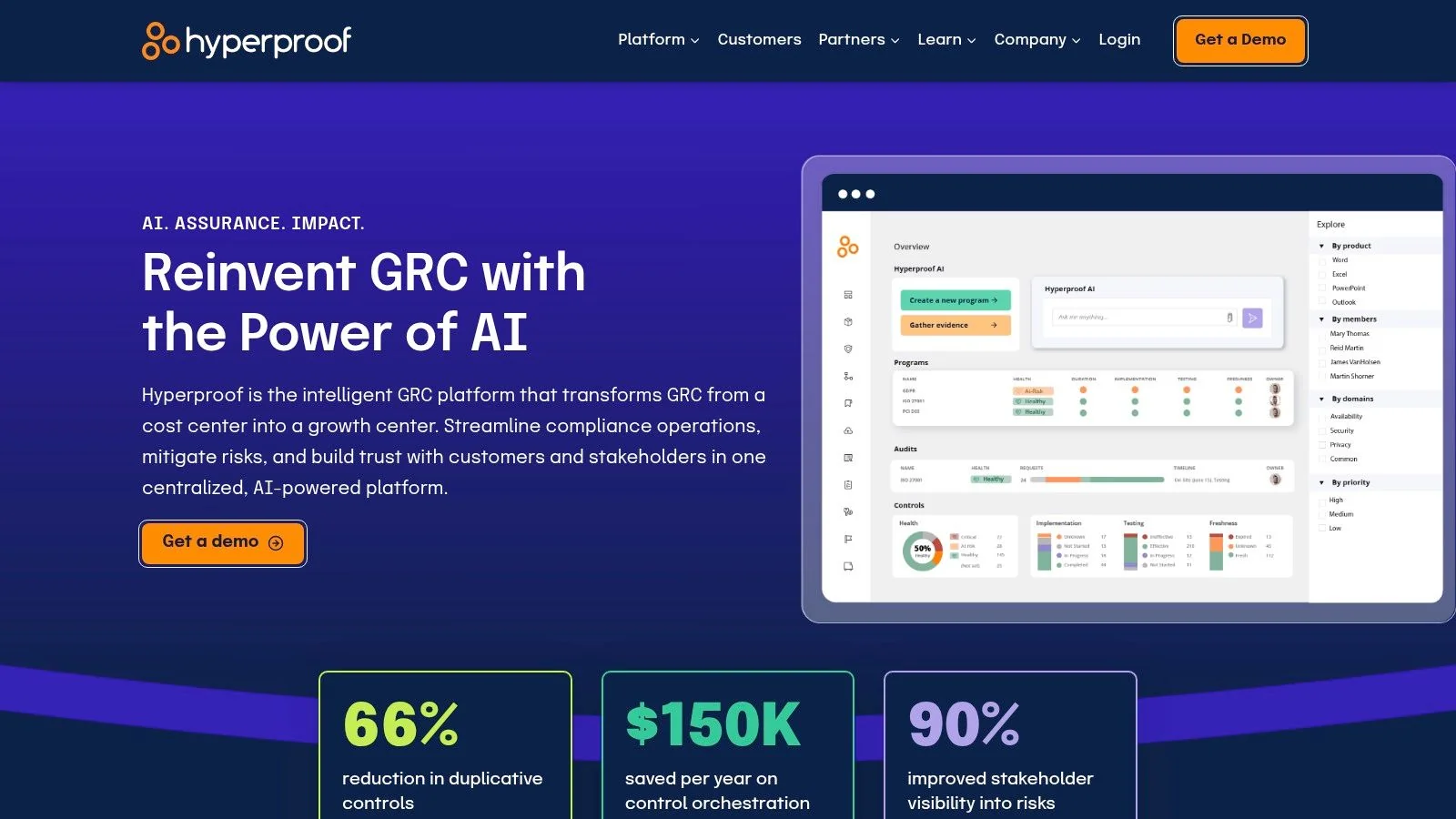
Hyperproof is the most enterprise-oriented platform on this list that still reasonably serves mid-market buyers. Where most Vanta alternatives focus on automating SOC 2 evidence collection, Hyperproof is primarily a multi-framework GRC platform — one designed to manage several frameworks, risk programs, and vendor assessments across a maturing compliance function, with dedicated SOC 2 support built in.
Key differentiators
- 100+ framework library. Built for organizations that need to manage SOC 2 alongside SOX, NIST, FedRAMP, or regional standards — not just teams tackling a first audit.
- Dedicated risk and vendor management modules. Risk management and third-party risk are first-class features, not add-ons. This matters for teams building toward a mature GRC program rather than a one-time certification.
- Scalable workflows. Clear task delegation, evidence review processes, and detailed reporting for auditors and executives — more appropriate for organizations with dedicated compliance staff.
Pricing: Quote-only. Vendr’s transaction data puts the range at $22,160–$70,000/year (estimate) — well above the entry-tier pricing that single-framework SOC 2 tools charge, and Hyperproof’s own FAQ explicitly contrasts itself with vendors “solely focused on SOC 2 requirements.”
Weakness: Setup complexity and implementation time are higher than lighter tools. Not well-suited for a first-time SOC 2 team without dedicated compliance resources; Hyperproof’s named customers (Appian managing 28 frameworks, a 22,000-employee company, Thales) skew toward organizations already running a formal GRC program.
G2 showed Hyperproof at 4.5/5 across 217 reviews, and Capterra listed 60 integrations — fewer than most platforms on this page. See the Hyperproof platform profile for the supporting sources, and our Hyperproof review for the full review.
Other Vanta alternatives worth considering
The main shortlist covers common reasons for replacing Vanta. Consider these additional options for specific support or GRC requirements:
- Scytale combines software with a dedicated consultant in Build DFY or Build Stronger; Build Starter is platform-only. Its AWS Marketplace listing starts at $7,500 for 12 months of software plus one framework. That starting price does not establish the cost of either consulting bundle; request a scoped quote.
- Carbide — renamed from Securicy on 1 February 2022 — publishes its pricing outright: $7,500–$22,000/year (confirmed, carbidesecure.com), and pairs the platform with a human advisory team, similar in spirit to ComplyJet’s model.
- Anecdotes and Trustero both genuinely support SOC 2, but both are built for a company already running a formal, multi-framework GRC program rather than a first-time single-audit startup. Anecdotes is estimated at $46,875–$78,125/year; Trustero is reported from $5,000/year plus a separate SOC 2 Type 2 add-on.
These options are narrower-fit, not lower quality.
How do you switch from Vanta without disrupting an audit?
Switch at a clean audit boundary when possible, and involve the CPA firm before moving evidence during an active examination.
- Preserve the evidence record. Export policies, evidence, control mappings, access reviews, vendor records, and auditor requests. Confirm which history transfers and which records require manual retention.
- Map and prove the replacement. Reconcile control mappings, then test the identity provider, cloud environment, code repository, HR system, and ticketing integrations that supply core evidence.
- Overlap before cancelling. Keep Vanta available until owners can operate the new workflow and the auditor can access equivalent evidence. Budget for overlapping subscriptions and implementation work.
- Document continuity. Record the final export location, retention owner, contract end date, and renewal notice before closing the old account.
What should you verify before signing with a Vanta competitor?
Verify the replacement against the same audit scope, evidence sources, service package, and renewal horizon. A lower first-year quote is not a saving if it leaves critical evidence manual or adds separate service fees.
- Scope and evidence. Confirm framework support, integration depth, implementation ownership, and which controls remain manual.
- Auditor fit. Ask the CPA firm whether it can work with the platform’s evidence exports and whether the vendor’s own audit relationship changes your independence or switching options.
- Complete commercial terms. Put platform, frameworks, implementation, support, trust center, questionnaire automation, audit, penetration test, renewal, and headcount-growth effects on separate lines.
- Independent signals. Use user-review themes and a reference customer with similar infrastructure as directional evidence, not as a substitute for testing the actual workflow.
Comparing SOC 2 software more broadly? See our top SOC 2 software picks by buyer fit for pricing signals, best-for guidance, and weaknesses. Browse SOC 2 compliance software to compare more platforms, or start with the Vanta platform profile.
Once you’ve shortlisted platforms, the next step is choosing a compatible audit firm. SOC2Auditors connects you with vetted CPA firms that have direct experience with your chosen compliance platform — find your auditor match.
Vanta buyer guides
Start with the product record, then compare Vanta's review, pricing, SOC 2 coverage, and alternatives before you shortlist.