 Menu
Menu
On this page
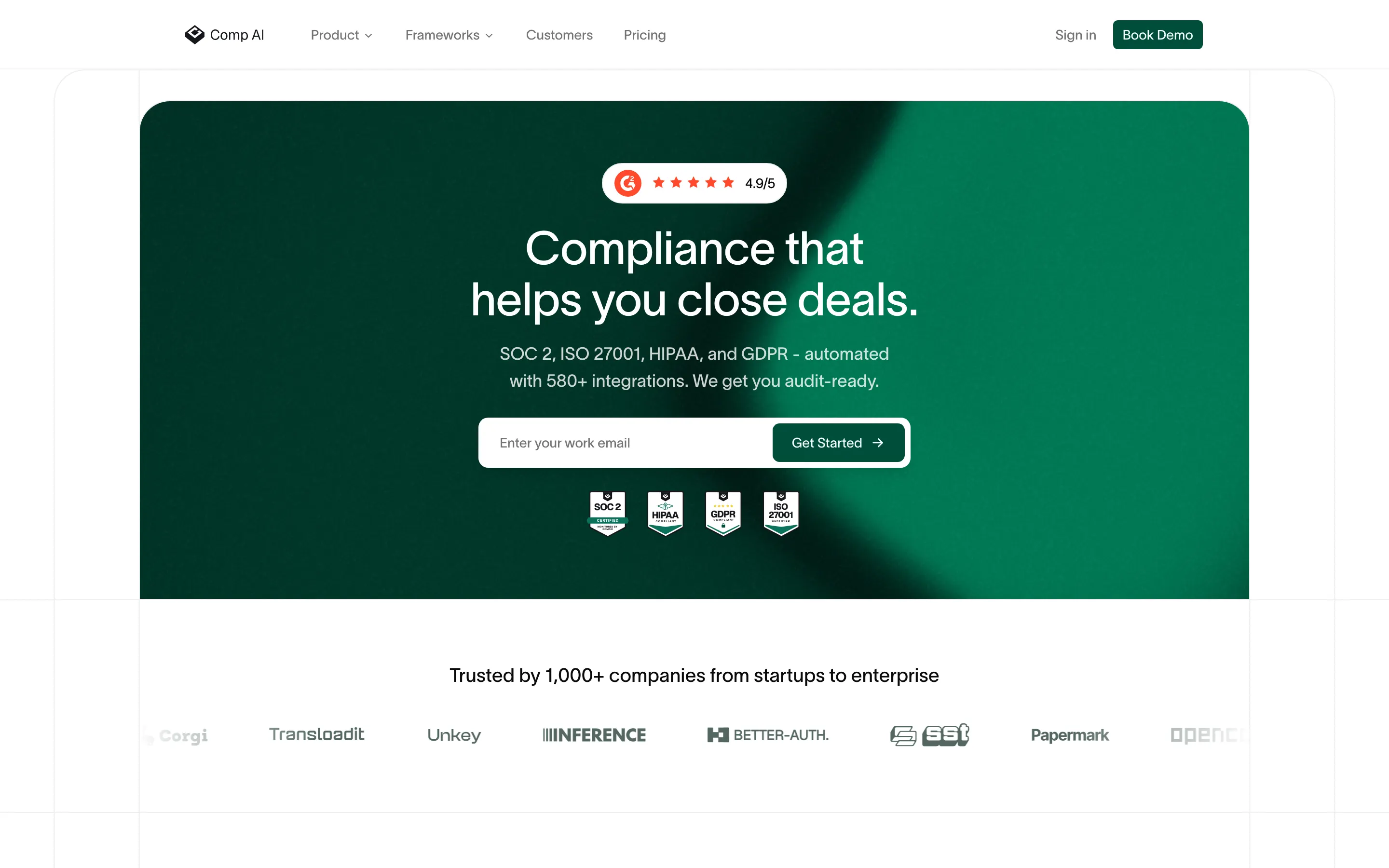
Comp AI (TryComp.ai) is an open-core compliance automation platform for SOC 2 and related frameworks. It publishes an AGPLv3 core and a documented self-hosting path; its
/eeEnterprise Edition is commercially licensed. It is a strong shortlist candidate for engineering-led teams that value inspectable code, provided its required integrations, auditor workflow, identity controls, and edition boundary pass a scoped demo.
For the current quote inputs, public contract terms, and managed-versus-self-hosted cost model, use the Comp AI pricing guide.
How we evaluated Comp AI
We applied the same six questions used in the software directory:
- Can the evidence-collection model be inspected and explained?
- Which automation and collaboration capabilities are documented?
- Will the product fit the buyer’s actual systems and frameworks?
- Can administrators control access and user lifecycle safely?
- Can an independent auditor consume the evidence without avoidable rework?
- What do review data and the age of the product leave uncertain?
| Decision fact | Current evidence | Evidence class |
|---|---|---|
| Product model | Public AGPLv3 core plus a commercially licensed Enterprise Edition | Vendor repository |
| Pricing | Quote-only; no current public rate card | Vendor pricing page |
| Standard term | Minimum 12 months; one-year auto-renewal unless either party gives 30 days’ notice | Vendor terms; Order Form controls the actual deal |
| Integrations | 580+ claimed as of 2026-08-11 | Vendor-reported |
| Frameworks recorded | 11 specifically named frameworks; the pricing page also uses the unspecific label “NIST” | Vendor-claimed |
| Review signal | 4.7/5 across 68 G2 reviews as of 2026-08-11 | Review-platform sentiment |
| Native SCIM | Unknown | No reliable current primary-source confirmation found |
| Auditor workflow | Documented, but not independently tested | Auditor role, export, and finding workflows are documented; we did not test the interface |
What Comp AI does differently
Comp AI’s meaningful difference is inspectability. A security engineer can inspect the public evidence-collection code. That does not establish feature or code parity with Comp AI’s managed service or commercially licensed Enterprise Edition. The company also documents self-hosting, allowing a team to keep the application and evidence store inside infrastructure it controls.
The license model is worth clarifying during evaluation. Comp AI’s website describes the platform as fully open source, while the repository README describes a 99% AGPLv3 core and a commercially licensed /ee Enterprise Edition. Together, those materials establish a substantial public core while leaving buyers to confirm which required features, deployment modes, and support terms sit within the Enterprise Edition.
The open-source SOC 2 software comparison applies the same licence, workflow, and operating-owner questions to Comp AI, CISO Assistant, and SimpleRisk.
Self-hosting gives a technical team more control over deployment and data location, while also making that team responsible for upgrades, availability, backups, and incident response. A company modifying the AGPLv3 software and making it available over a network should obtain legal advice on its obligations. Buyers that prefer less operational ownership can evaluate the managed service instead.
| Operating input | Managed cloud | Self-hosted Docker path |
|---|---|---|
| Application and evidence store | Comp AI | Buyer |
| Database | Comp AI | Buyer |
| Transactional email | Comp AI | Buyer |
| Background jobs | Comp AI | Buyer |
| TLS / reverse proxy | Comp AI | Buyer |
| Backups, monitoring, upgrades, incident response | Comp AI | Buyer |
From Comp AI’s documented Docker self-hosting path, via our Comp AI record. The current Compose path also requires an external PostgreSQL 14+ database with SSL. Confirm the exact stack in current docs before you budget for it.
Evidence automation and auditor handoff
Current product materials document automated evidence, policy workflows, a device agent, a public trust center, questionnaire assistance, and cloud tests. Comp AI says cloud-infrastructure tests run daily; its device agent checks a narrower set of endpoint controls hourly. For a category-level comparison of recurring testing and manual evidence work, see compliance automation software.
Comp AI’s API documentation describes a built-in auditor role, an auditor-only organization evidence export, audit findings, revision notes, and remediation statuses. We did not independently test the browser interface or confirm the exact organization-level scope an invited auditor sees, so buyers should verify those details with their intended audit firm.
Comp AI documents role-based permissions and custom roles, but we could not confirm native SSO or SCIM. Buyers that need automated user provisioning or deprovisioning should ask Comp AI to demonstrate the identity lifecycle before purchase.
The useful demo is not “show us 580 integrations.” Give Comp AI the buyer’s system inventory, ask it to collect one representative control from each critical system, invite the intended auditor, and have that firm inspect a representative export and revision workflow.
Framework and timeline claims
Comp AI’s pricing page currently names SOC 2, ISO 27001, HIPAA, GDPR, PCI DSS, SOC 1, FedRAMP, ISO 42001, ISO 9001, CCPA, and NEN 7510. It also lists “NIST” without specifying CSF, 800-53, or 800-171, so we do not map that label to a specific NIST framework. Every item is vendor-claimed, not an independently validated control-level implementation.
The company also says controls map across frameworks. That may reduce duplicate work, but it does not establish a separate native control set for each standard. Before purchase, request the exact control map, identify reused controls, and confirm who maintains regulatory changes. AI startups comparing ISO 42001 platform fit can use the ISO 42001 software guide for AI startups.
Treat the speed claim captured August 11, 2026 carefully. Comp AI describes a best case of reaching Type I audit readiness in as little as 24 hours and roughly 14 days of preparation before a Type II observation window. It separately acknowledges that the CPA audit and report still take time, and its Type II guide uses a minimum three-month observation period. Readiness is not report issuance, and these are vendor claims rather than typical implementation times.
What reviewers say
G2 showed a 4.7/5 rating from 68 reviews on August 11, 2026. That is a positive early sentiment signal, not the same evidence depth as a platform with thousands of reviews. A published reviewer in our directory reported intermittent automation failures and wanted stronger GDPR support.
We do not convert the G2 score into our own rating. Review-platform scores mix company sizes, scopes, implementation partners, and contract periods. They identify questions to test; they do not establish product reliability for a specific environment.
What does Comp AI cost?
Comp AI publishes no current numeric rate card. Its quote depends on frameworks, headcount, timeline, and whether audit, penetration testing, or trust-center work is included. Public terms set a 12-month minimum and annual renewal; the Comp AI pricing guide has the full source table, self-hosted cost model, and Order Form checklist.
Who should shortlist Comp AI?
Shortlist Comp AI when:
- an engineering owner can evaluate the public code or operate a self-hosted deployment;
- code inspectability or data residency is a real procurement requirement;
- the required integrations and framework mappings work in a representative test; and
- the intended auditor approves the access model and evidence export.
Compare more established platforms when:
- native SCIM or a fully demonstrated auditor workspace is a hard gate;
- the compliance owner cannot support self-hosting and the managed offer is not compelling;
- product history and a much larger review base carry more weight than code access; or
- the required framework mapping cannot be demonstrated.
For a three-product decision, compare the Vanta review and Drata review separately. That keeps this page focused on whether Comp AI itself passes evaluation.
Comp AI FAQ
What does Comp AI do?
Comp AI is an open-core compliance automation platform. Its published materials describe automated evidence, policy workflows, a device agent, a trust center, questionnaire assistance, and daily cloud-infrastructure tests. A separate CPA firm still performs and signs a SOC 2 examination.
Is Comp AI open source?
Comp AI publishes an AGPLv3 codebase and self-hosting documentation. Its repository says the core is 99% AGPLv3 and the Enterprise Edition is commercially licensed, while the website calls the platform fully open source. Confirm which planned features and support terms sit within the Enterprise Edition.
How much does Comp AI cost?
Comp AI does not publish a current numeric rate card. Its standard terms set a 12-month minimum and one-year automatic renewals unless notice is given at least 30 days before term end. The Order Form governs the buyer’s actual price, scope, and term; see the Comp AI pricing guide for the itemized checklist.
Will an auditor accept Comp AI evidence?
The auditor decides whether evidence is sufficient. Comp AI documents an auditor role, auditor-only evidence export, and finding workflows, but we did not independently test the interface or establish every permission a CPA firm may require. Ask the intended firm to inspect a representative export before purchase.
Is Comp AI a good fit for an enterprise?
It can be a good fit for an engineering-led enterprise that values inspectable code and self-hosting. Native SCIM remains unknown, while the exact auditor-access scope and Enterprise Edition feature set are useful points to confirm in a demo and written quote. Use the enterprise SOC 2 software matrix to compare Comp AI’s unconfirmed SCIM support with the identity and administration evidence for other platforms.
Verdict
Comp AI is a credible, differentiated shortlist candidate for buyers that can turn code access into operational value. Its public core, self-hosting option, broad claimed integration catalogue, daily connected checks, and documented auditor workflow give engineering-led teams several concrete reasons to evaluate it.
A strong evaluation should demonstrate the buyer’s required integrations and framework maps, let the intended auditor review the evidence workflow, and put identity controls, Enterprise Edition scope, and total cost in writing. If those points check out, Comp AI can be an attractive alternative to more established compliance platforms.
See the full software directory for other platforms and their evidence labels.