 Menu
Menu
On this page
- Is Secureframe the Right Tool for Your SOC 2?
- How Secureframe Automates Compliance (What’s Actually New in 2026)
- Onboarding and Ongoing Effort
- Secureframe Pricing and Total Cost of Ownership (2026)
- Secureframe vs Vanta vs Drata vs Sprinto (2026 Comparison Table)
- Real User Sentiment (G2 / Reddit / Trustpilot 2026)
- How Secureframe Works With Your Auditor
- Decision Framework: Should You Pick Secureframe?
- Secureframe FAQ
- Final Verdict
Secureframe is the strongest fit for cloud companies with complex or custom environments, and for teams that want dedicated compliance support through their first or second audit. It is not the cheapest entry point for simple cloud-native stacks — Vanta often wins there on integration breadth, and Comp AI is the inspectable or self-hosted comparison. For multi-framework programs and high-touch onboarding, Secureframe frequently outperforms both.
Secureframe launched in 2020 and has grown to 6,000+ customers and 300+ integrations — one of the larger compliance automation platforms by customer count, alongside Vanta and Drata. Comply AI (2023) and AI Evidence Validation (May 2025) add automated risk assessment, policy drafting, and cross-framework evidence validation on top of an already strong evidence-collection engine. Your first SOC 2 will cost $30K–$85K all-in. Whether Secureframe’s $10K–$35K base tier earns its place in that budget depends on how complex your environment is and how much hand-holding your team needs.
Is Secureframe the Right Tool for Your SOC 2?
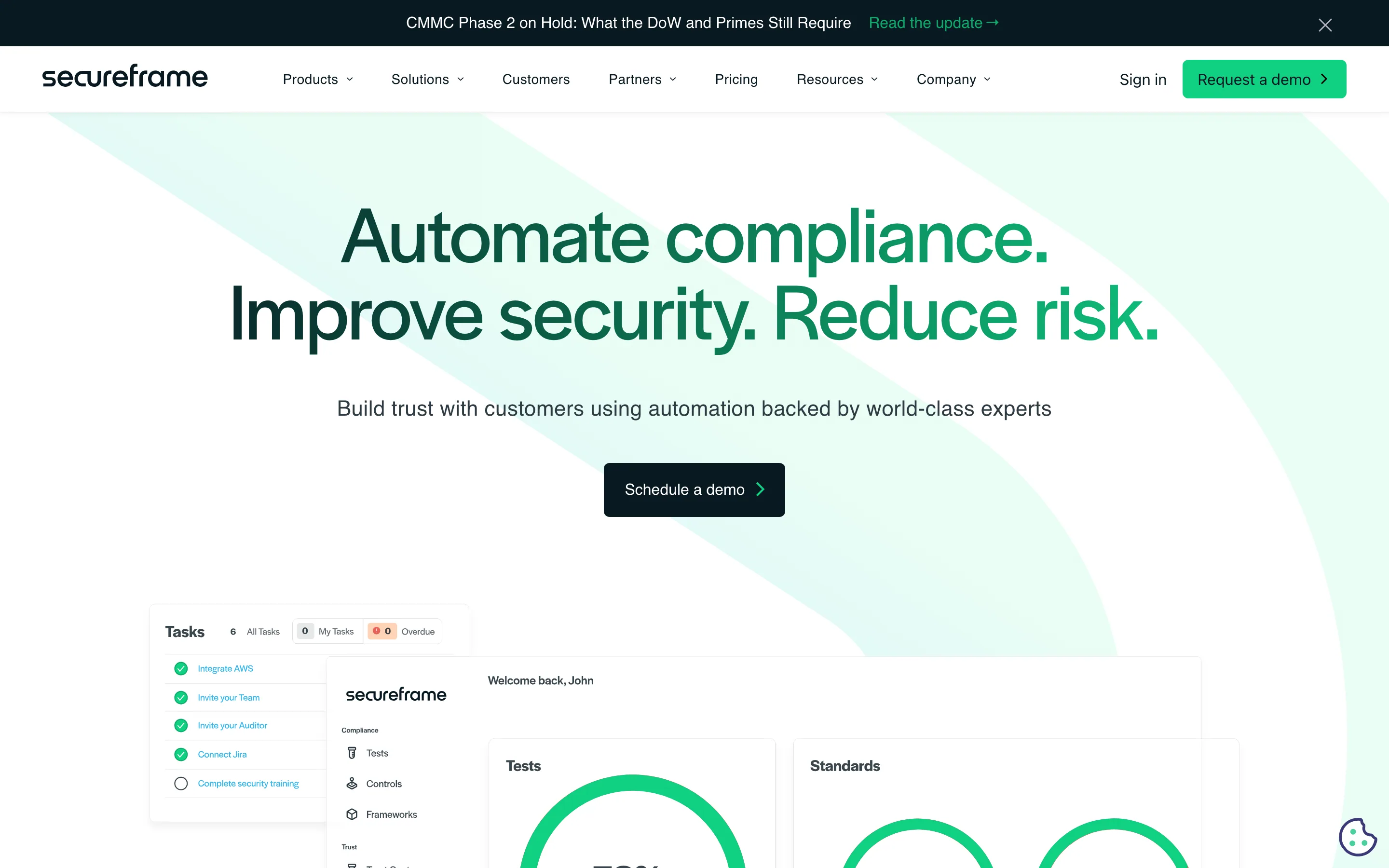
Secureframe is a compliance automation platform founded in 2020 in San Francisco. Its core function: integrate with your cloud infrastructure, identity providers, HR systems, and code repositories via API, run automated tests against the AICPA Trust Services Criteria and 35+ other frameworks, collect timestamped evidence, and give your team a real-time dashboard so that when an auditor arrives, the bulk of the evidence is already organized. The product is organized into three tiers — Fundamentals, Complete, and Defense (a March 2026 addition built for CMMC 2.0 and defense contractors). Unlike Vanta, which leads on raw integration count, Secureframe’s differentiation is in the depth of its integrations for complex cloud environments and the quality of human support available across all tiers.
What Secureframe does not do: fix anything. Every failing control still requires your team to remediate. And the platform does not come with an auditor — you engage and pay a licensed CPA firm separately. This review covers what Secureframe actually automates, what the real cost looks like including renewals, how Comply AI and AI Evidence Validation change the equation, and when you should pick a competitor instead.
Secureframe at a Glance
| Attribute | Detail |
|---|---|
| Founded | 2020 |
| HQ | San Francisco, CA |
| Customers | 6,000+ |
| Frameworks | 35+ including SOC 2, ISO 27001, HIPAA, PCI DSS, GDPR, CMMC 2.0, FedRAMP, NIST 800-53 |
| Integrations | 300+ |
| Plan Tiers | Fundamentals, Complete, Defense (Mar 2026, CMMC-focused) |
| G2 Rating | 4.7 / 5 (700+ reviews, 2026 Q2) |
| Base Pricing | $10K–$35K/year (small-to-mid company, single framework) |
| Enterprise Pricing | $50K+ (multi-framework, mid-market) |
| Best For | Complex/custom cloud environments, high-touch support needs, multi-framework programs |
Secureframe fit by company profile
| Company Profile | Fit | Why |
|---|---|---|
| Early-Stage Startup (Seed–Series A) | Conditional fit | Solid tooling but higher entry price than Sprinto; better fit if stack is already complex. |
| Growth-Stage Company (Series B–C) | Strong fit | Sweet spot — multi-framework needs, growing team, enough budget for the platform’s value to land. |
| Mid-Market / Enterprise | Good fit | Strong for complex environments; custom integrations and dedicated support scale well. |
| Heavily Regulated (FinTech, HealthTech) | Strong fit | HIPAA + SOC 2 overlap mapped automatically; high-touch support helps navigate nuanced controls. |
| Bootstrapped / Low Budget | Weak fit | Platform cost ($10K+) plus auditor fees ($15K–$50K) is a significant commitment; evaluate Sprinto first. |
Secureframe Pros and Cons
Secureframe Pros
- 300+ integrations — including deep support for complex AWS configurations and custom systems via API.
- Strong G2 rating — 4.7/5 across 700+ reviews; consistent praise for support quality.
- Comply AI (2023) & AI Evidence Validation (May 2025) — automated risk assessment, policy drafting, and cross-framework evidence validation.
- High-touch support model — dedicated compliance experts available across tiers, not just enterprise plans.
- 35+ frameworks with cross-framework mapping — including a March 2026 Defense tier for CMMC 2.0; overlapping controls identified automatically for multi-cert programs.
- Continuous monitoring — real-time dashboard; failing controls surface immediately with remediation guidance.
Secureframe Cons
- Smaller customer base than Vanta/Drata — 6,000+ vs Vanta’s 16,000+; fewer auditors fluent in Secureframe exports by default.
- Higher entry-tier price than Sprinto — Sprinto starts at $8K–$10K vs Secureframe’s $10K–$35K range.
- Doesn’t include the audit — you still pay $15K–$50K to a CPA firm separately.
- No public pricing — every quote is custom; budgeting requires a sales conversation.
- Renewal price creep — similar to competitors, multi-year or multi-framework additions can push costs up substantially at renewal.
How Secureframe Automates Compliance (What’s Actually New in 2026)
Secureframe’s automation model has three core layers: continuous controls monitoring, automated evidence collection, and a policy and vendor risk module. A fourth layer, AI, is split across two named products: Comply AI (2023) and AI Evidence Validation (May 2025). Here is what each layer does in practice.
The buying questions Secureframe actually changes versus the rest of this shortlist are SCIM entitlement, defense-oriented frameworks, and whether custom infrastructure is in scope. Comp AI is on the list because it changes a different constraint — inspectable code and self-hosting — not because it matches Secureframe’s Complete-tier identity controls.
| Buying requirement | Secureframe | Vanta | Drata | Comp AI |
|---|---|---|---|---|
| Native SCIM | Yes, Complete and above | Yes; may require an upgrade or add-on | Unknown (group-to-role only) | Unknown |
| CMMC 2.0 / Defense | Dedicated Defense tier (Mar 2026) | Not the differentiator | Vendor-claimed CMMC | Vendor-claimed FedRAMP |
| Custom / on-prem stack | Stronger fit | Standard cloud-native | Standard cloud-native | Self-host option |
| G2 (sourced) | 4.7 / 809 | 4.6 / 2,665 | 4.7 / 1,331 | 4.7 / 68 |
Capability values from our sourced directory records (Secureframe, Vanta, Drata, and Comp AI). Unknown means current public evidence does not establish the feature.
Continuous Controls Monitoring
Secureframe runs automated tests against your connected systems continuously. Examples of what these tests catch: an S3 bucket that became public, an employee who hasn’t enabled MFA, a production system without encryption at rest, a GitHub repo missing branch protection. Each test maps to a specific SOC 2 Trust Services Criterion — for instance, CC6.1 for logical access controls, CC7.1 for system monitoring.
When a test fails, Secureframe surfaces it in the dashboard with the affected resource, the control it maps to, and a remediation suggestion. Your team fixes it; Secureframe re-checks. This continuous loop converts audit prep from a once-a-year sprint into a rolling process, which auditors familiar with the platform can typically process faster during fieldwork.
Automated Evidence Collection
Secureframe pulls evidence directly from connected systems via API rather than requiring your team to export files manually. It grabs user access lists from Okta, configuration states from AWS, training completion records from HR platforms, and packages everything with timestamps into auditor-ready format.
For a CC6.1 logical access test as a concrete example: Secureframe connects to Okta and AWS IAM, pulls all user access grants and MFA status, flags exceptions, and stores the result as a timestamped export the auditor can access directly. The auditor does not need to request a manual report — it is already there. This reduces auditor fieldwork time and minimizes disruption to your engineering team.
Comply AI and AI Evidence Validation
Comply AI launched in 2023 and handles risk assessment and policy work; AI Evidence Validation launched in May 2025 and focuses on validating and mapping evidence across frameworks. The headline capabilities are:
- Automated risk assessment (Comply AI) — analyzes your connected systems and identifies control gaps, prioritizing by severity and mapping them to specific TSC criteria, rather than surfacing a flat list of failing tests.
- Policy drafting (Comply AI) — rather than generic templates, Comply AI drafts policy language based on your actual configured environment, reducing the gap between a generic template and a finalized, auditor-ready policy.
- Evidence validation and mapping (AI Evidence Validation, May 2025) — flags evidence that satisfies multiple controls across frameworks simultaneously, reducing manual mapping work for teams pursuing SOC 2 alongside ISO 27001 or HIPAA.
The honest caveat: AI Evidence Validation is the newer of the two products and still maturing. Policy drafts require human review before adoption — the AI generates first drafts, not final documents. Buyers should evaluate AI features in a trial rather than assuming full automation out of the box.
Policy, Vendor Risk, and Training Modules
Beyond Comply AI and AI Evidence Validation, the platform includes a library of policy templates for SOC 2, ISO 27001, HIPAA, and other supported frameworks that your team customizes and approves within the platform. The vendor risk module lets you inventory third-party vendors, issue security questionnaires, and track their responses. Employee security training completion and policy acknowledgment are tracked automatically, giving auditors the evidence they need for personnel-related controls. These modules have been part of Secureframe for several years and are considered mature.
Onboarding and Ongoing Effort
Weeks 1–2: The Integration Sprint
Onboarding starts with connecting your tech stack. Every integration you complete turns on another automated evidence feed. Common first-week connections: AWS or GCP (cloud infrastructure), Okta or Google Workspace (identity), GitHub (code repos), Rippling or Gusto (HR). Most standard integrations take under an hour to connect. After connecting, Secureframe runs its full test suite and surfaces all failures — this becomes your remediation backlog.
In parallel, your team reviews and customizes Secureframe’s policy templates to match how your company actually operates. Generic policies pass basic review but get flagged by experienced auditors. Budget real time for customization — typically 4–8 hours per policy for a team that has not done this before. Comply AI can accelerate this step by generating environment-specific first drafts.
Weeks 2–6: Gap Remediation
The initial test run surfaces failures across access controls, encryption settings, HR processes, and vendor management. Secureframe assigns each failing test to the relevant owner with a remediation suggestion. Engineering and IT teams fix issues; Secureframe re-tests automatically.
For a cloud-native company on a standard stack, most critical failures resolve within 3–4 weeks. The harder work is controls that don’t map to an automated test — written procedures, evidence of periodic access reviews, penetration test documentation. These require manual uploads. Budget for this manual layer: even with Secureframe, 20–30% of evidence collection for a first audit involves human effort. Secureframe’s support team is typically involved in helping identify and close these gaps — a differentiator vs more self-service platforms.
Long-Term Maintenance
After your first audit, Secureframe’s value depends on operational discipline. The platform surfaces new failures continuously — a new employee without MFA, a vendor certificate expired, configuration drift in production. Someone on your team needs to own the remediation queue week-over-week.
Common ongoing tasks: remediating failing tests as they appear, managing quarterly access reviews, completing annual policy reviews, and keeping vendor risk questionnaires current. Organizations that assign clear ownership sustain compliance. Those that treat Secureframe as set-and-forget see their dashboard drift red before their renewal audit.
Secureframe Pricing and Total Cost of Ownership (2026)
For the dedicated pricing breakdown (observed range, monthly-equivalent math, and what changes a quote), see our Secureframe pricing guide. The bands below are the context needed to weigh cost against the rest of this review.
Base Pricing Bands
Secureframe does not publish a public price list. Based on reported market data from G2, Reddit, and buyer conversations, approximate bands are:
- $10K–$35K/year — small-to-mid company (single framework, fewer than 200 employees)
- $50K+/year — mid-market with multi-framework (SOC 2 + ISO 27001 or HIPAA, 200+ employees)
- Bespoke — enterprise (500+ employees, multiple frameworks, dedicated CSM)
Use the SOC 2 cost tool to model your specific scenario before getting a quote.
Cost Drivers
Three variables move your Secureframe quote most: employee count (the primary billing tier), number of compliance frameworks (each additional framework adds to the base), and integration complexity (custom integrations outside the standard 300+ library may carry additional cost). Comply AI and AI Evidence Validation are included in current plans — verify scope during the sales process, as AI tier availability can vary by contract.
Renewal Price Creep — The Honest Section
Like Vanta and Drata, Secureframe’s most consistent negative feedback in G2 reviews centers on renewal pricing. Users report year-2 increases when headcount grows (moving to a higher tier) or when adding a second framework at renewal. Multi-year price locks are negotiable. The practical advice from experienced buyers: negotiate a 24–36 month price cap before signing your initial contract, include explicit terms for headcount growth increments, and get additional framework pricing in writing upfront. Secureframe’s sales team has latitude to negotiate.
Total Cost of Ownership vs Manual
| Cost Category | Secureframe-Assisted | Manual Process |
|---|---|---|
| Compliance platform | $10K–$50K/year | $0 |
| External CPA audit | $15K–$50K | $15K–$50K |
| Internal labor (compliance prep) | $10K–$25K | $40K–$120K |
| Estimated Year-1 Total | $35K–$125K | $55K–$170K |
Internal labor estimates assume a 25–200 person company. Manual process assumes 3–6 months of part-time engineering and security staff time. SOC2 Auditors analysis; actual savings depend on stack complexity. For a detailed benchmark, see our SOC 2 audit cost guide.
Secureframe vs Vanta vs Drata vs Sprinto (2026 Comparison Table)
| Dimension | Vanta | Drata | Secureframe | Sprinto |
|---|---|---|---|---|
| Customers | 16,000+ | 8,000+ | 6,000+ | 3,000+ |
| Integrations | 400+ | 300+ | 300+ | 200+ |
| Frameworks | 35+ | 20+ (SOC 2, ISO, HIPAA, PCI, GDPR, CMMC, NIS2) | 35+ (incl. CMMC 2.0, FedRAMP) | 200+ standards (AI-mapped) |
| Founded / HQ | 2018 / San Francisco | 2020 / San Diego + SF | 2020 / San Francisco | 2020 / Bengaluru + San Francisco |
| AI (2025–2026) | Vanta AI Agent (Jun 2025) / Agentic Trust Platform (Nov 2025) | Agentic AI for VRM (Aug 2025) + AI-native rebrand | Comply AI (2023) / AI Evidence Validation (May 2025) | Sprinto AI (2025) / Autonomous Trust Platform (Mar 2026) |
| G2 Rating | 4.6 (2,424) | 4.8 (1,100+) | 4.7 (700+) | 4.8 (1,300+) |
| Base Price | $10K–$15K | $7.5K–$15K | $10K–$35K | $8K–$10K |
| Enterprise Price | $50K–$80K+ | $25K–$50K+ | $50K+ | $30K+ |
| Best For | Cloud-native SaaS, first SOC 2 | Growth-stage, multi-framework, support-sensitive | Complex / custom cloud setups | Budget-conscious startups, India-HQ teams |
G2 review counts are approximate 2026-Q2 values; confirm on g2.com/products/secureframe/reviews before major decisions.
Secureframe wins when you have a complex or custom environment where Vanta’s more standardized integration set doesn’t fully reach, or when dedicated hands-on support through your audit prep matters more than raw integration count. Vanta wins when integration breadth and auditor familiarity are the deciding factors — most first-SOC-2 cloud-native companies fall there. Drata is worth evaluating when support quality and G2 satisfaction scores are central, or when a growing team needs guidance through multi-framework complexity. Comp AI is the shortlist pick when inspectable code or self-hosting is the constraint you want to change. See our Secureframe vs Vanta and Secureframe alternatives pages for deeper head-to-head comparisons.
Real User Sentiment (G2 / Reddit / Trustpilot 2026)
What G2 Says
Secureframe holds a 4.7 out of 5 across 700+ reviews on G2 — the highest rating among the four major platforms in this review, though across fewer total reviews than Vanta. Consistent praise centers on three things: the quality and responsiveness of the Secureframe support team (described as “compliance consultants” in many reviews, not just technical support), the clarity of the remediation workflow, and the platform’s effectiveness for complex or multi-cloud environments. Critical themes cluster around two areas: pricing opacity (no public list, quotes vary) and renewal cost increases when adding frameworks.
What Reddit Says (r/soc2)
Across Reddit’s r/soc2 and r/cybersecurity, Secureframe carries positive sentiment with a clear pattern: teams that chose it specifically because of custom infrastructure or complex AWS setups consistently report satisfaction. Teams that chose it without a clear fit reason sometimes note that Vanta or Sprinto would have been cheaper for equivalent coverage on a simple stack. Recurring feedback on renewal pricing mirrors G2 — multi-year lock-in is the standard advice from community veterans. There are fewer Secureframe migration stories than exist for Vanta, which community members attribute to the higher support investment Secureframe makes in each customer relationship.
Glassdoor Signal
Secureframe’s Glassdoor profile reflects a smaller but growing company with ratings above 4.0 overall. This is a soft proxy for product and support stability — the same characteristics that show up in G2 reviews. It is not a direct buying signal, but it aligns with the consistent support-quality theme that distinguishes Secureframe from more self-service competitors.
How Secureframe Works With Your Auditor
Secureframe gives your auditor read-only access to your compliance workspace. From that view, the auditor can pull evidence directly, review test results, and inspect policy acknowledgments without requesting manual exports from your team. Audit firms experienced with Secureframe know exactly where to look — though because Secureframe has fewer total customers than Vanta, fewer CPA firms have it as their primary workflow tool by default. When selecting an audit firm, ask directly whether their team has conducted audits using Secureframe evidence exports. Firms without that experience may request supplemental evidence in formats Secureframe doesn’t natively produce, adding friction.
Our guide on how to choose a SOC 2 auditor covers this selection criteria in detail. You can also browse vetted auditors who work with Secureframe on our directory.
Decision Framework: Should You Pick Secureframe?
1. How complex is your environment?
If your infrastructure relies on custom AWS configurations, proprietary internal systems, or a mix of cloud and on-prem components, Secureframe’s flexible integration model and API support make it the strongest fit in this tier. For standard cloud-native stacks (AWS/GCP + Okta + GitHub + a standard HR tool), Vanta’s 400+ integration library reaches everything you need at a comparable or lower price. Use this as the primary filter.
2. How much compliance expertise does your team have?
Secureframe’s high-touch support model delivers the most value to teams without a dedicated compliance function — it functions closer to a guided compliance service than a self-service SaaS tool. If your organization has an experienced CISO or a compliance team that has completed audits before and prefers to work independently, you may not extract the full value that Secureframe’s support model commands.
3. Are you pursuing multiple frameworks simultaneously?
Secureframe’s cross-framework control mapping is a genuine differentiator for companies pursuing SOC 2 + ISO 27001, or SOC 2 + HIPAA in parallel. The platform identifies overlapping controls automatically, reducing duplicated remediation work. For single-framework programs, this advantage disappears and the price comparison tightens against Vanta and Sprinto.
4. What is your total budget for platform, audit, and labor?
Model the all-in number before committing. Secureframe platform ($10K–$50K+) plus auditor ($15K–$50K) plus internal time lands your first-year range at roughly $35K–$125K+. Use our SOC 2 cost tool and timeline calculator to build a scenario that matches your headcount and framework scope before getting a quote. For a broader evaluation of your options, see Secureframe alternatives.
Secureframe FAQ
How much does Secureframe cost per year?
Secureframe pricing is not publicly listed. Based on reported market data, annual subscriptions for small-to-mid-sized companies pursuing a single framework typically range from $10K–$35K. Multi-framework or mid-market programs commonly reach $50K+. Pricing is driven by employee count, number of frameworks, and integration complexity. Every quote is custom, so you need a sales conversation to get an accurate number for your situation. See our full Secureframe pricing guide for the monthly-equivalent math and cost drivers.
Does Secureframe include the SOC 2 audit?
No. Secureframe prepares your evidence and controls but does not conduct the audit. You must engage a licensed CPA firm separately, which typically charges $15K–$50K for a SOC 2 Type 2 audit depending on auditor, scope, and complexity. Combined with Secureframe, your all-in first-year compliance spend commonly lands at $30K–$85K for a startup-scale program. See our full SOC 2 audit cost guide for a detailed breakdown.
Is Secureframe better than Vanta?
It depends on your environment. Secureframe outperforms for complex or custom cloud setups, and for teams that want high-touch support through their audit. Vanta leads on integration breadth (400+ vs 300+), total customer scale (16,000+ vs 6,000+), and auditor familiarity at the CPA-firm level. Both land in similar pricing territory at startup tier. For a detailed head-to-head, see our Secureframe vs Vanta comparison.
What is Secureframe AI?
Secureframe’s AI capabilities are split across two named products: Comply AI (launched 2023), which handles automated risk assessment and policy drafting, and AI Evidence Validation (launched May 2025), which validates and maps evidence across frameworks. Together they analyze connected systems to identify control gaps, suggest remediation steps, and draft policy language tailored to your specific environment. For multi-framework programs, they identify overlapping controls automatically. Policy drafts still require human review before adoption — treat AI output as a first draft, not a final document.
How long does it take to get audit-ready with Secureframe?
For cloud-native companies on standard stacks, Secureframe customers commonly reach audit-readiness in 6–12 weeks from initial integration. The onboarding sprint (connecting systems, customizing policies, remediating failing tests) typically runs 2–6 weeks. The observation period for a SOC 2 Type 2 report adds 3–6 months on top — that clock starts once controls are operational, not when you sign up. Use our SOC 2 timeline calculator to model your specific scenario.
What frameworks does Secureframe support?
Secureframe supports 35+ frameworks including SOC 2, ISO 27001, HIPAA, PCI DSS, GDPR, CMMC 2.0, FedRAMP, and NIST 800-53 — the last three added alongside the March 2026 Defense tier built for defense contractors. Multi-framework programs are a significant use case — the platform maps overlapping controls across frameworks automatically, reducing duplicated remediation effort when pursuing more than one certification simultaneously.
How does Secureframe handle custom or on-prem infrastructure?
Secureframe is frequently cited as the stronger choice for complex or custom cloud environments compared to Vanta. Its flexible API and custom integration support allow teams to connect proprietary systems that fall outside the standard 300+ integration library. Heavily on-prem environments still require significant manual evidence uploads regardless of platform, but Secureframe’s support team typically provides more hands-on guidance for those gaps than more self-service alternatives.
Final Verdict
Secureframe is the right choice for growth-stage and mid-market companies with complex cloud environments who need dedicated compliance support through their audit program. Its 4.7/5 G2 rating is the highest in the peer group, and the consistent praise for support quality is real — users describe the compliance experts as substantively helpful, not just ticket-closers. Comply AI and AI Evidence Validation add genuine value for policy drafting and multi-framework evidence mapping, with the standard caveat that AI-generated policies require human review before adoption.
Secureframe is not the right choice if your stack is straightforward and budget is tight — Sprinto remains the guided option for simpler environments, and Comp AI is the inspectable or self-hosted comparison. It is also not the right choice if auditor familiarity with your platform is the primary concern — Vanta’s 16,000+ customer base means more CPA firms have built direct workflows around Vanta exports. If your primary question is raw integration breadth, Vanta (400+) leads.
One honest caveat that applies to any compliance platform: Secureframe accelerates your audit prep, but it does not make you compliant. Your team still owns remediation, access review decisions, policy accuracy, and vendor due diligence. The platform surfaces what needs fixing — your people have to fix it. Going in with that expectation produces better outcomes than signing up and waiting for the dashboard to turn green.
Browse Secureframe alternatives if you want to compare additional options, or see our SOC 2 automation overview for a broader look at where compliance platforms fit in the process.
Ready to find the right audit partner for your Secureframe-prepped program? At SOC2Auditors, we match you with vetted firms fluent in compliance automation platforms, with real pricing and timelines. Get three tailored matches in 24 hours.