 Menu
Menu
On this page
- How to Read a SOC 2 Report Example
- Example: Is the System Description Specific Enough?
- Example: Can You Tell What Would Make the Control Fail?
- Example: What a Useful Test Procedure Looks Like
- Compare Sections for Internal Consistency
- How to Read Exceptions in an Example Report
- Type 1 and Type 2 Examples
- Frequently Asked Questions
A SOC 2 report is useful because it records an auditor’s work, not because it gives a vendor a single score. When you review an example, look for enough detail to connect the vendor’s service, its stated controls, and the auditor’s test results. A clean opinion is an important starting point; it does not tell you whether the report covers the service or risk that matters to your company.
This guide uses short, fictional extracts to show what readers can verify in a report. For the report’s five sections, opinion types, and Type 1 versus Type 2 distinction, start with our SOC 2 audit report guide.
How to Read a SOC 2 Report Example

Start with the auditor’s opinion and the report period. Then read the system description and a small number of controls that matter to your use case. For each one, ask whether the description, control, test procedure, and result tell the same story. That short path is usually more useful than treating page count as a proxy for rigor.
What an Example Can — and Cannot — Show
An example can show how an auditor describes a system and documents a test. It cannot establish that a different vendor’s report is current, that its CPA firm is properly licensed, or that its controls meet your own risk requirements. Confirm those separately; our guide to checking whether a SOC 2 report is real covers the first checks.
Example: Is the System Description Specific Enough?
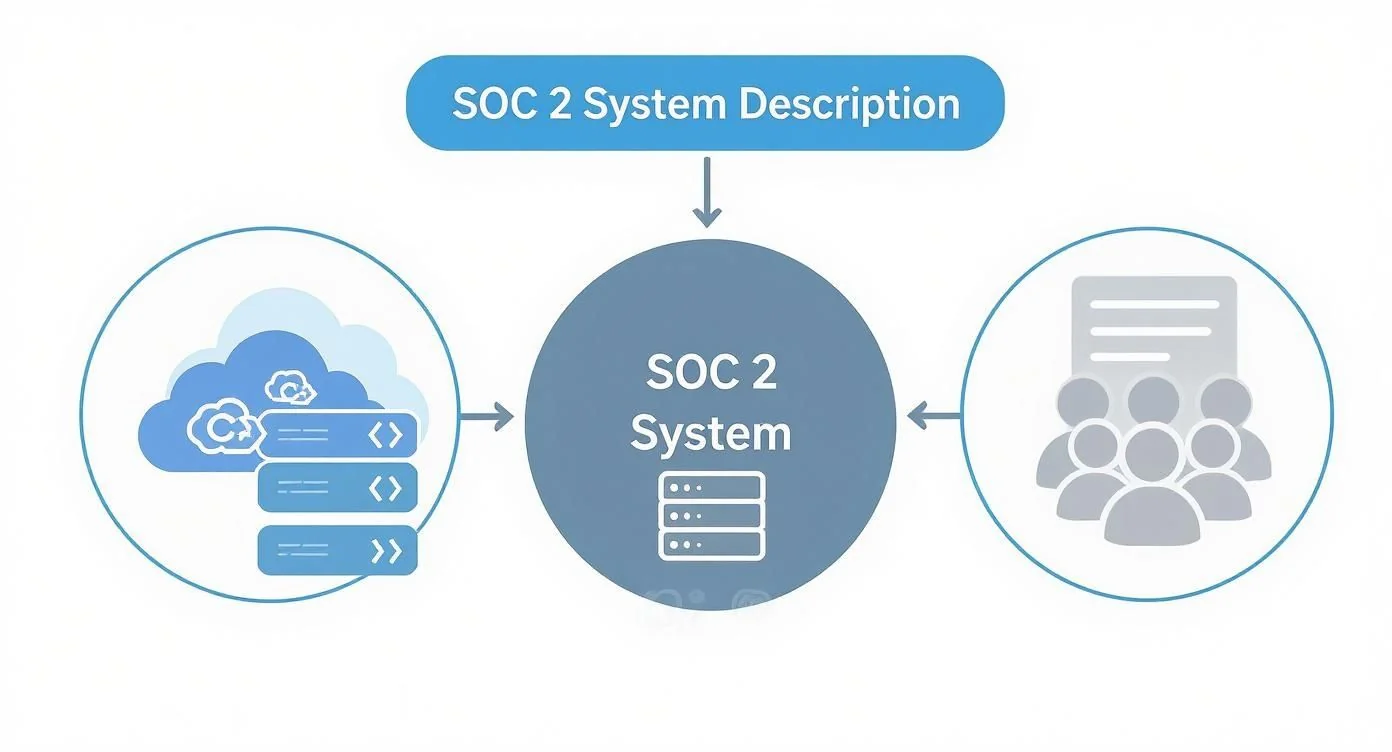
The system description defines what the audit covered. A useful one identifies the service, the boundary around it, and the parts of the environment that handle customer data. It should give a buyer enough context to compare the report with the product they plan to use, the vendor’s subprocessor list, and their own data flow.
| Report language | What it lets you check | Next question |
|---|---|---|
| Specific: “The in-scope service processes customer support tickets in a named cloud environment and relies on listed identity and hosting providers.” | Whether the product, environment, and outside services match your planned use. | “Does this include the tenant and data path we will use?” |
| Too general: “The company uses industry-standard cloud services to protect customer information.” | Very little. The language does not establish which service or boundary the auditor examined. | Ask for the in-scope service, relevant providers, and any material exclusions. |
Specificity is not a demand for every internal detail. It is enough detail to make the audit boundary intelligible. If a core service, data store, or subservice organization is missing from the description, ask whether it is out of scope and how the vendor manages that dependency.
Example: Can You Tell What Would Make the Control Fail?
A useful control statement gives the reader an observable condition. You should be able to picture the record an auditor would inspect and the result that would count as a failure, rather than accepting a broad policy promise.
| Broad claim | Observable control statement | What becomes reviewable |
|---|---|---|
| “Backups are regularly validated.” | “After each quarterly recovery exercise, the infrastructure owner records the restored system, completion time, observed recovery time, and unresolved steps in the recovery ticket.” | The exercise, result, timing, and unresolved work can be inspected. |
| “Large data exports are protected.” | “Before a support user exports more than 500 customer records, the service requires manager approval and records the requester, approver, row count, and time.” | A reviewer can identify the trigger, required approval, and audit record. |
The criterion label is not proof by itself. Spot-check whether the statement’s observable condition could reasonably address the risk named by that criterion. A backup-recovery exercise, for example, should not be the only support for an unrelated confidentiality commitment.
Example: What a Useful Test Procedure Looks Like
The test procedure is where a reader sees what the auditor actually examined. Compare these fictional descriptions:
Less informative: “Inspected evidence that terminated users had their access removed.”
More informative: “Selected terminated users from the review period, compared the HR termination date with identity-provider access records, and noted whether access was removed within the stated time frame.”
The second version identifies the population, evidence, comparison, and condition being tested. It still does not guarantee that the control works for your particular risk, but it gives you something concrete to evaluate. If a procedure is broad enough to fit any control, ask what evidence was examined, which period it covered, and how the auditor determined the result.
Compare Sections for Internal Consistency
A report should not describe one environment in the system description and test another in the control matrix. Cross-check a few precise nouns: the service name, key systems, control frequency, roles, and any stated exclusion. A quarterly review in one section should not become an annual review in another; the same system should not gain a different name without an explanation.
These are practical evidence checks, not a pass/fail vendor score. The SOC 2 Quality Guild’s reliability rubric similarly distinguishes the reliability of a report as evidence from whether a vendor meets a buyer’s particular requirements. Use the report to frame follow-up questions, then judge the answers against your use case.
How to Read Exceptions in an Example Report
An exception records an instance where the auditor found that a control did not operate as described. It deserves follow-up, but one exception does not settle a vendor decision. Read the affected control, the population or period involved, and the management response. Repeated exceptions in a control area that matters to your deployment deserve more attention than an isolated issue elsewhere.
Management may describe a fix, but that response is management’s statement; the audit opinion does not independently verify a future remediation. Our guide to SOC 2 exceptions and qualified opinions explains how to turn that distinction into a risk-based follow-up.
Type 1 and Type 2 Examples
A Type 1 report gives an opinion on control design as of a specified date. A Type 2 report also addresses whether those controls operated effectively over a review period. In either case, the same reading habits apply: confirm the system boundary, trace a control to the relevant criterion, and read the test description and result. A Type 2 gives more operating history; it does not make scope questions disappear.
For the practical implications, see SOC 2 Type 1 versus Type 2.
Frequently Asked Questions
How Long Should a SOC 2 Report Be?
There is no reliable page-count threshold. A shorter report may reflect a narrow service or fewer criteria, while a long report can still be difficult to use. Read the scope and a sample of relevant controls and test procedures.
What Are Complementary User Entity Controls?
Complementary User Entity Controls (CUECs) are responsibilities the service organization assigns to its customers. They may include customer-managed access settings, account configuration, or other actions outside the vendor’s control. Treat them as part of the operating conditions for using the service, not as fine print to skip.
Need help comparing audit firms by pricing, timeline, and industry fit? Start with the SOC 2 auditor directory.