 Menu
Menu
On this page
- What Is a SOC 2 Audit Report?
- SOC 2 Type 1 vs Type 2 Reports
- The Five Sections of a SOC 2 Report
- Auditor Opinions and Red Flags
- How Long a SOC 2 Report Is Valid (and Bridge Letters)
- How to Evaluate a Vendor’s SOC 2 Report
- Using Your SOC 2 Report in a Sales Process
- SOC 2 Timelines, Costs, and Auditor Selection
- Frequently Asked Questions About SOC 2 Reports
A SOC 2 audit report (also called a SOC 2 report) is a written attestation, issued by a licensed CPA firm, on whether a service organization’s controls meet the AICPA’s Trust Services Criteria for security, availability, processing integrity, confidentiality, and privacy. It documents what the auditor tested, how they tested it, what they found, and their formal opinion. A Type 2 report adds a verdict on whether those controls operated effectively across a window of time, usually 6 to 12 months.
A buyer reads the report to answer one question: can I trust this vendor with my data? This guide explains what each of the five standard sections contains, how to spot exceptions and qualified opinions, how long a report stays valid, and how to evaluate a report a vendor hands you.
What Is a SOC 2 Audit Report?

A SOC 2 report is third-party evidence that a vendor’s security controls exist and work. The auditor is independent of the company being audited, which is what gives the report weight in a vendor security review: the claims come from a CPA firm with its license on the line, not from the vendor’s marketing.
SOC 2 falls under the AICPA’s System and Organization Controls framework, alongside SOC 1 (financial-reporting controls) and SOC 3 (a short public summary). The report is the document most SaaS, FinTech, and HealthTech vendors end up sharing when mid-market or enterprise buyers ask how they handle customer data. A clean report can shorten the security review and clear a standard procurement requirement earlier.
Why the Report Matters in a Sales Cycle
For a growing company, the report shortens deal cycles. Instead of filling out a security questionnaire from scratch for every prospect, the sales team shares the report and points to the auditor’s opinion.
What it does in practice:
- Answers most of a prospect’s security-team questions before they’re asked.
- Clears the procurement checkpoint many large buyers set before a vendor evaluation can even begin.
- Separates you from competitors who haven’t completed an audit, especially if you hold a Type 2.
Getting a clean report comes down to demonstrating effective internal controls. For the underlying framework, see our guide on what SOC 2 compliance is.
SOC 2 Type 1 vs Type 2 Reports
The first decision in a SOC 2 engagement is whether to pursue a Type 1 or a Type 2 report. The two differ in what the auditor evaluates and the assurance the report carries.
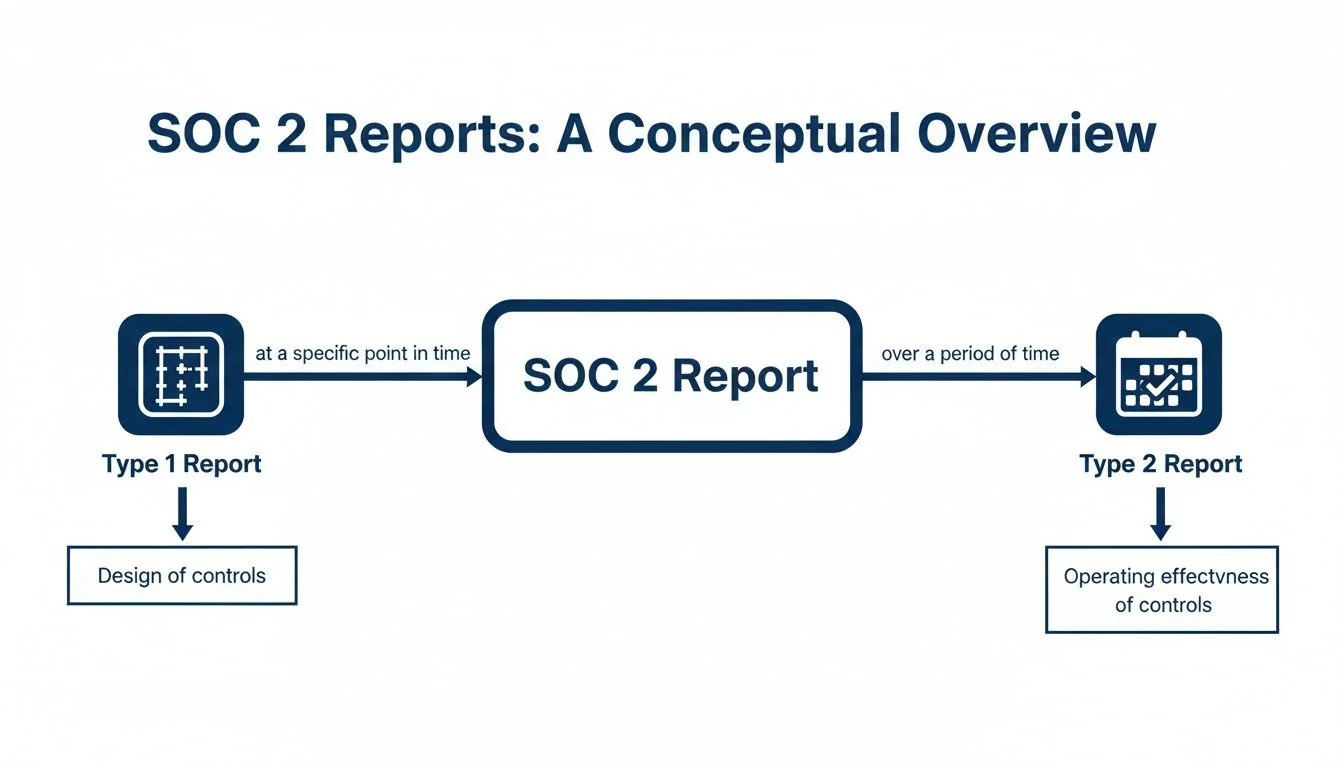
A SOC 2 Type 1 report evaluates whether controls are designed appropriately as of a single date. It confirms the right controls are in place on the day the auditor looks, but says nothing about whether they worked before or after.
A SOC 2 Type 2 report evaluates both design and operating effectiveness across a review period, typically 6 to 12 months. The auditor samples evidence throughout the window to confirm controls operated consistently, not just on one day.
Why Type 2 Is the Standard for Enterprise Buyers
A Type 1 is faster and cheaper, and it can satisfy smaller vendor reviews. But a control that looks correct on paper but fails in practice offers no protection, and a single-day snapshot cannot show whether it failed. That is why buyers often prefer a Type 2: it addresses whether controls operated over time.
Handing a Type 1 to a large prospect usually triggers the follow-up, “When will you have your Type 2?” Many companies that start with a Type 1 complete a Type 2 within the same year, paying for two audit cycles. For a deeper breakdown, see our guides on SOC 2 Type 1 vs Type 2 and what a SOC 2 Type 2 report entails.
Key Differences Between SOC 2 Type 1 and Type 2 Reports
| Attribute | SOC 2 Type 1 | SOC 2 Type 2 |
|---|---|---|
| Focus | Design of controls at a single point in time. | Design and operating effectiveness of controls over time. |
| Timeframe | A “snapshot” taken on a specific date. | A continuous period, typically 6 to 12 months. |
| Assurance Level | Moderate. Shows the controls were designed appropriately on that date. | High. Shows the controls operated consistently over time. |
| Typical Use Case | An initial compliance step or for less demanding customers. | The standard requirement for enterprise sales and long-term vendor trust. |
Choosing the report type is a business decision. If the goal is enterprise deals, a Type 2 from the start is usually the most direct path; starting with Type 1 means paying for two cycles in one year.
The Five Sections of a SOC 2 Report
A SOC 2 report follows a standard structure defined by the AICPA. Knowing what each section contains lets you orient quickly before deciding which controls need a closer read. Every report, Type 1 or Type 2, contains the same core sections.
- Section I — Auditor’s Opinion. The formal letter from the CPA firm stating their conclusion on whether controls are suitably designed and (for a Type 2) operated effectively over the period. Read this first.
- Section II — Management’s Assertion. The company’s signed statement claiming its system description is accurate and its controls were in place to meet the chosen Trust Services Criteria. This is what the auditor is opining on.
- Section III — System Description. A narrative of the services, infrastructure, software, people, data, and processes that were in scope, plus the criteria selected. This defines the boundary of what was audited.
- Section IV — Trust Services Criteria, Controls, Tests, and Results. The body of the report. It lists each control mapped to the relevant criteria, the tests the auditor performed, and the result of each test. In a Type 2, any exceptions (controls that failed during testing) appear here.
- Section V — Other Information (optional). Unaudited content the company chooses to include, such as management’s response to exceptions or roadmap commitments. The auditor does not opine on this section, so weigh it accordingly.
A Type 1 report covers design as of a single date; a Type 2 covers design and operating effectiveness across the full review period.
| Read | Decision question | If the answer is unclear |
|---|---|---|
| Opinion and period | What did the auditor conclude, and how current is the period? | Read the basis for any modified opinion; request current coverage or a bridge letter if needed. |
| System description | Does the audited service and boundary match how you will use the vendor? | Ask about excluded systems, environments, and relevant subservice organizations. |
| Relevant controls and tests | Was a meaningful control tested in a way that addresses your risk? | Ask which evidence, population, and period the auditor examined, then follow up on exceptions. |
Start With the Auditor’s Opinion
Section I is the executive summary. It tells you whether the company passed and whether the auditor found significant problems. The best outcome is an unqualified opinion, a clean report. A qualified, adverse, or disclaimer of opinion is a flag that warrants investigation (the four opinion types are explained below).
Check the Scope in the System Description
After the opinion, read Section III to confirm what was actually audited. A report can be scoped to one product line, one environment, or a subset of Trust Services Criteria. If the scope does not cover the service you plan to use, the report may not be relevant to your risk. Look for the named service, environment, key dependencies, and material exclusions, then compare them with the vendor’s product and your planned data flow. Confirm which of the five criteria are in scope; security (the Common Criteria) is always included, while availability, processing integrity, confidentiality, and privacy are optional. See our guide to the Trust Services Criteria for what each one covers.
Read the Control Tests for Exceptions
Section IV is where the substance lives. Do not scan only for a pass or fail. Look for exceptions, instances where a control did not operate as described during testing. Then read a few controls that matter to your deployment. A clear control says what happens, who performs it, and when; its test procedure should identify the evidence or population examined and what the auditor verified. Check that the control logically addresses the criterion beside it, and that names, scope, and frequencies agree with the system description.
Those are evidence-quality checks, not a substitute for deciding whether the vendor meets your requirements. The SOC 2 Quality Guild’s reliability rubric makes the same distinction: it concerns how much weight to give a report as evidence, rather than whether a vendor is right for a particular buyer. To see the details in fictional report language, walk through a SOC 2 report example.
Auditor Opinions and Red Flags
The auditor’s opinion in Section I is the CPA firm’s formal conclusion. For anyone vetting a vendor, the four possible outcomes carry very different meanings.
The Four Types of Auditor Opinions
Ranked from best to worst:
- Unqualified opinion: The clean outcome. The auditor found no material problems, the system description is fair, and controls are designed and (for Type 2) operating effectively.
- Qualified opinion: Mostly clean, but the auditor identified a material problem in one or more areas, a “fairly stated, except for X” verdict. Read the basis for the qualification before deciding whether it matters to you.
- Adverse opinion: The auditor found widespread, material failures; the system is not operating as described. Usually a deal-breaker.
- Disclaimer of opinion: The rarest outcome. The auditor couldn’t gather enough evidence to reach a conclusion, often signaling missing documentation or limited cooperation.
Any opinion other than unqualified should trigger a direct conversation with the vendor about what went wrong and what they’ve fixed.
Look Past the Opinion to the Exceptions
A clean opinion doesn’t end the review. An exception is a documented instance where a control failed during testing. For example, an auditor might sample 25 employee terminations and find one where access wasn’t revoked within the required window; that’s logged as an exception, and the opinion can still be unqualified if the failure isn’t material.
Isolated exceptions are normal in a long Type 2. Patterns are the concern: multiple exceptions in access controls, change management, or incident response can point to a systemic weakness the high-level opinion doesn’t surface.
Read Management’s Response to Exceptions
When exceptions appear, the report usually includes a management response (often in Section V). Don’t skip it. A strong response names the root cause and the specific corrective action with a timeline. A vague or defensive response is itself a signal about how seriously the company treats control failures. Because this section is unaudited, treat the commitments as claims, not verified facts.
How Long a SOC 2 Report Is Valid (and Bridge Letters)
A SOC 2 report doesn’t expire on a fixed date, but most buyers treat it as valid for 12 months from the end of the report’s review period. After that, the report is stale: it no longer covers the most recent period, and security reviews will ask for a current one.
Type 2 reports also cover a period that ends in the past. If a report’s period ended on December 31 and you’re reviewing it in May, there’s a gap of several months the report says nothing about. Vendors cover that gap with a bridge letter (also called a gap letter), a short statement from the vendor’s management affirming that no material changes to controls have occurred between the report’s end date and today. A bridge letter is signed by the vendor, not the auditor, so it carries less weight than the report itself and typically covers no more than about three months. Our bridge letter guide covers what one should include.
Because reports lapse, mature vendors run an annual audit cycle so they always have a current report and a fresh observation period. A continuous series of Type 2 reports with no gaps is a stronger signal than a single point-in-time report.
How to Evaluate a Vendor’s SOC 2 Report
When a vendor sends you a report as part of a security review, work through it in this order:
- Confirm it’s real and current. Check that the report is issued by a named, licensed CPA firm and that the review period ended within the last 12 months. If there’s a gap, ask for a bridge letter. For verification steps, see how to check a SOC 2 report is real.
- Read the opinion (Section I). Confirm it’s unqualified. If it’s qualified, read the basis and judge whether the issue touches your use case.
- Match the scope to your usage (Section III). Verify the system in scope is the product and environment you’ll actually use, and that the Trust Services Criteria you care about (for most buyers, security plus confidentiality or availability) are covered.
- Scan exceptions (Section IV). Note any exceptions, then look for patterns in access control, change management, and incident response.
- Read management’s responses. Check whether exceptions have a named root cause and a remediation timeline. Treat commitments about future fixes as management’s statements, not as audit evidence.
- Confirm the type. A Type 1 tells you controls were designed correctly on one day. A Type 2 adds operating effectiveness over time; decide whether that additional evidence is needed for this vendor and use case.
If the report is unqualified, current, scoped to your use case, and free of patterned exceptions, it’s doing its job. Anything missing is a question to send back to the vendor, not a reason to abandon the review.
Using Your SOC 2 Report in a Sales Process

Keep your SOC 2 report ready to use in deals. A clean Type 2 report gives buyers a faster way to understand your controls and can separate you from competitors who have not finished an audit.
Instead of answering the same questionnaire from scratch for every prospect, your team can share the report and point to the auditor’s opinion. That gives the buyer’s security team a place to start.
Give Sales Something Usable
A 100-page technical report is not the right first document for a prospect. Give your go-to-market team a shorter version they can actually use.
Start with a customer-friendly executive summary: a one- or two-page document that covers the essentials.
- The unqualified auditor’s opinion, which signals a clean report.
- The scope of the audit, stating which Trust Services Criteria were covered.
- A short, non-technical overview of your security environment.
- A statement on how you protect customer data.
Shared under an NDA, this summary gives prospects enough assurance to move forward without sending the full report on the first call.
SOC 2 is now a standard procurement gate for software vendors, especially in financial services, healthcare, and government, where enterprise buyers routinely require a current report before a deal proceeds. Type 2 is the version that matters for those deals: most enterprise security teams have stopped accepting a Type 1 snapshot as sufficient assurance.
A clean Type 2 can be the difference between making an enterprise shortlist and getting filtered out before the first call.
Equipping Your Team to Talk Security
Your sales and marketing team needs to understand what the report says. They do not need to be security experts, but they should be able to explain three things clearly:
- The difference between Type 1 and Type 2. A Type 1 confirms controls were designed correctly on one date; a Type 2 confirms they operated correctly across 6 to 12 months.
- What an unqualified opinion means. It is the clean outcome: an independent CPA firm concluded the controls met the criteria.
- How to share the full report. Have a simple NDA process so the complete document gets to the prospect’s technical reviewers without delay.
SOC 2 Timelines, Costs, and Auditor Selection
A SOC 2 report takes time and money. Knowing the scope up front helps you avoid surprises. For a Type 2 report, budget 6 to 15 months end to end: readiness, the observation period, fieldwork, and report writing. A prepared team lands at the low end; a team starting from scratch lands at the high end.
Realistic Timelines for a SOC 2 Audit
The SOC 2 process breaks down into a few distinct phases. Underestimating any one of them can push out both the audit and any deal tied to it.
- Readiness Assessment (2-6 weeks): Find and fix control gaps before fieldwork starts. Access control gaps are among the most common findings in first readiness assessments. Rushing this stage usually leads to a longer, more expensive audit.
- Observation Period (6-12 months): For a Type 2 report, this is the hardest constraint to compress. Your auditor needs continuous evidence that controls operated consistently across the full window. Six months is the standard for a first audit; enterprise buyers increasingly expect 12 months on renewals. Controls can be designed in weeks. Operating evidence can only be generated by time passing.
- Audit Fieldwork (4-8 weeks): The auditors actively collect evidence, interview your team, and verify that your controls performed the way you claim. This phase is shorter than most people expect. The observation period is the real work.
- Reporting (2-4 weeks): Once fieldwork closes, the auditor drafts, reviews, and issues the final report.
Total end-to-end, most first-time Type 2 audits run 9 to 14 months for startups and 12 to 18 months for more complex mid-market organizations. What causes delays? Remediation surprises in the middle of the observation period, too few internal resources assigned to evidence collection, and late auditor selection (sign your auditor 4 to 6 months before you need fieldwork to start).
SOC 2 Audit Costs
The cost of a SOC 2 report is more than the auditor’s invoice. In 2026, audit firm fees for a SOC 2 Type 2 engagement typically run $20,000 to $85,000 for most SaaS companies, with boutique specialist firms at the lower end and Big 4 firms (Deloitte, PwC, EY, KPMG) stretching to $200,000 or more for complex enterprise engagements.
But that’s just the auditor’s line item. Stack on a readiness assessment ($5,000–$25,000), a compliance automation platform ($7,500–$20,000 per year), penetration testing ($5,000–$20,000), and your internal team’s time, and total first-year spend lands closer to $30,000–$150,000 for most companies. Startups with narrow scope can come in well below that range; mid-market companies with complex cloud architectures or multiple Trust Services Criteria in scope regularly hit the upper end.
First-time organizations routinely underestimate total cost because they price only the auditor’s fee and forget internal labor, remediation, and tooling. Those line items often add up to more than the audit itself. Tightening scope before you engage an auditor is the most effective lever for keeping the total down.
Pricing in this market is opaque, which makes it hard to budget. SOC2Auditors.org aggregates real price ranges across our auditor directory so you can filter by budget and company size. For a deeper breakdown, see our guide to SOC 2 Type 2 audit costs.
Choosing the Right Audit Partner
The auditor you pick shapes how the engagement goes and how much the report is trusted later. Look past the price tag and weigh three things:
- Industry expertise. An auditor who already understands SaaS, FinTech, or HealthTech runs a sharper engagement and wastes less of your team’s time on basics.
- Responsiveness. Slow, unclear communication turns small questions into schedule slips. A responsive auditor keeps the timeline intact.
- Client satisfaction. Ask for references or check verified reviews. Satisfaction scores from past clients tell you more than a sales pitch.
The right firm understands your business and runs an efficient engagement. That matters more than a polished sales pitch.
Frequently Asked Questions About SOC 2 Reports
Is a SOC 2 Report a Certification?
No. People say “SOC 2 certified,” but SOC 2 produces an attestation report, not a certificate. An independent CPA firm doesn’t issue a pass/fail credential; it audits the controls and states a formal opinion on whether they’re designed and (for Type 2) operating effectively. That’s an examination under AICPA attestation standards, which is why the report carries more weight than a checkbox certification.
How Often Do You Need a SOC 2 Report?
Buyers generally treat a report as valid for 12 months from the end of its review period. After that it’s stale and security reviews will ask for a current one. Run the audit annually so you always hold a fresh report and an unbroken observation period; a bridge letter can cover the short gap between the report’s end date and the next one.
What Is the Difference Between SOC 2 and SOC 3?
Both cover the same Trust Services Criteria, but they serve different audiences. A SOC 2 report is the detailed, restricted document, shared under NDA, containing the system description, controls, and the auditor’s tests. A SOC 3 report is a short public summary with the auditor’s opinion but none of the sensitive control detail, so it can be posted on a website. For a full breakdown, see SOC 2 vs SOC 3 report differences.
What If My Report Has Inaccuracies?
You review a draft before the report is issued. Read the system description and control list closely. If a process is misstated or the wrong tool is named, flag it with your auditor before issuance. An accurate report avoids back-and-forth during later vendor reviews.
Choosing the right auditor shapes the whole engagement. If you want to compare firms by pricing, timeline, and industry fit, start with the SOC 2 auditor directory.