 Menu
Menu
On this page
- When does a startup actually need SOC 2?
- SOC 2 by startup stage: pre-seed to Series B
- Is it too early? Four signals that flip the answer
- What SOC 2 no longer settles in 2026
- The minimum viable first audit
- What to send before you have a report
- What you are committing to after the report
- Common SOC 2 questions from startup founders
- Related Resources
SOC 2 becomes worth doing the moment a named customer makes it a condition of a contract — not at a headcount, a revenue number, or a funding round. That timing question is the one most founders are really asking, and it has a cleaner answer than the “you should probably start early” advice that surrounds it.
This page covers when SOC 2 is warranted at your stage, how to tell whether you are early or late, and what to send buyers while you do not have a report. For the framework itself, see our SOC 2 compliance guide; for what a report costs, see the startup cost breakdown.
When does a startup actually need SOC 2?
A startup needs SOC 2 when a specific customer contract depends on it. No law, and no AICPA rule, requires a SOC 2 report at any company size. The requirement arrives from a buyer: a security questionnaire lands, a procurement portal will not advance the deal without an attached report, counsel adds a security addendum, or a platform partnership makes attestation a listing condition. Until one of those happens, SOC 2 is a bet on demand you have not seen yet.

That framing matters because the alternative — starting on a schedule — is what produces the two failure modes founders complain about. Start too early and you buy a report nobody reads, then renew it annually. Start when the deal is already in procurement and you are three to five months from a Type 1 that the buyer wanted last week.
SOC 2 by startup stage: pre-seed to Series B
Stage is not the trigger, but it is a good predictor of when the trigger arrives, because it tracks who you are selling to. Use this to plan, then act on the signals in the next section.
| Stage | What usually triggers it | What to do now | The cost of getting it wrong |
|---|---|---|---|
| Pre-seed / pre-PMF | Almost nothing. Design partners rarely run vendor review. | Free groundwork only: SSO and MFA on production, a written list of who can reach customer data, a maintained subprocessor list. | Paying for a report and its annual renewal before you have a buyer who wants to read it. |
| Seed, first upmarket interest | A questionnaire arrives from a prospect one or two sizes above your current customers. | Ask that prospect what it will accept and by when. Get the answer in writing before you scope anything. | Scoping to a rumor. Teams routinely buy Type 2 when the buyer would have taken a Type 1. |
| Series A, deliberate enterprise motion | Procurement gates a contract; counsel adds a security addendum. One commonly cited threshold is an annual contract value around $50,000. | Commit to Type 2 as the destination, with a Type 1 only if a live deal cannot wait for it. | Starting after the deal is in procurement, which turns a planned project into expedited fees and an all-hands scramble. |
| Series B and beyond | Renewals and RFPs assume a current Type 2. Regulated buyers start naming additional frameworks. | Keep the observation period continuous so there is never a gap to explain, and decide which second framework you are heading toward. | Letting the report lapse between periods, then discovering a renewal cannot close without it. |
The Series A threshold is a rule of thumb rather than a standard: the compliance advisory BD Emerson puts the concrete trigger at a questionnaire, a procurement portal, or a security addendum on a contract worth $50,000 or more a year (BD Emerson, 19 July 2026). Treat it as a sanity check on whether the deal justifies the spend, not a threshold that creates an obligation.
On fundraising: SOC 2 is rarely a hard gate at Series A, but for B2B companies its absence tends to generate diligence questions about enterprise readiness. It removes a discount, rather than earning a premium — a reason to have a credible plan, not a reason to buy a report for investors.
Is it too early? Four signals that flip the answer
Headcount is the wrong test, which is why “we’re only 20 people” is a bad reason to wait and “we just raised” is a bad reason to start. It is the wrong test for how long the audit takes too — readiness and scope drive that, not team size. Check these instead.
- A buyer you can name has asked, in writing. A questionnaire, a procurement portal invitation, or an addendum. Not a rumor from a sales call, and not a competitor’s trust page.
- The contract is worth more than the program. Compare the annual contract value to first-year spend. Specialist Type 2 examinations in our directory currently run $15,000–$50,000, and a platform plus internal time sits on top of that. If the deal does not clear that order of magnitude, the report is being bought for a pipeline that does not exist yet. Current bands: startup cost breakdown.
- You hold real customer production data. Demo data and design-partner sandboxes do not carry the same risk, and buyers can tell the difference when they read your system description.
- One person can own it. Not “the team.” A named owner with hours actually allocated — usually a CTO or senior engineer at roughly a fifth of their time.
If fewer than two are true, wait. Do the free groundwork from the stage table and send the evidence packet below when a prospect asks. If three or four are true, you are already late; the constraint is the observation period, and no amount of budget compresses it. Our timeline breakdown shows which phases can overlap and which cannot. Pre-revenue teams and startups that only sell to other startups are covered in the FAQ.
What SOC 2 no longer settles in 2026
A clean report still does the main job: it answers the security team’s standing checklist before anyone asks, so a review that would otherwise run on questionnaire round-trips can be settled with one document. That is the deal-velocity case, and it holds.
What has changed is that the report is increasingly the floor rather than the finish line, especially if you ship AI features. The security teams running your vendor review are having trouble governing AI inside their own walls. In a survey of 300 US IT and security professionals at companies with 1,000 to 20,000 employees — roughly the size of the buyers gating these deals — conducted by Wakefield Research for Drata between 12 and 27 March 2026 (margin of error ±5.7 points), 71% said an AI tool used for GRC had already contributed to a failed audit or a lapsed regulatory standard, and only 13% were fully confident they could see every AI tool their own employees used (State of GRC in the Age of AI; Drata, 15 July 2026). Vanta’s third State of Trust report, surveying 3,500 business and IT leaders, found 59% saying AI risks outpace their expertise (The State of Trust Report).
Questionnaires have followed. Vendor-risk guidance published through 2026 consistently describes an AI section bolted onto the standard SOC 2 template: named AI subprocessors, model provenance, output monitoring, retention of anything sent to a model, and alignment with ISO 42001 or the NIST AI Risk Management Framework. That guidance is vendor-published rather than independent research, so treat the pattern as directional. The planning consequence is concrete either way — if your product calls a model, expect questions your SOC 2 report does not answer, in the same review, and budget time to answer them.
The minimum viable first audit
If the signals say start, the cheapest credible path is a narrow one. Scope is the single biggest lever a startup controls.
- Security criterion only. All SOC 2 reports include it; Availability, Confidentiality, Processing Integrity, and Privacy each multiply control count and testing time. Add one only when a customer has actually asked.
- Production and the people who reach it. Exclude corporate IT, office networks, development and staging environments, and internal tooling. Write the boundary down — auditors test it.
- One named owner. Shared ownership is the most reliable way to miss a report date.
- Automated evidence collection. Manual screenshotting is where these projects fail, and it is also what makes the Type 1 to Type 2 transition painful. We compare the platforms for seed-to-Series-B teams in best SOC 2 software for startups.
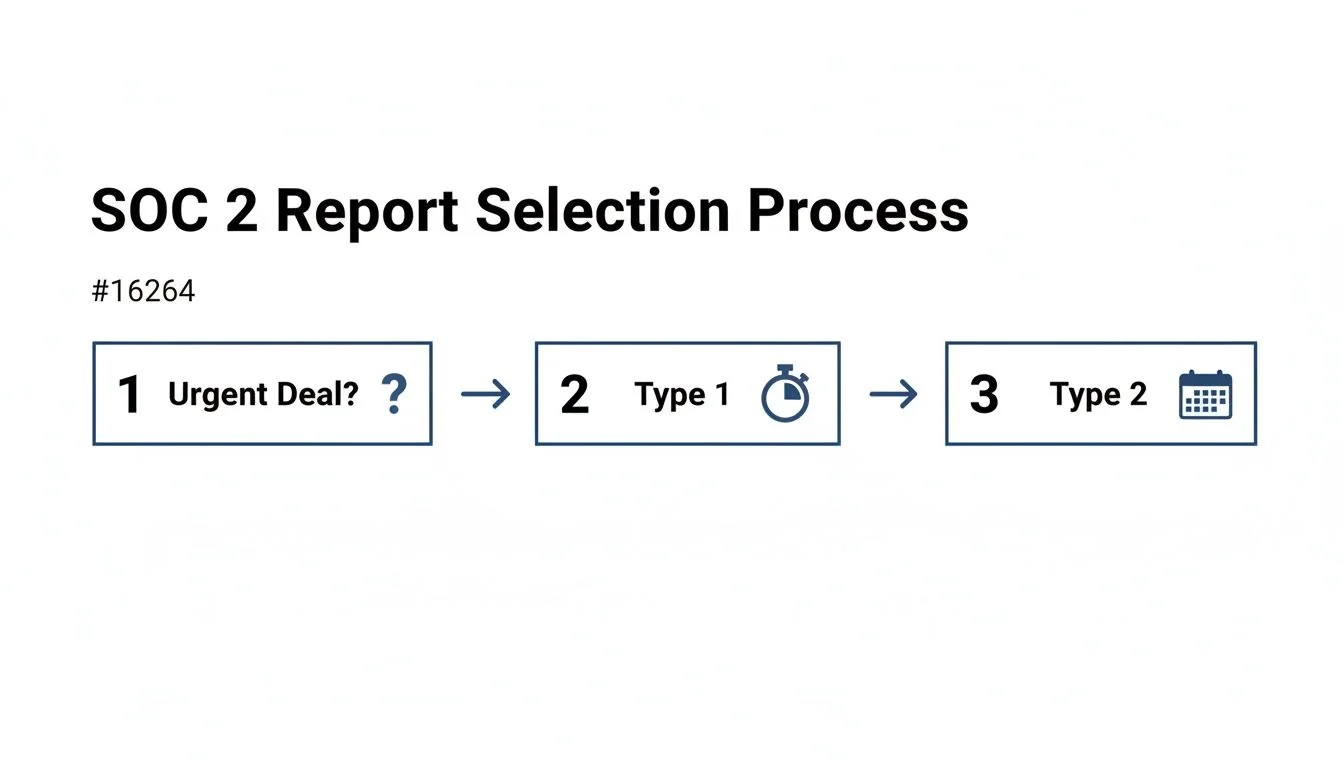
On report type, the stage table’s logic is the whole answer: Type 2 is the destination, Type 1 is a bridge you buy only when a live deal cannot wait. Ask the prospect which it will accept before paying for the faster one, and start the observation period the day the Type 1 is issued. The full comparison is in SOC 2 Type 1 vs. Type 2, and the readiness checklist covers what to build before fieldwork.
Auditor choice is a real cost lever — boutique firms that specialize in SaaS startups price a first audit very differently from national firms. We track and compare startup-focused firms on speed, pricing transparency, and reviews in the SOC 2 auditor directory for startups.
Don’t pick an auditor on the lowest fee. A cheap firm that issues an exception-heavy report gives your prospect reasons to keep asking questions. A clean report from a credible firm ends the conversation.
What to send before you have a report
Between “a buyer asked” and “the report exists” there is a gap of months. Most deals that die in that gap die from a vague answer, not from the missing report. Send a packet instead:
- A system and data-flow summary. What the product does, where customer data lives, how it is encrypted, how long it is kept.
- A current subprocessor list and a signed DPA. These are the two artifacts a reviewer asks for immediately and the two most startups cannot produce on demand.
- Your own answers to their questionnaire, written once and reused. Buyers accept a self-assessment far more readily when it is specific.
- A recent penetration test summary. Penetration testing is not explicitly mandated by the AICPA Trust Services Criteria, but enterprise reviewers ask for it, and a scoped report with remediation evidence carries weight while the audit is pending.
- A dated commitment. The audit start date, the report type, the auditor if you have engaged one, and the expected issue date. A date is defensible inside the buyer’s organization; “we’re working on it” is not.
One correction worth making, because it comes up: a bridge letter is not an option here. A bridge letter covers the gap between the end of a completed report’s observation period and today, and the working consensus is that it should span no more than about three months. It cannot substitute for a report you have never had.
What you are committing to after the report
Worth pricing into the decision: SOC 2 is a subscription, not a purchase. Once evidence collection is automated, ongoing work settles into quarterly access reviews, annual policy sign-offs, and supporting fieldwork — roughly four to eight hours a month for most teams with a platform in place, plus the annual audit fee and platform license.
The controls, not the report, are the durable asset. They map onto ISO 27001 Annex A, the HIPAA Security Rule, and GDPR Article 32, which is why a second framework typically costs meaningfully less than the first. If EU, healthcare, or federal buyers are on your roadmap, the scope and control decisions you make in the first audit determine how much rework the second one needs.
Common SOC 2 questions from startup founders
I’m a Series A startup with 20 employees. Is it too early?
Headcount is the wrong test. A 20-person company with a named enterprise prospect in procurement is late; a 200-person company selling to other small businesses may never need a report. Run the four signals above: a buyer has asked in writing, the contract justifies the spend, you hold real customer production data, and one person can own the work. If those are true at 20 employees, start now.
At what revenue or employee size does SOC 2 become necessary?
There is no threshold, because nothing makes SOC 2 mandatory. It becomes necessary the first time a contract depends on it, which is a function of who you sell to rather than how big you are. Startups selling into regulated industries hit that point at a handful of employees. Startups selling to other startups can pass a hundred employees without being asked once.
Can I get SOC 2 if my company is pre-revenue?
Yes. Nothing in a SOC 2 engagement requires customers or revenue — the auditor tests your controls, not your income statement. It is rarely worth it. The two cases where it usually pays off: a signed deal is waiting on the report, or you sell to enterprise and regulated buyers from day one and are funded to build the program before revenue arrives. A report is also a recurring commitment, so buying one before you have buyers means renewing it annually before anyone reads it. We run the return-on-investment math for the earliest stage in is SOC 2 worth it for pre-seed startups.
Do I need SOC 2 if I only sell to small businesses?
Your buyer’s size decides this, not yours. Formal vendor review is mostly a practice of companies large enough to employ someone to run it, so selling exclusively to other startups and small businesses rarely produces the requirement. Two exceptions: a small buyer in a regulated sector may inherit it from its own obligations, and a platform or marketplace partnership can make attestation a listing condition regardless of deal size.
Can a small team handle it?
Yes. Teams of five to twenty engineers get through SOC 2 with two things: a named owner with about a fifth of their time allocated, and a platform that collects evidence automatically. Without the platform, the manual evidence burden usually costs more engineering hours than the platform costs in dollars.
What do startups get wrong most often?
- Scoping to a rumor. Ask the prospect what it will accept before you scope. Teams routinely buy Type 2 when Type 1 would have closed the deal.
- Scoping too broadly. Including development environments, office networks, and internal tools triples the control count for no customer benefit.
- No assigned owner. Shared accountability means the report date slips.
- Starting the observation period late. If Type 2 is the destination, the observation period starts the day the Type 1 is issued. Every month of delay moves the Type 2 date by a month.
Related Resources
- SOC 2 Compliance Overview
- SOC 2 Audit Cost for Startups
- SOC 2 Auditors for Startups
- SOC 2 Type 1 vs. Type 2
- How Long Does a SOC 2 Audit Take
- Best SOC 2 Software for Startups
Ready to find the right auditor without the guesswork? SOC2Auditors helps you compare verified firms based on real pricing, timelines, and startup experience. Get three tailored matches in 24 hours at https://soc2auditors.org.