 Menu
Menu
On this page
- How long does each SOC 2 phase take?
- Why do people quote such different SOC 2 timelines?
- Does the AICPA require a three-month Type 2 observation period?
- What can overlap in a SOC 2 timeline?
- What does a realistic Type 1 or Type 2 plan look like?
- How do you back-plan from a customer deadline?
- What usually delays a SOC 2 report?
- Does compliance automation shorten the timeline?
- How should auditor selection account for the deadline?
- SOC 2 timeline FAQ
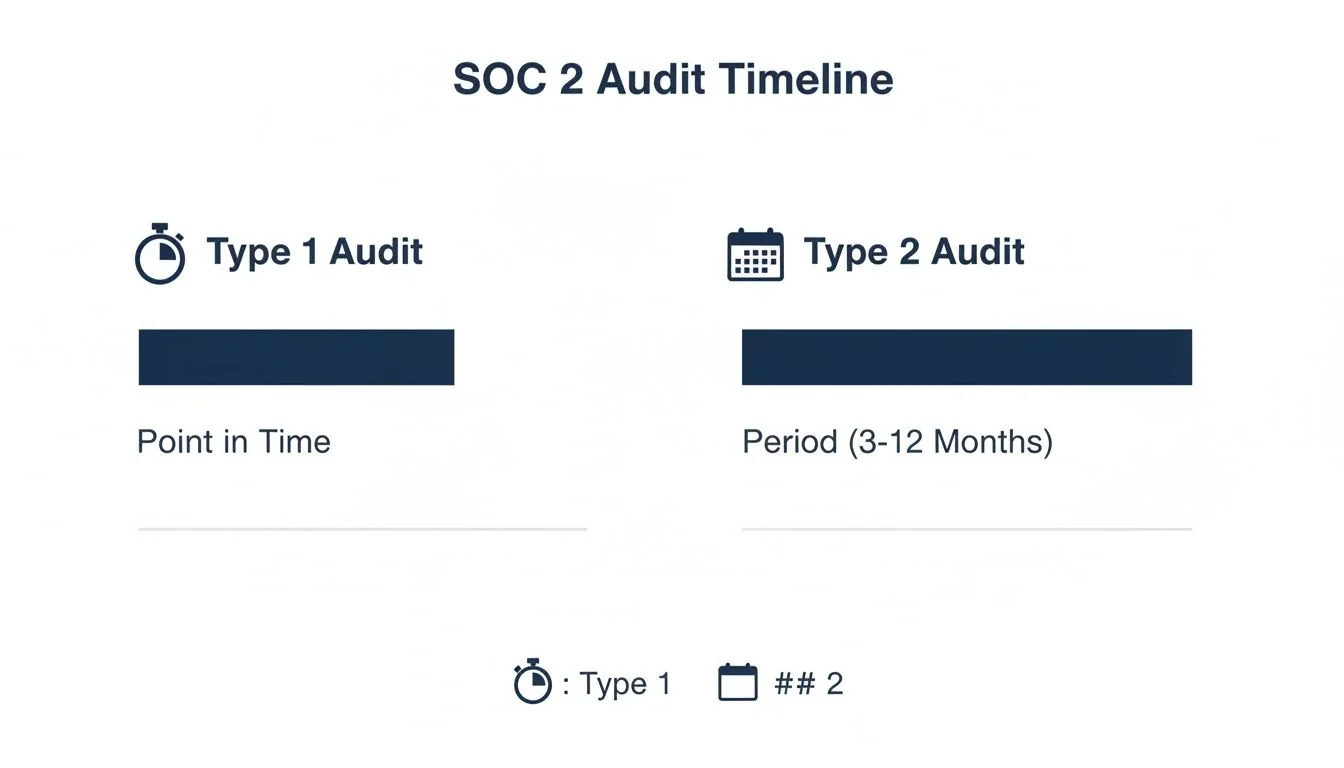
A SOC 2 audit usually takes about 2–3 months once scope, controls, and evidence are ready. End-to-end, plan about 3–6 months for Type 1 and 6–12 months or more for a first Type 2. Type 2 takes longer because it covers control operation over an agreed period, commonly 3, 6, or 12 months.
Those are planning ranges, not delivery guarantees. Current CPA-firm guidance brackets the post-readiness work similarly: A-LIGN lists 2–6 weeks for walkthroughs and control testing, followed by draft and final review; Cherry Bekaert gives a few weeks to two months for Type 1 fieldwork, one to two months for Type 2 fieldwork, and about one month for wrap-up and issuance. Your critical path still depends on readiness, report type, scope, auditor capacity, and response time.
If you need calendar dates rather than phase guidance, use the SOC 2 timeline calculator to work backward from the buyer’s deadline.
How long does each SOC 2 phase take?
A defensible plan separates preparation, the Type 2 period, auditor review, and report production. Preparation has no honest universal duration because a company with mature controls starts in a different place from one still choosing systems and writing policies. The CPA-controlled work begins only after scope and evidence are usable.
| Phase | Planning range | Applies to | What controls the finish date |
|---|---|---|---|
| Scope and auditor selection | Variable | Type 1 and Type 2 | Buyer requirement, system boundary, Trust Services Criteria, and firm capacity |
| Readiness and remediation | Variable | Type 1 and Type 2 | Number of control gaps, implementation work, and evidence ownership |
| Specified period | Commonly 3, 6, or 12 months | Type 2 only | Dates approved by the CPA firm and evidence produced while controls operate |
| Auditor review and testing | About 2–8 weeks across the CPA-firm guides above | Type 1 and Type 2 | Scope complexity, evidence quality, sample requests, and response speed |
| Draft and final report | About 3–5 weeks after fieldwork | Type 1 and Type 2 | System-description readiness, management review, and firm review process |
Do not simply add every maximum in the table. Some firms begin review during a Type 2 period, while others start most testing after it closes. Ask the firm which work it performs concurrently and what must wait.
Why do people quote such different SOC 2 timelines?
They are often timing different projects. “The audit took six weeks” may describe the CPA firm’s testing and reporting after the company was ready. “SOC 2 took nine months” may describe the whole program from first gap assessment through a Type 2 period and final report.
Use these two clocks in every planning conversation:
- Company clock: scope, control design, remediation, policy approval, system description, and evidence operations.
- CPA clock: engagement planning, testing, follow-up requests, evaluation of exceptions, draft review, and report issuance.
The company clock is the larger source of uncertainty. A firm cannot give a reliable report date while scope is moving or key controls are not operating. Run a SOC 2 readiness assessment before treating any estimate as a committed schedule.
Does the AICPA require a three-month Type 2 observation period?
No universal three-month minimum appears in the AICPA’s public SOC 2 description. The AICPA’s authoritative SOC 2 guide frames the work around control design and operating effectiveness; a Type 2 report addresses operation over a specified period.
Three, six, and twelve months are common practitioner planning windows, not AICPA-prescribed tiers. The engaged CPA firm must approve the start and end dates and decide whether the period produces enough appropriate evidence for the controls in scope. A short period may omit a quarterly or annual control entirely.
For the evidence and buyer-acceptance decision, use the dedicated SOC 2 observation-period guide. It owns the detailed 3-vs-6-vs-12-month choice.
What can overlap in a SOC 2 timeline?
Auditor selection, system-description drafting, evidence checks, and some testing can overlap; unresolved controls and missing evidence cannot be scheduled away. Agree on the concurrency plan before the Type 2 period begins.
| Workstream | Can it overlap? | Dependency to confirm |
|---|---|---|
| Auditor selection and readiness | Usually | The firm must preserve independence; confirm which readiness services it may provide |
| System-description drafting and control operation | Yes | Freeze the system boundary and keep the description current as systems change |
| Type 2 period and interim evidence review | Sometimes | Ask whether the firm performs walkthroughs or interim testing before the period closes |
| Remediation and Type 2 control operation | Risky | A changed or newly implemented control may not have operated for the full stated period |
| Final testing and report drafting | Partly | Open samples, exceptions, and management responses can block the draft |
| Customer review and report issuance | No | Customers review the issued report; they do not approve the CPA firm’s opinion |
The most useful scheduling question is not “How fast can you finish?” It is “Which milestone starts each downstream task, and what evidence proves that milestone is complete?”
What does a realistic Type 1 or Type 2 plan look like?
Use scenarios, not a single market-wide promise. The same report type can have a short or long path depending on whether the control environment is ready when the CPA firm starts.
| Starting position | Defensible planning approach | Do not assume |
|---|---|---|
| Type 1; controls and evidence ready | Reserve the CPA review and reporting windows, plus time to finalize scope and the system description | That firm capacity is immediate or that every buyer accepts Type 1 |
| Type 1; material gaps remain | Finish remediation before anchoring the report date | That templates or software make an unimplemented control auditable |
| Type 2; controls ready | Agree the specified period, evidence cadence, interim testing, and report-review dates in writing | That three months is automatically acceptable to the CPA firm or customer |
| Type 2; controls are changing | Stabilize control design and ask how changes affect the period before starting the clock | That evidence from two different control designs can be combined without consequence |
If you have not chosen the report type, the SOC 2 Type 1 vs. Type 2 guide owns that decision. A Type 1 opinion addresses control design at a specified date; a Type 2 opinion also addresses operating effectiveness throughout a specified period.
How do you back-plan from a customer deadline?
Work backward from the report date only after the requester states what it will accept. “We need SOC 2 by December” is incomplete until the buyer confirms report type, any required period, and whether an interim artifact solves the procurement need.
- Get the requirement in writing. Record Type 1 or Type 2, requested Trust Services Criteria, coverage expectation, and report deadline.
- Choose the CPA firm before committing the calendar. Confirm capacity, engagement start, specified period or date, testing approach, and draft-to-final turnaround.
- Map every control to an owner and evidence source. A due date without an accountable operator is not a schedule.
- Test population completeness before day one. Verify that access, change, training, incident, and review records can be exported for the whole relevant period.
- Reserve review time. Name the people who will review the system description, answer samples, evaluate exceptions, and approve management representations.
- Publish one internal critical path. Track blockers that change the report date separately from ordinary tasks.
Then enter the target issue date in the timeline calculator to turn those dependencies into dated milestones.
What usually delays a SOC 2 report?
The common blockers are unstable scope, controls that are not operating as described, incomplete evidence populations, slow responses, unavailable firm capacity, and late report review. Each one breaks a dependency in the schedule rather than adding a predictable fixed number of days.
Before kickoff, ask:
- Is the system boundary approved, including subservice organizations?
- Are the selected Trust Services Criteria tied to a real buyer requirement?
- Has each control operated at its written frequency?
- Can the team produce a complete population from which the auditor can sample?
- Who answers each auditor request, and what response time is realistic?
- Who owns the system description and management review?
- What happens to the planned dates if a control changes or an exception appears?
The CPA firm evaluates exceptions in context. One exception does not mechanically add two weeks or force a qualified opinion, and remediation does not erase what happened during a Type 2 period.
Does compliance automation shorten the timeline?
It can reduce evidence-collection and handoff time when its integrations cover the in-scope systems. A platform can retain records, map evidence to controls, flag failed tests, and give the CPA firm an organized workspace.
It cannot implement a missing control, make a customer accept a shorter period, decide how an exception affects the opinion, or issue the report. The company still operates the controls; the independent CPA firm still performs the examination. Compare those boundaries before buying from the SOC 2 compliance software directory.
How should auditor selection account for the deadline?
Compare the schedule behind the quote, not just the promised turnaround. Ask each firm for the same written scope and have it identify the engagement start, Type 2 dates if applicable, interim work, expected evidence-response time, fieldwork window, and draft-to-final review process.
A fast headline is not useful if the firm cannot start when you need it or if its estimate begins only after an undefined “audit-ready” milestone. The auditor-selection guide explains how to compare independence, experience, team, methodology, price, and timing on the same basis.
SOC 2 timeline FAQ
How long does a SOC 2 audit take in 2026?
A SOC 2 audit usually takes about 2–3 months once scope, controls, and evidence are ready. End-to-end, plan about 3–6 months for Type 1 and 6–12 months or more for a first Type 2. Type 2 takes longer because it covers control operation over an agreed period, commonly 3, 6, or 12 months.
Does the AICPA require a three-month Type 2 observation period?
No universal three-month minimum appears in the AICPA’s public SOC 2 description. A Type 2 opinion addresses controls over a specified period. Three, six, and twelve months are common planning windows, but the engaged CPA firm must approve the dates and evidence plan.
Can a SOC 2 report be completed in under three months?
A Type 1 report can sometimes be issued in under three months when controls are already designed, evidence is ready, scope is stable, and a CPA firm has capacity. Do not promise the same for Type 2: it must cover an agreed period and still needs testing and report review.
What usually delays a SOC 2 report?
The common schedule blockers are unresolved scope, controls that are not yet operating, incomplete evidence populations, slow answers to auditor requests, unavailable audit capacity, and late review of the system description or draft report. Confirm owners and dates before kickoff.
Does compliance automation shorten a SOC 2 audit?
It can shorten evidence collection and reduce handoff friction when integrations cover the in-scope systems. It cannot implement controls, choose an acceptable Type 2 period, resolve exceptions, or issue the opinion. Those tasks remain with the company and its independent CPA firm.
Need a firm whose real capacity matches the deadline? Compare SOC 2 auditors by price, typical turnaround, platform experience, and industry fit, or send one scoped brief to get matched with available firms.