 Menu
Menu
On this page
- What are the best Drata alternatives?
- How we compare Drata alternatives
- Vanta
- Secureframe
- Sprinto
- Thoropass (formerly Laika)
- Hyperproof
- AuditBoard
- Scrut Automation (Scrut)
- TrustCloud (formerly Kintent)
- Strike Graph
- Scytale
- OneTrust (Compliance Automation)
- Comp AI
- Drata alternatives — 12-tool comparison
- When Drata Is Still the Right Pick
- Making Your Choice: Automation Platform + The Right Auditor
- Frequently Asked Questions
What are the best Drata alternatives?
Choose a Drata alternative by the constraint you want to change. Start with Vanta for a close mainstream-SaaS comparison and broader published integration count, Secureframe for guided support and defense-oriented frameworks, Sprinto for bundled implementation help, Strike Graph for published paid pricing, Hyperproof for mature multi-framework operations, and Comp AI when open-source deployment matters. Keep Drata when its connectors, interface, and multi-framework workflow already fit.
| Reason to compare | Start with | Main tradeoff | Pricing disclosure |
|---|---|---|---|
| Broader published integration count | Vanta | Similar quote-led buying process | Quote-only |
| Guided support or defense frameworks | Secureframe | SSO and SCIM start above its entry plan | Quote-only |
| Bundled implementation help | Sprinto | No public free trial or price list | Quote-only |
| Published starting price | Strike Graph | Limited lead-form option is not a standing free tier | Published paid plans |
| Mature shared-control GRC | Hyperproof | More platform and cost than many first-time teams need | Quote-only |
| Open-source core and self-hosting | Comp AI | Hosted pricing is now quote-only; self-hosting adds operating work | Quote-only for hosted service |
When Drata is still the better fit
Keep Drata on the shortlist when its 300+ integrations cover your systems, you want a polished multi-framework workflow, and its written quote — including implementation, add-ons, renewal terms, and auditor access — beats the switching cost. The software organizes evidence; an independent CPA firm still performs the examination and issues the report.
How we compare Drata alternatives
We assess replacement fit, pricing evidence, framework coverage, integrations, support, and auditor workflow using our sourced vendor records. These are editorial comparisons, not numerical scores. We distinguish unknowns from documented capabilities and label estimated prices. Browse the compliance tools hub for the related reviews and pricing guides.
Vanta
Vanta stands as one of the most established Drata alternatives, with a mature platform and extensive integration ecosystem. It automates a significant portion of the work required for security and privacy frameworks like SOC 2, ISO 27001, HIPAA, and GDPR. The platform excels at continuous controls monitoring, pulling evidence from 400+ cloud services, HR systems, and infrastructure providers to ensure your security posture remains strong post-audit.
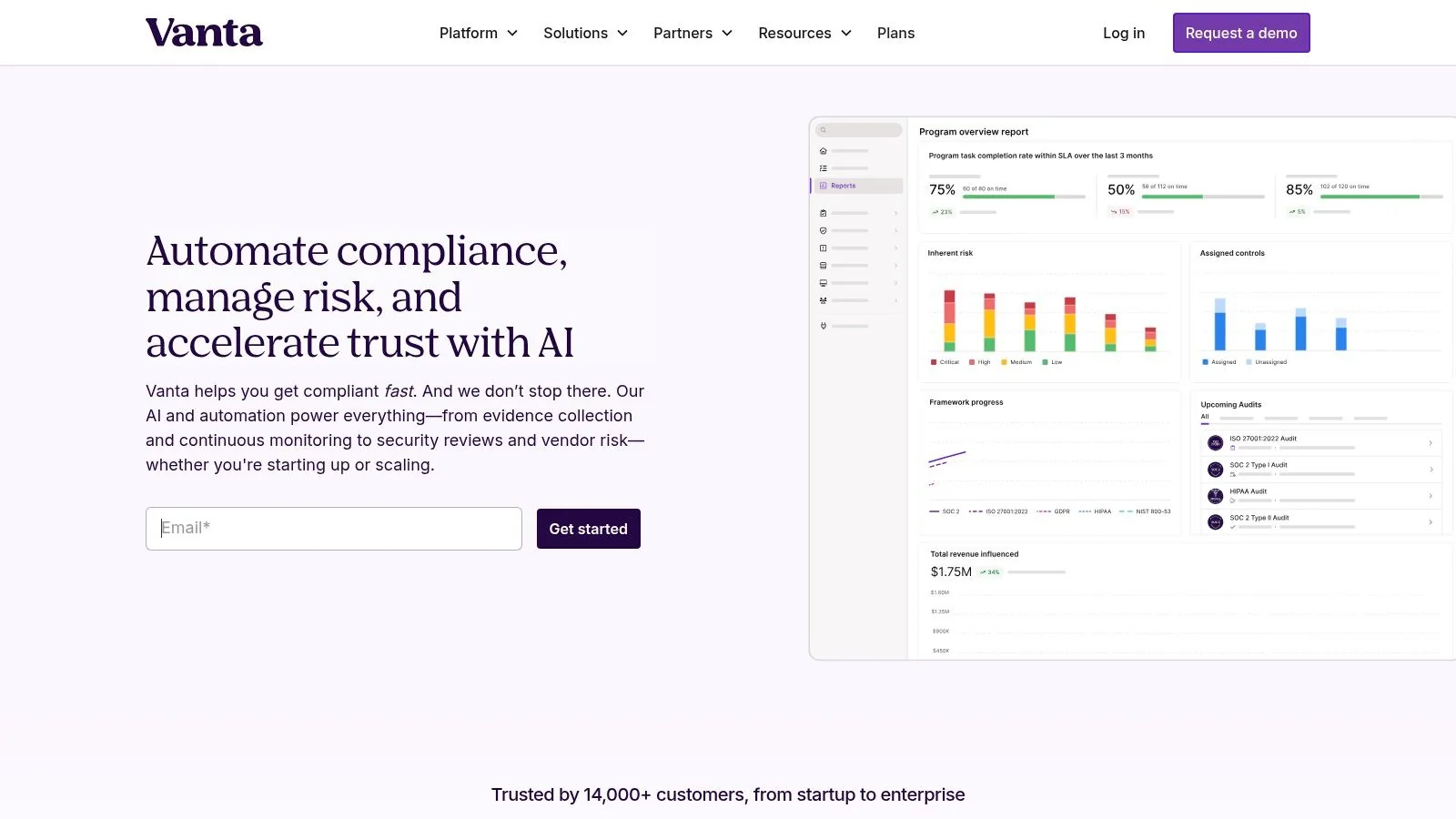
In 2025 and into 2026, Vanta has moved firmly toward what it calls an “agentic trust platform.” The Vanta AI Agent, now generally available, handles policy drafting, evidence checks, questionnaire responses (with a reported 95% acceptance rate), and issue remediation across your infrastructure. Vanta launched support for the NIST AI Risk Management Framework in early 2026, giving teams building AI products a path to demonstrate AI governance alongside their existing SOC 2 or ISO 27001 program. In April 2026, Vanta released a remote MCP server in public preview, allowing teams using Claude, Cursor, or Windsurf to query their compliance program directly from their editor and generate infrastructure-as-code fixes for failing controls across 500+ AWS, GCP, and Azure tests.
Plan structure now runs four tiers: Essentials, Plus, Professional, and Enterprise. AI Agent features are gated by plan, with more advanced agentic capabilities (issue management, agentic evidence collection, agentic policy generation) unlocking at Professional and above. Questionnaire Automation is bundled at 25 responses per year on Plus, 144 on Professional. For a more direct comparison of their features and ideal customer profiles, our detailed analysis of Vanta vs. Drata offers additional insights.
Platform Highlights
- Best For: Growth-stage startups and mid-market companies needing to build trust with enterprise customers, and teams building AI products who need NIST AI RMF coverage alongside SOC 2.
- Key Features: 400+ integrations, tiered Vanta AI Agent (policy generation, evidence checks, issue management), AI-powered questionnaire automation, Trust Center, NIST AI RMF support, remote MCP server for editor-native compliance workflows.
- Pricing: Quote-based across four tiers (Essentials, Plus, Professional, Enterprise). Ask for every required AI, questionnaire, risk, and testing add-on in the written quote.
- Pros: Mature feature set, 400+ integrations, sales-enablement tools, and a scoped auditor workspace.
- Cons: Advanced agentic features are gated at higher plan tiers, which means the headline price understates the real cost for teams who want full AI automation. Add-on pricing for vendor risk management and questionnaire automation raises the total materially versus the base license.
Website: https://www.vanta.com
Secureframe
Secureframe positions itself as a strong Drata alternative by combining a powerful automation platform with access to in-house compliance experts and a curated auditor network. It streamlines compliance for frameworks like SOC 2, ISO 27001, and HIPAA through continuous monitoring and automated evidence collection. The platform is designed to guide users through the entire compliance journey, from readiness assessment and policy generation to audit management, making it a comprehensive solution for companies looking for a more hands-on approach.
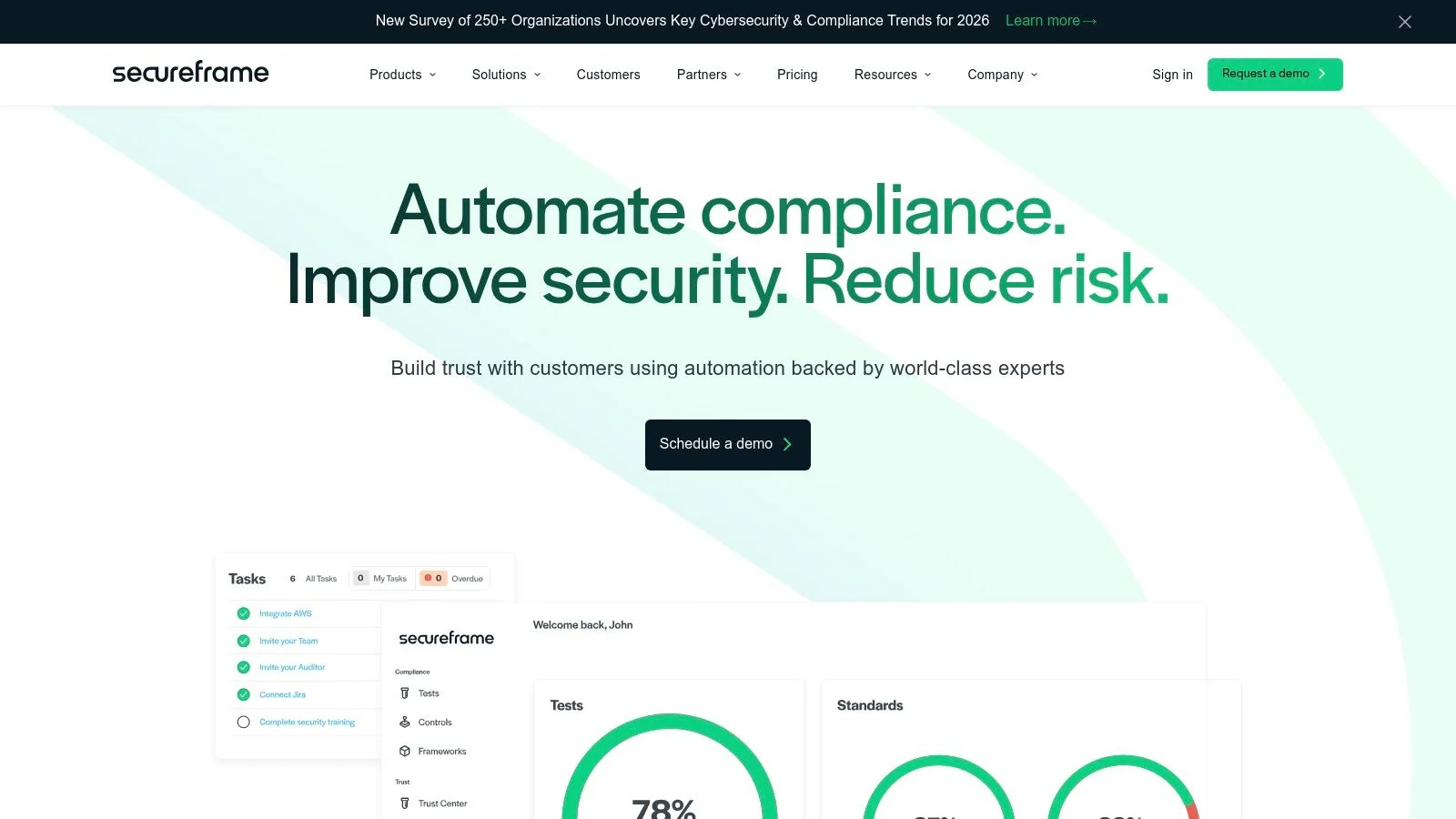
A notable aspect of Secureframe is its structured packaging, which caters to different stages of a company’s compliance maturity. It also offers a specialized add-on for federal compliance, assisting with System Security Plan (SSP) and Plan of Action & Milestones (POA&M) tracking for frameworks like FedRAMP. This makes it an appealing option not only for commercial businesses but also for those venturing into the public sector. The platform’s emphasis on expert guidance and a clear onboarding process helps demystify complex compliance requirements for teams without a dedicated GRC function.
Platform Highlights
- Best For: Companies wanting guided onboarding, and organizations that may need to pursue federal compliance frameworks in the future.
- Key Features: Continuous control monitoring, automated evidence collection, policy and risk management, built-in Trust Center, optional federal compliance module.
- Pricing: Quote-based, with Fundamentals, Complete, and Defense packages.
- Pros: Strong reputation for customer support and hands-on onboarding, clear package structure helps align features with needs.
- Cons: Public pricing is not available, and some integrations or advanced capabilities are gated behind higher-priced tiers.
Website: https://secureframe.com
Sprinto
Sprinto positions itself as a forward-thinking Drata alternative by deeply integrating AI into the compliance workflow. Designed for cloud-native companies, the platform crossed 3,000 customers in 2026 and ships 300+ integrations covering cloud providers, HR systems, and SaaS tools. Sprinto AI, its agentic automation layer introduced in 2025 and rebranded as the Autonomous Trust Platform in March 2026, goes beyond point automation to treat controls, evidence, and policies as a continuously self-healing system.
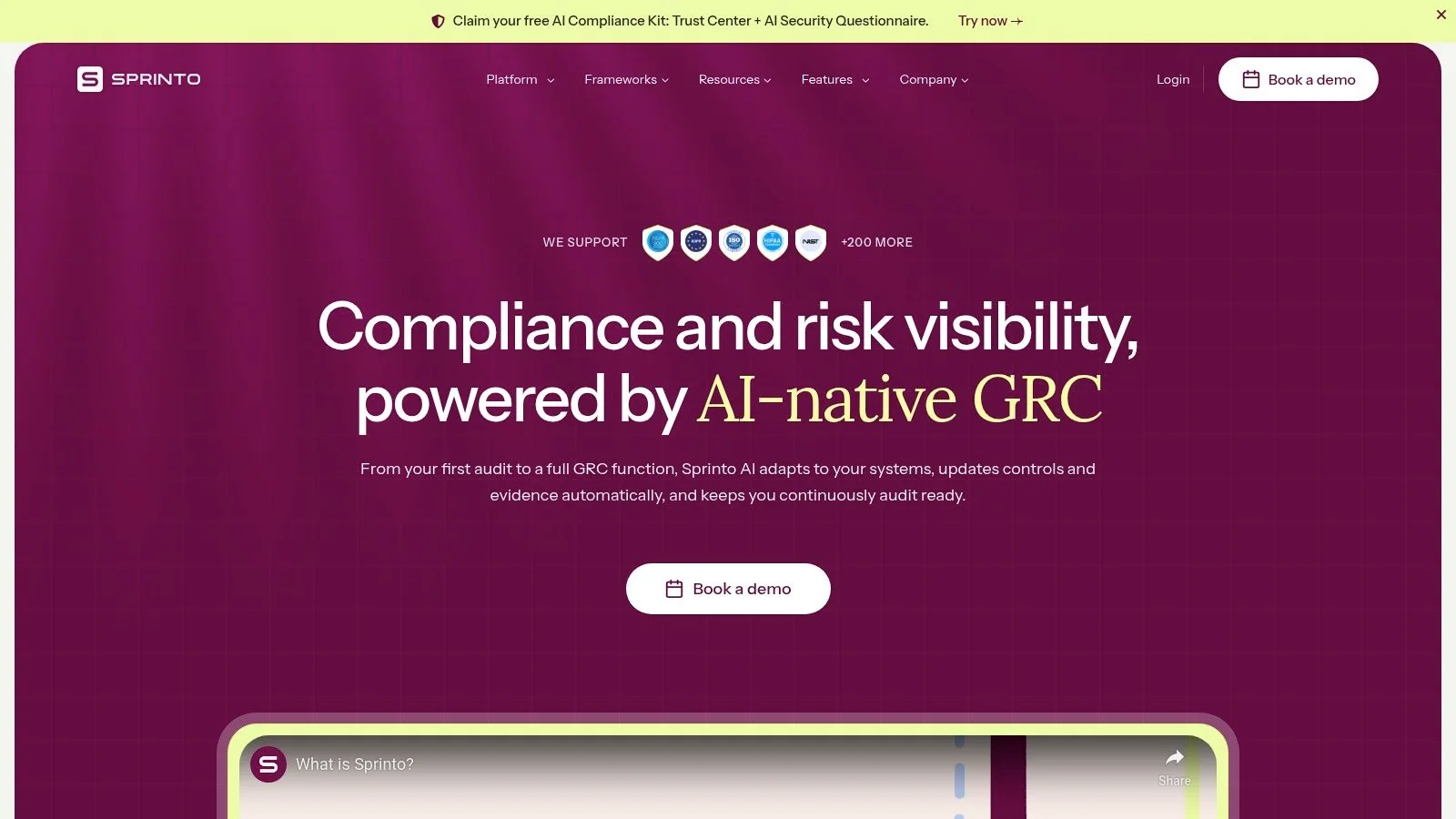
The autonomous compliance layer has four core capabilities. Autonomous control testing validates controls continuously without manual scheduling and surfaces drift as it happens. AI-assisted evidence collection identifies which artifacts map to which controls and packages them automatically. Intelligent gap analysis prioritizes the remediation backlog by risk severity rather than presenting an undifferentiated list of failing tests. Infinite Framework Mapping, released in November 2025, lets teams add new or custom frameworks in minutes by automatically detecting control overlaps and building cross-framework mappings without manual configuration. Sprinto reports 80%+ accuracy across AI-generated outputs and uses a human-in-the-loop design: evidence and policy drafts are prepared and surfaced by AI, but compliance judgment before audit submission remains a human responsibility.
The platform also includes vendor risk management, a Chrome extension for evidence capture from cloud consoles, and security questionnaire automation. Sprinto’s current directory record shows quote-only pricing and no public free trial, so evaluate the implementation support and included frameworks from a written proposal. Our complete Sprinto review covers the maintained details.
Platform Highlights
- Best For: Cloud-native startups and cost-conscious tech companies looking for the most price-competitive full-featured compliance automation, particularly those managing two or more frameworks simultaneously.
- Key Features: Autonomous Trust Platform / Sprinto AI (autonomous control testing, AI evidence collection, gap analysis), Infinite Framework Mapping, 300+ integrations, vendor risk management, multilingual questionnaire automation.
- Pricing: Quote-only. Request the included frameworks, implementation work, add-ons, term, discount, and renewal basis in writing.
- Pros: Bundled-expert onboarding, strong evidence and control-mapping automation, and broad multi-framework coverage.
- Cons: The AI Autonomous Platform is maturing and evidence outputs still require human review before audit submission. Pricing is not published and renewal increases can be significant. Best suited for cloud-first environments; teams with heavily on-premise or custom infrastructure may hit integration limits.
Website: https://sprinto.com
Thoropass (formerly Laika)
Thoropass, formerly known as Laika, combines compliance software with services from a related but legally separate CPA-firm entity. Thoropass, Inc. provides the software; Laika Compliance, LLC, doing business as Thoropass Assurance, issues the SOC 2 report on the bundled path. Buyers should evaluate the shared corporate umbrella, independence safeguards, and renewal structure against their procurement policy.
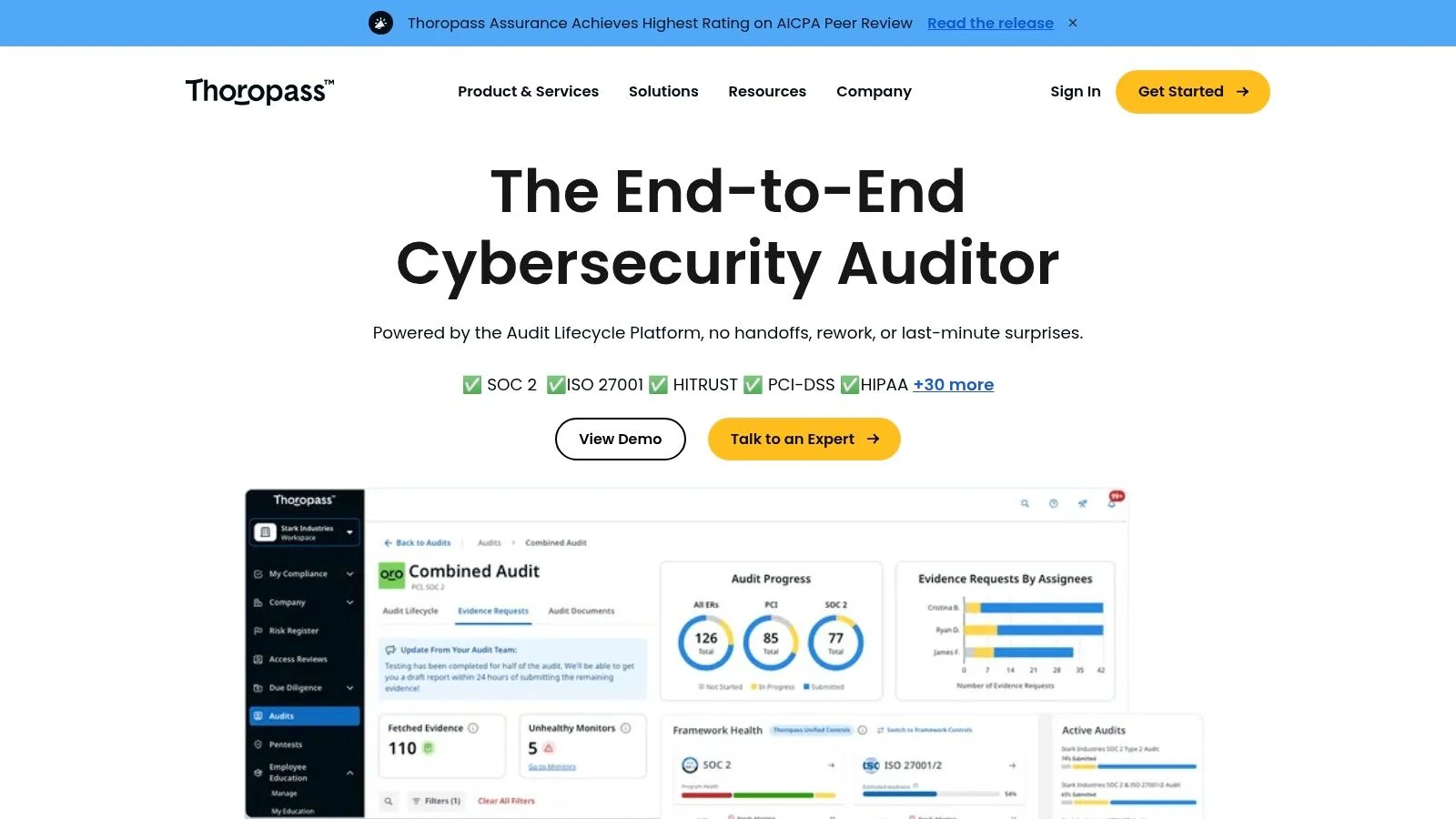
The differentiator is a connected software-and-examination workflow. Thoropass also describes an audit-first path for teams keeping another GRC platform. Compare the two purchase paths and keep platform, readiness, penetration testing, and examination fees explicit in the proposal. Our guide to SOC 2 audit cost provides the independent planning context.
For a deeper look at First Pass AI, real pricing across employee bands, and the Laika Compliance LLC audit-firm structure, see our full Thoropass review.
Platform Highlights
- Best For: Companies wanting a single vendor for both compliance software and audit services, especially those undertaking their first SOC 2 or ISO 27001.
- Key Features: Integrated audit and penetration testing, software-plus-services model, continuous controls monitoring, vendor risk management.
- Pricing: Quote-based via a consultative sales process. The bundled nature can offer cost predictability but may be a larger initial investment.
- Pros: Streamlined audit process with an integrated auditor, hands-on guidance is ideal for first-timers, single point of contact for software and audit.
- Cons: The platform’s breadth may be more than what very small startups require, and on the bundled contract the software and audit renewals move together. Companies that want to keep their current platform can engage Thoropass Assurance, the separate CPA entity, as the audit firm on its own.
Website: https://thoropass.com
Hyperproof
Hyperproof positions itself as a more comprehensive GRC platform, making it a strong Drata alternative for organizations maturing beyond single-framework compliance into integrated risk management. It excels at managing multiple overlapping security frameworks by using a “common control set,” allowing teams to map one piece of evidence to satisfy requirements across standards like SOC 2, ISO 27001, and NIST. This “test once, comply with many” approach is highly efficient for scaling companies.
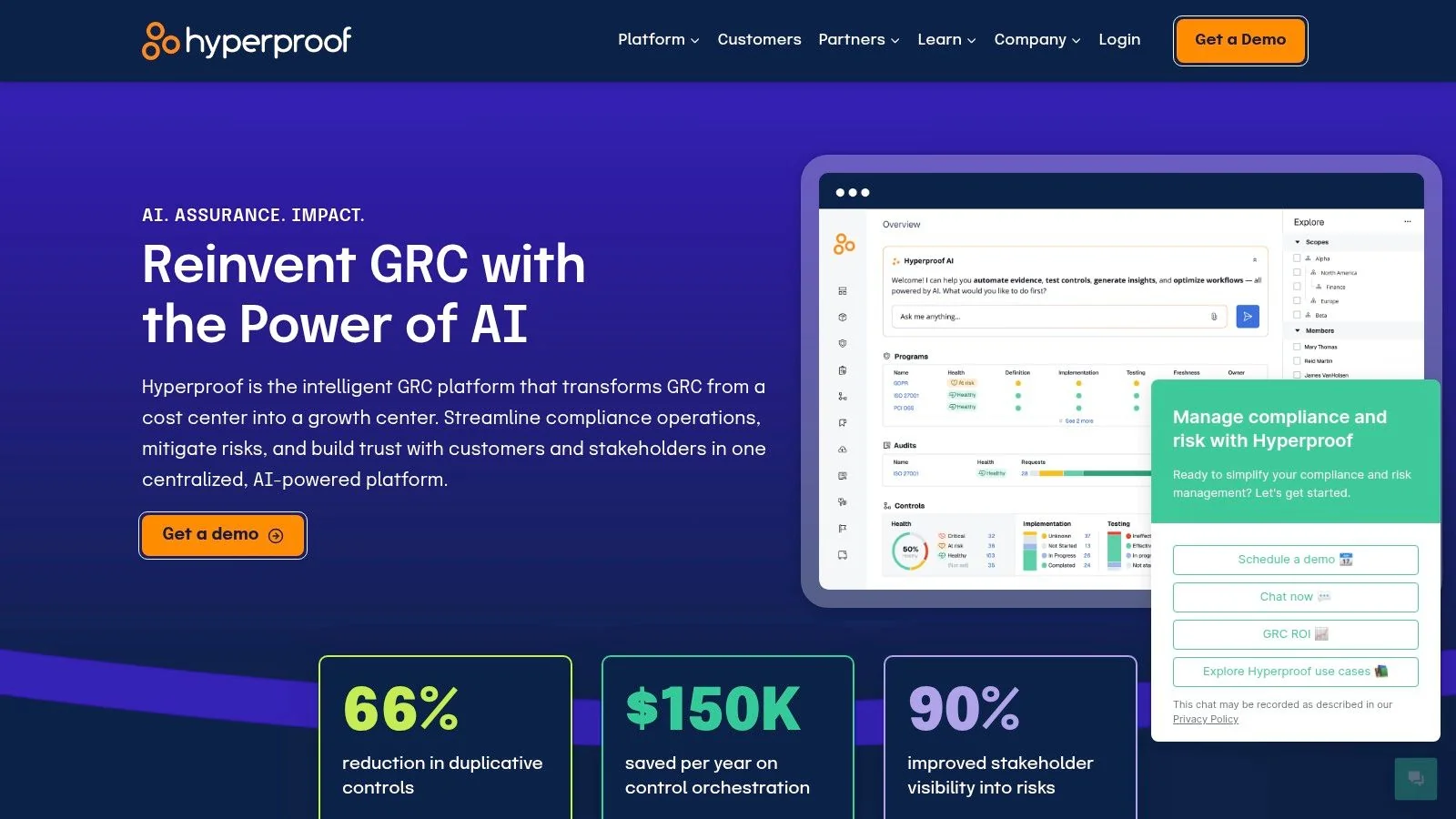
The platform is distinctly structured into modules like “Comply” for compliance operations and “Mitigate” for risk management, which can be adopted incrementally. This modular design, combined with its automated evidence collection and orchestration, provides a clear pathway from achieving an initial audit to establishing a sophisticated, ongoing GRC program. Hyperproof is particularly well-suited for companies that foresee a future where compliance and risk management must be deeply intertwined, rather than managed in separate silos. Its ability to scale with complexity makes it a strategic choice for businesses with long-term governance goals.
Platform Highlights
- Best For: Mid-market and enterprise companies managing multiple compliance frameworks or looking to integrate risk management with their compliance efforts.
- Key Features: Common control mapping for multi-framework efficiency, dedicated risk management module (“Mitigate”), automated evidence orchestration, and plan-dependent unlimited-user licensing models.
- Pricing: Quote-based and tailored to specific needs. Pricing is not public, and potential customers should anticipate setup or implementation fees as part of the total cost.
- Pros: Excellent for managing numerous overlapping frameworks, provides a strong, integrated approach to both risk and compliance, and offers a scalable path for growing GRC programs.
- Cons: The platform’s complexity and pricing model may be excessive for an early-stage startup pursuing only one report, and it requires a custom quote and implementation process.
Website: https://hyperproof.io
AuditBoard
AuditBoard emerges as a powerful Drata alternative for large, complex organizations that need a unified platform for audit, risk, and compliance management. Originating with a strong focus on internal audit and Sarbanes-Oxley (SOX) compliance, its platform is engineered for enterprise-grade GRC workflows. This makes it a compelling choice for public companies or enterprises managing multiple, intersecting compliance frameworks far beyond just SOC 2 or ISO 27001.
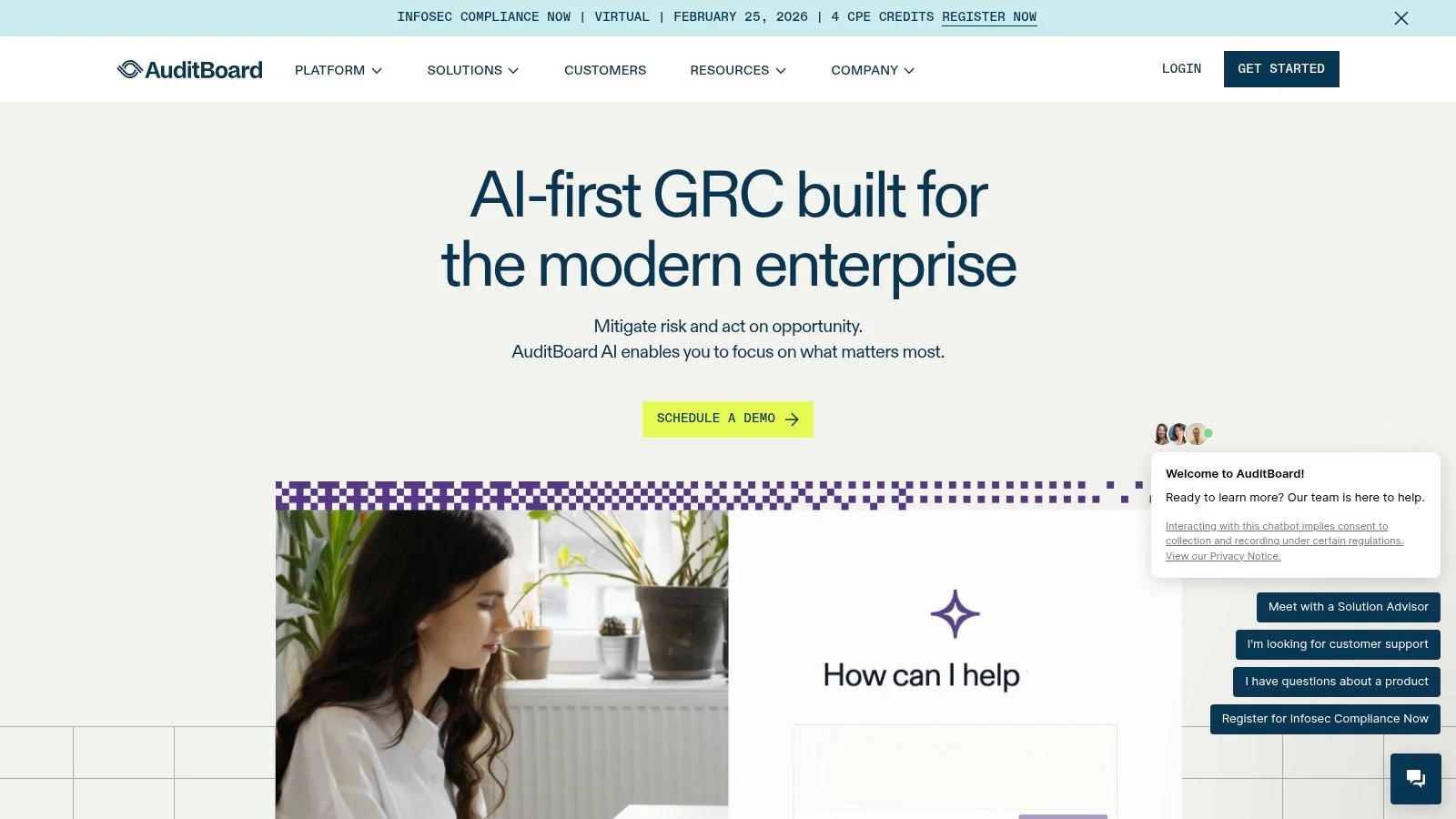
The platform’s core strength lies in its unified data model, which connects work across audit, risk, infosec, and ESG teams, eliminating silos. AuditBoard leverages AI to accelerate reporting, identify risks, and generate insights from compliance data. A significant differentiator is its unlimited stakeholder licensing model, which encourages widespread collaboration without incurring additional seat-based costs. This is ideal for organizations where compliance involves numerous departments and cross-functional input is essential for maintaining a strong internal control environment.
Platform Highlights
- Best For: Large enterprises, public companies, and organizations requiring a unified GRC platform beyond just InfoSec compliance.
- Key Features: Unified data core for audit, risk, and compliance, AI for report generation and insights, robust analytics, and unlimited stakeholder licenses for collaboration.
- Pricing: Quote-based enterprise pricing. It is a significant investment positioned for the upper mid-market and enterprise segments.
- Pros: Deep capabilities for managing complex, multi-framework programs at scale; exceptional collaboration features for large teams.
- Cons: Overly complex and expensive for most startups and SMBs; its primary focus is broader than pure-play security compliance automation.
Website: https://www.auditboard.com
Scrut Automation (Scrut)
Scrut Automation positions itself as a risk-first GRC platform, making it a compelling Drata alternative for companies that prioritize continuous risk visibility alongside compliance. It excels at serving cloud-native firms by deeply integrating with their tech stack to automate evidence collection and monitor controls across multiple frameworks, from SOC 2 and ISO 27001 to GDPR and HIPAA. The platform’s approach is to embed security and compliance directly into the cloud development lifecycle.
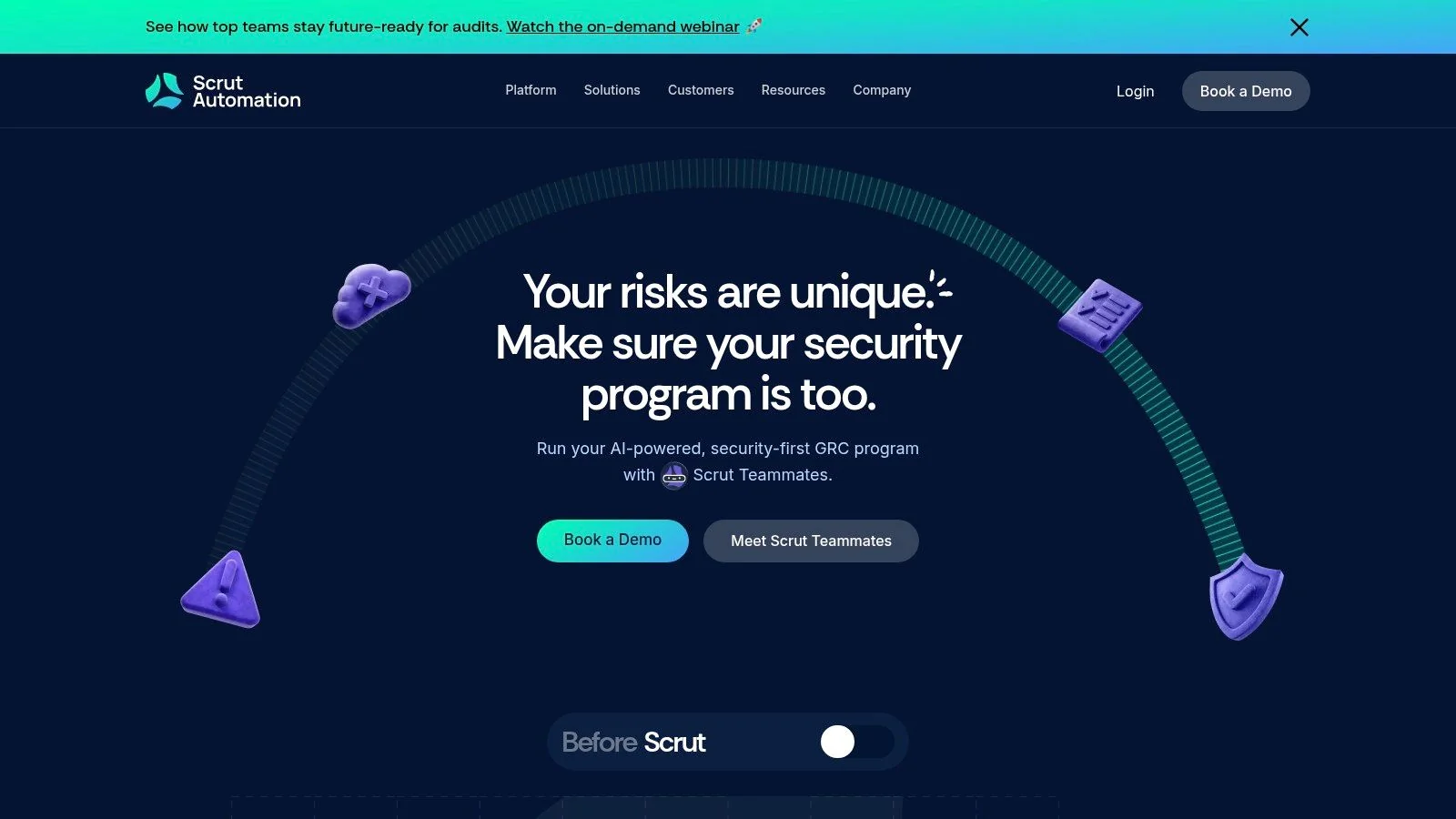
A key differentiator for Scrut is its suite of AI-powered “Scrut Teammates,” designed to assist with specific compliance and risk management tasks. These AI assistants help streamline workflows, analyze evidence, and provide insights, reducing the manual burden on internal teams. This focus on tying cloud security posture management directly to GRC automation makes Scrut particularly valuable for organizations where the line between infrastructure security and compliance auditing is blurred. The platform is built to provide a single source of truth for both risk and compliance activities.
Platform Highlights
- Best For: Cloud-native companies that need strong cloud risk visibility integrated with their compliance automation workflows.
- Key Features: AI “Scrut Teammates” for task automation, automated evidence collection, continuous risk tracking, multi-framework support.
- Pricing: Quote-based. The platform is marketed to a wide range of company sizes, from startups to enterprises, so packaging and pricing will vary.
- Pros: Strong user satisfaction and high ratings for ease of use, excellent for tying cloud posture management directly to compliance needs.
- Cons: Non-public pricing requires a sales call, and it delivers the most immediate value for organizations heavily invested in a cloud-centric tech stack.
Website: https://www.scrut.io
TrustCloud (formerly Kintent)
TrustCloud, formerly Kintent, combines compliance operations with TrustShare, its trust-center and questionnaire workflow. It is most relevant when sales assurance and inbound security reviews matter alongside SOC 2 readiness.
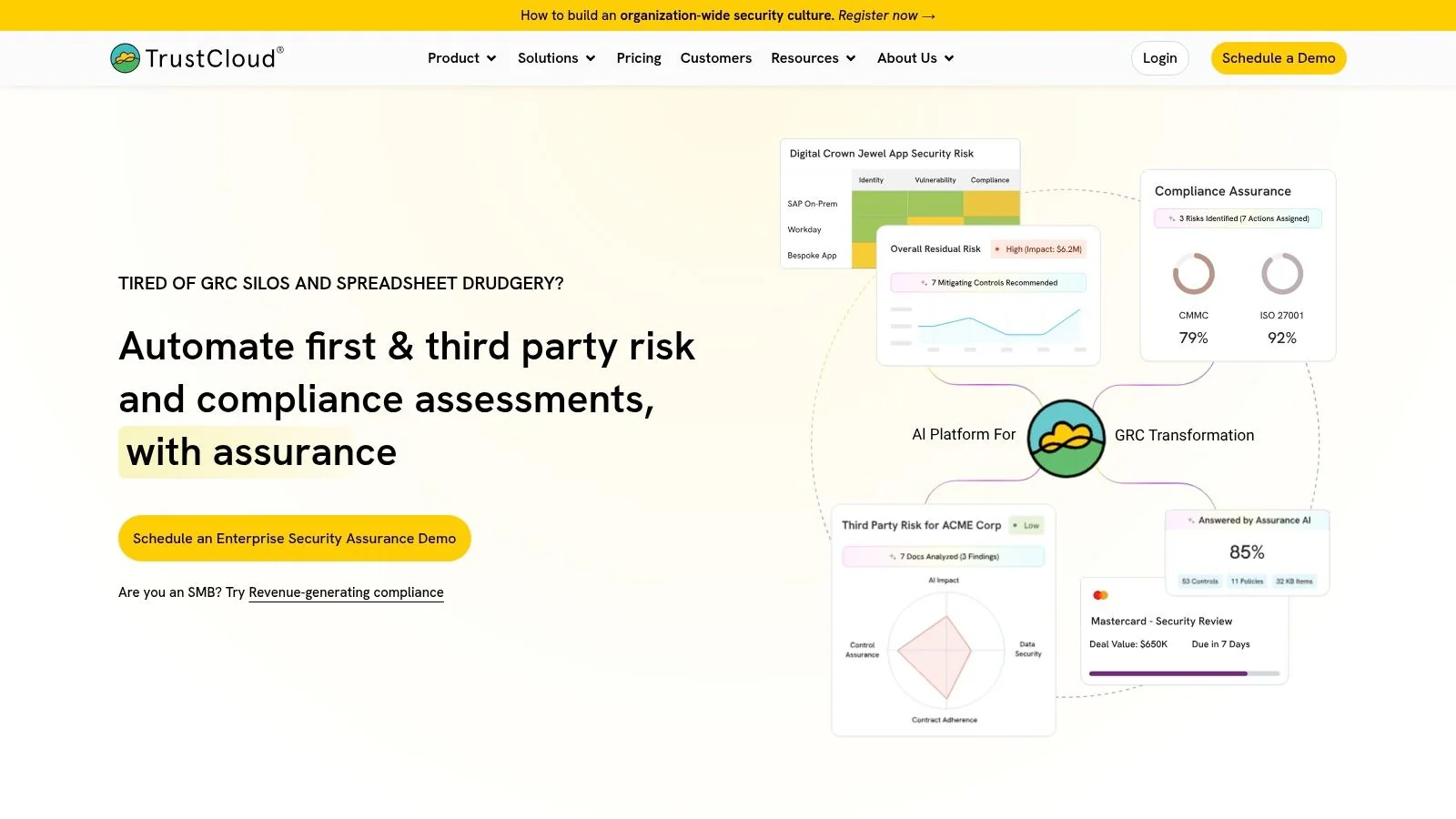
A key differentiator is TrustShare’s portal and AI-assisted questionnaire tooling. The current pricing page is quote-only; our directory found no current public trial or free tier. Ask which TrustOps and TrustShare functions are included, how auditor access works, and how the renewal basis is calculated.
Platform Highlights
- Best For: Companies with heavy security-questionnaire and trust-center workflows alongside compliance operations.
- Key Features: Modular platform (Compliance, Risk, Trust), TrustShare portal for sales, AI-assisted questionnaire responses, common control cross-mapping.
- Pricing: Quote-only; no current public trial or free tier confirmed.
- Pros: Strong focus on customer assurance and questionnaire automation.
- Cons: Heavier enterprise capabilities require custom quotes, and paid tiers may involve annual billing commitments with variable pricing.
Website: https://www.trustcloud.ai
Strike Graph
Strike Graph is the clearest Drata alternative when published paid-plan pricing is the deciding factor. Its live pricing table lists paid software tiers and separate framework and service add-ons. A limited lead-form entry option exists, but it is not a standing free tier in the paid-plan comparison.
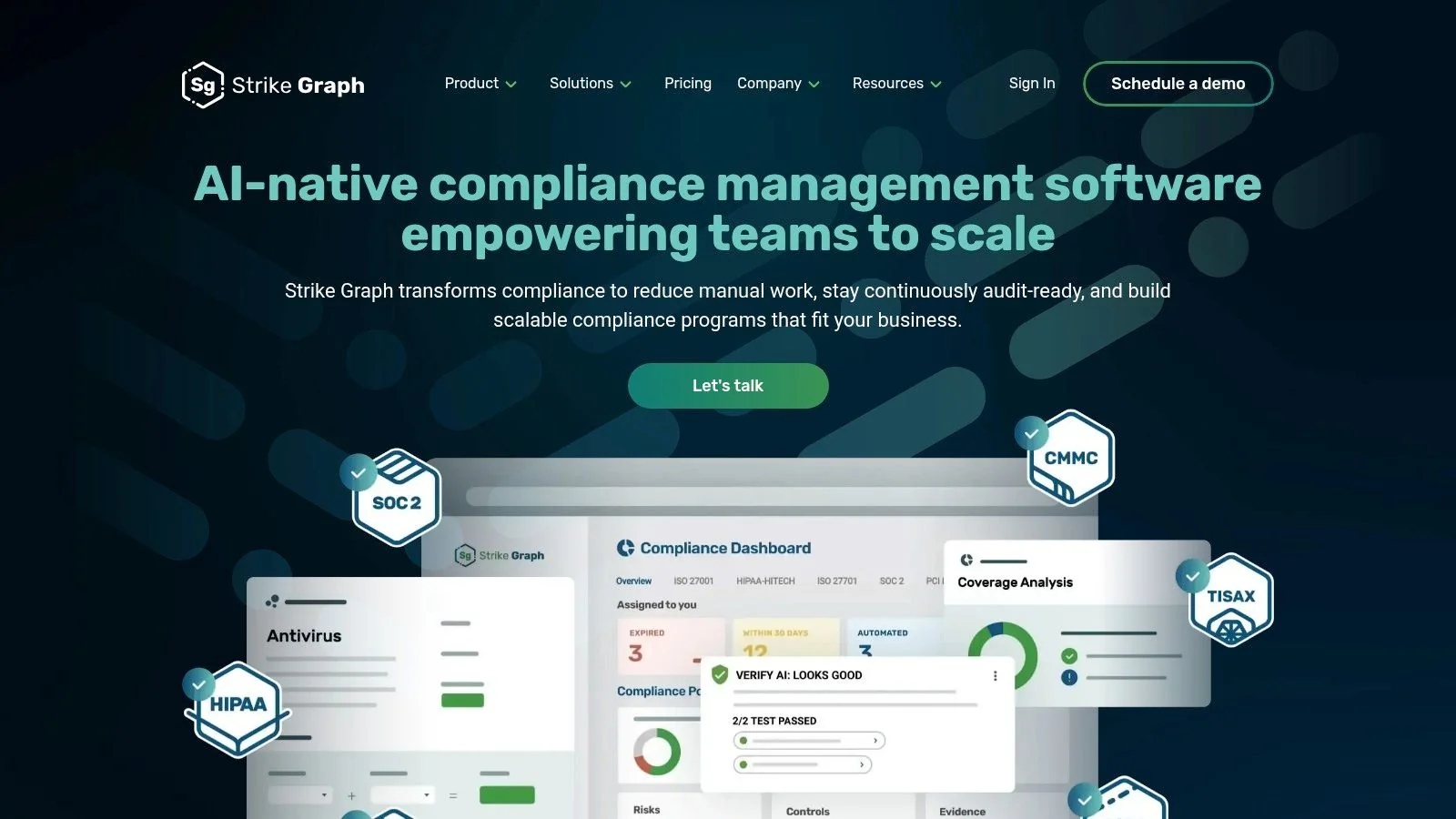
A key differentiator for Strike Graph is its business model, which includes unlimited user seats on all paid plans. This approach is particularly beneficial for growing organizations where multiple stakeholders from engineering, sales, and management need access without incurring additional per-user fees. While core frameworks like SOC 2 and ISO 27001 are included in standard plans, the platform’s a-la-carte model for other frameworks and advanced features like SBOM monitoring allows companies to build a compliance package that precisely fits their needs and budget, avoiding payment for unused capabilities.
Platform Highlights
- Best For: Startups and SMBs seeking transparent, predictable pricing and the option to bundle compliance automation with audit services from a single vendor.
- Key Features: AI-powered evidence collection, questionnaire tooling, SBOM monitoring, cross-mapping between frameworks, optional integrated audits and pen tests.
- Pricing: Published paid plans, with separately priced framework, audit-partner, and testing add-ons.
- Pros: Transparent pricing model eliminates guesswork, unlimited users on paid plans offer great value for growing teams, and bundling audits can streamline vendor management.
- Cons: The a-la-carte model can increase the total cost significantly as more frameworks or integrations are added, and the integration library is less extensive than some mature competitors.
Website: https://www.strikegraph.com
Scytale
Scytale positions itself as a strong Drata alternative by combining a powerful AI-driven automation platform with dedicated human expertise. This hybrid approach is designed to accelerate compliance for frameworks like SOC 2, ISO 27001, and HIPAA. The platform offers 24/7 continuous control monitoring and real-time alerts, ensuring that security and compliance gaps are identified and addressed immediately, preventing last-minute audit surprises.
A key differentiator for Scytale is its integrated, expert-led services, including advisory and penetration testing. This can fit companies that prefer a guided experience rather than a purely self-service tool. Its questionnaire automation and customizable Trust Center also support customer-assurance work. Confirm which entity performs any examination and which services are included in the software quote.
Platform Highlights
- Best For: Companies that want a blend of high-tech automation and dedicated expert guidance, especially those needing integrated pen-testing.
- Key Features: Continuous control monitoring, AI security questionnaire automation, integrated pen-testing and advisory services, supports over 40 frameworks.
- Pricing: Quote-based. Pricing is not publicly available and requires a demo to determine the cost based on specific needs.
- Pros: The software-plus-service model provides comprehensive support, leading to a faster time-to-readiness for audits.
- Cons: Not ideal for teams seeking a purely self-service, software-only solution; the requirement for significant expert involvement might not suit all budgets or workflows.
Website: https://scytale.ai
OneTrust (Compliance Automation)
OneTrust is a major player in the broader GRC (Governance, Risk, and Compliance) space, making it a powerful Drata alternative for large enterprises looking to consolidate multiple functions. Its Compliance Automation product is just one module within a vast ecosystem that also covers privacy, ethics, and ESG. This platform lets you map evidence once and reuse it across more than 50 frameworks, a significant advantage for global companies managing numerous regulations.
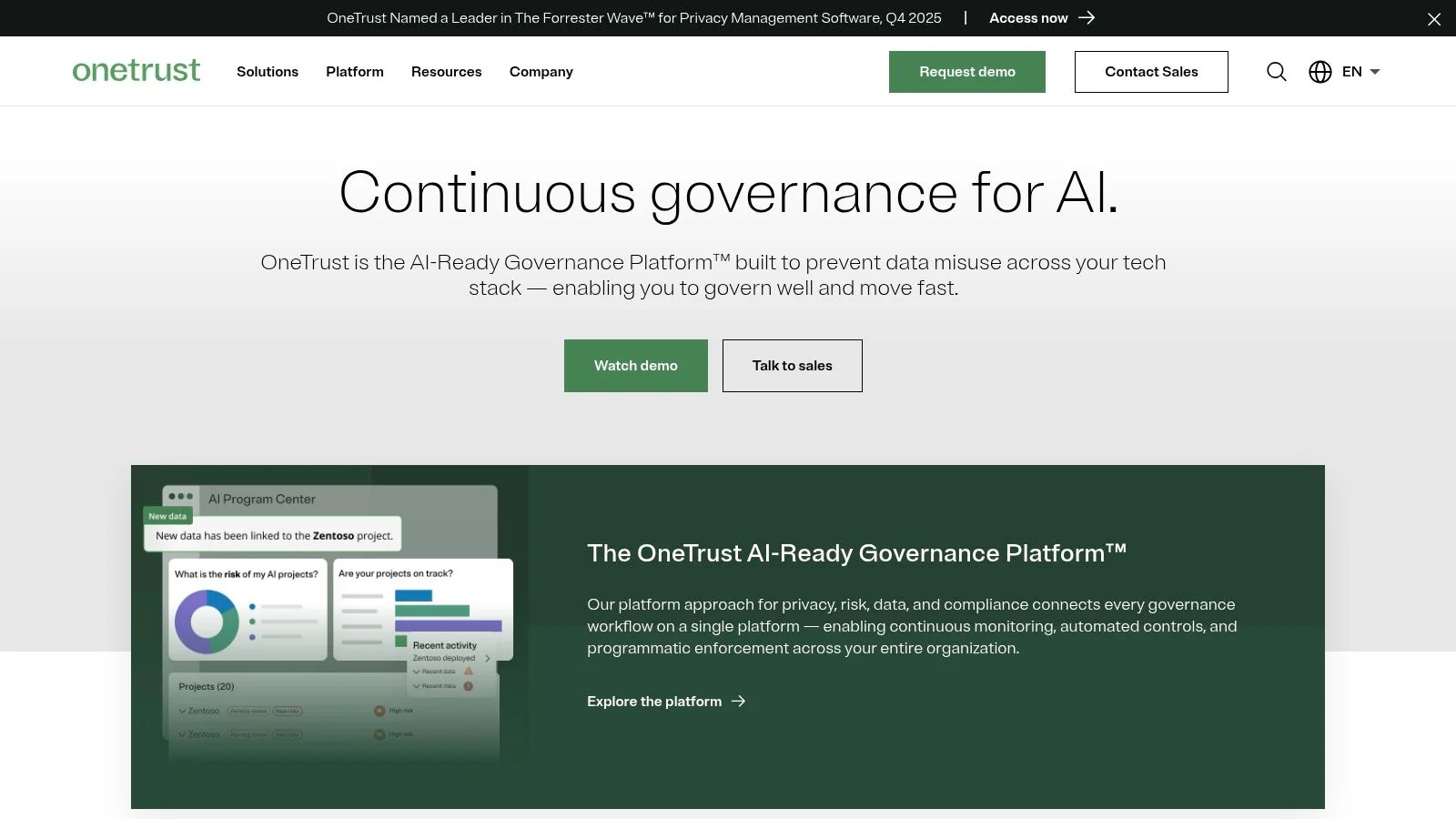
The key differentiator for OneTrust is its enterprise scale and integrated approach. While startups may find it overly complex, a multinational corporation can manage SOC 2 alongside GDPR, CCPA, and internal risk assessments all within a single, interconnected platform. This unified view simplifies governance by linking security controls directly to privacy policies and risk registers, providing a holistic perspective that standalone compliance tools often lack. It is best suited for organizations that have outgrown point solutions and need a centralized command center for all GRC activities.
Platform Highlights
- Best For: Large enterprises and global organizations needing to consolidate security, privacy, and risk management into a single platform.
- Key Features: Pre-mapped controls across 50+ frameworks, automated evidence collectors, dynamic reporting, and deep integration with other OneTrust governance modules.
- Pricing: Quote-based and customized for the enterprise. Pricing is not publicly available and requires engagement with their sales team.
- Pros: Highly scalable platform that grows beyond just security compliance, and ideal for consolidating GRC tools and centralizing evidence.
- Cons: The enterprise-focused sales process and substantial configuration needs can be overwhelming for smaller teams, making it less agile than startup-focused tools.
Website: https://www.onetrust.com
Comp AI
Comp AI fits engineering-led teams that want to inspect the evidence-collection code or self-host the platform. Its repository distinguishes the AGPLv3 core from the commercially licensed Enterprise Edition directory. The hosted service is quote-only; a self-hosted deployment still needs infrastructure, backups, monitoring, and upgrades.
The Comp AI vendor record records 590 repository-catalog entries as of August 11, 2026; the homepage advertises a rounded 580+. Catalog membership does not establish the evidence checks available for each system. Comp AI lists SOC 2, ISO 27001, HIPAA, and GDPR support; ask it to demonstrate the controls and integrations needed for your scope.
The open-source SOC 2 software comparison puts Comp AI beside CISO Assistant and SimpleRisk when the requirement is code access or self-hosting.
Comp AI advertises one-to-one Slack guidance from compliance experts. Your team still implements the controls. Its documented auditor role, evidence exports, and findings workflow support audit handoff, but Comp AI does not issue the SOC 2 report. Confirm the independent CPA firm, its access to evidence, and the audit fee in the quote.
Platform Highlights
- Best For: Engineering-led teams that value an open-source core or self-hosting and can evaluate the operating tradeoffs.
- Key Features: Open-source core (AGPLv3), self-host or hosted options, SOC 2 / ISO 27001 / HIPAA / GDPR coverage, large integration library, automated evidence collection and policy management.
- Pricing: Hosted service is quote-only; the open-source core can be self-hosted, with infrastructure and operating labor borne by the buyer. See the Comp AI pricing guide for contract terms and the managed-versus-self-hosted checklist.
- Pros: Inspectable core, documented self-hosting, and expert guidance for implementation.
- Cons: No public hosted rate card; Enterprise Edition features require a commercial licence. Our directory does not establish SCIM provisioning, and self-hosting leaves operations with your team.
Website: https://www.trycomp.ai
Drata alternatives — 12-tool comparison
| Platform | Core features | Best for | Speed & support | Pricing | Unique selling point |
|---|---|---|---|---|---|
| Vanta | 400+ integrations; continuous controls; AI questionnaire; Trust Center; Auditor API | Mature startups & mid-market | Fast onboarding; strong questionnaire enablement | Quote-based (can be heavy for very early-stage) | Broad ecosystem + built-in customer Trust Center |
| Secureframe | Continuous monitoring; automated evidence; policy and risk tools; Trust Center | Teams wanting guided onboarding | Guided support | Fundamentals/Complete/Defense; quote-only | Guided support plus defense-oriented frameworks |
| Sprinto | AI-assisted evidence, questionnaire automation, vendor-risk workflows | Cloud-native startups wanting implementation help | Bundled-expert onboarding | Quote-only | Guided implementation plus broad framework mapping |
| Thoropass (Laika) | Continuous monitoring; auditor connections; software + services | Teams seeking hands-on advisory (first-time audits) | Integrated auditor experience reduces back‑and‑forth | Sales/consultative pricing | Software + expert advisory with integrated audit workflow |
| Hyperproof | Common control set; automated evidence orchestration; risk modules | Scaling orgs managing many frameworks | Mature risk–compliance alignment; may require implementation | Custom quotes (no public pricing) | Strong multi-framework mapping and risk integration |
| AuditBoard | Unified audit-risk-compliance core; AI reporting; analytics | Large enterprises (SOX, multi-framework) | Deep collaboration at scale; enterprise support | Enterprise pricing via sales | Enterprise-grade audit & SOX roots with AI insights |
| Scrut Automation | Continuous control monitoring; AI teammates; cloud posture visibility | Cloud-native companies | High satisfaction; fast value for cloud stacks | Not public | Cloud-first risk visibility + AI teammates |
| TrustCloud (Kintent) | TrustShare portal; AI questionnaire automation; cross-mapping | Teams with heavy customer-assurance work | Self-serve product motion | Quote-only; no current free tier confirmed | Trust center plus questionnaire workflow |
| Strike Graph | SOC 2/ISO/HIPAA plans; questionnaire tooling; SBOM and evidence API | Teams wanting published costs and self-service | Published paid plans; limited lead-form option | Published paid pricing; add-ons separate | Visible starting prices plus optional services |
| Scytale | Continuous monitoring; AI questionnaire; integrated pen-testing | Teams wanting software + expert pen-test/advisory | Fast time-to-readiness with hands-on support | Demo/quote required (no public pricing) | Integrated pen-testing + advisor-backed automation |
| OneTrust (Compliance Automation) | Pre-mapped frameworks; automated collectors; shared evidence model | Large enterprises consolidating governance | Enterprise onboarding; substantial configuration | Enterprise quotes (no public pricing) | Evidence reuse across 50+ frameworks, spanning privacy & security |
| Comp AI | Open-source core; self-host or hosted; SOC 2/ISO/HIPAA/GDPR; large advertised integration library | Engineering-led teams evaluating open source | Guided hosted service; self-hosting shifts operations to buyer | Hosted service quote-only | Open-source core and self-hosting option |
When Drata Is Still the Right Pick
Keep Drata if evidence collection works, your auditor can use its outputs, and no alternative solves a specific gap worth the migration cost. Our guide to running Drata for a SOC 2 program covers that workflow.
Making Your Choice: Automation Platform + The Right Auditor
Compare written quotes for the same systems, frameworks, implementation work, add-ons, contract term, and renewal terms. Include internal staff time and the CPA examination in the budget.
Choosing compliance software addresses evidence and control operations, not report issuance. A licensed CPA firm must perform the examination and issue the SOC 2 report. For bundled models, confirm the legal identity of the software vendor and issuing CPA firm and evaluate the documented independence safeguards.
Compare firms by industry experience, platform workflow, and price in the SOC 2 auditor directory.
Frequently Asked Questions
What is the best Drata alternative?
There is no universal winner. Vanta is a close mainstream-SaaS comparison, Sprinto emphasizes bundled implementation help, Strike Graph publishes paid pricing, Comp AI offers an open-source core, Thoropass connects software and an affiliated CPA-firm path, and Hyperproof, AuditBoard, and OneTrust address broader GRC needs. See our Vanta vs Drata, Drata vs Secureframe, and Drata vs Sprinto comparisons.
Is there a free or open-source Drata alternative?
Comp AI has an AGPLv3 open-source core that can be self-hosted, but its current hosted service is quote-only. TrustCloud has no current free tier confirmed in our directory. Strike Graph exposes a limited lead-form option, but its maintained product table begins with paid plans. Treat infrastructure and staff time as costs when evaluating self-hosting.
How much does Drata cost compared to alternatives?
Drata and most alternatives are quote-only, so compare the same headcount, framework set, onboarding scope, add-ons, contract term, and renewal basis. Strike Graph publishes paid-plan starting prices; Comp AI’s hosted service is now quote-only. See the Drata pricing guide and Drata review for the maintained details.
Do I still need an auditor if I use a Drata alternative?
Yes. No compliance platform can issue a SOC 2 report. The software collects evidence and monitors controls, but an independent, licensed CPA firm performs the actual audit and issues the report. Choose your software and your auditor separately so you can pair the best tool with the best audit partner.
Which Drata alternative is best for startups?
Startups should shortlist by required integrations, internal capacity, and the full written quote. Sprinto is relevant when bundled implementation help matters, Comp AI when self-hosting is acceptable, Strike Graph when published paid pricing matters, and Vanta when its broader mainstream integration coverage fits. See the best SOC 2 software for startups for more.
Don’t leave your auditor selection to chance. SOC2Auditors provides a free, unbiased platform to compare verified CPA firms, giving you access to real pricing data and timelines. Find the perfect audit partner to complement your chosen automation tool at SOC2Auditors.
Comparing SOC 2 software? See our side-by-side breakdown of all 12 compliance platforms — pricing, best-for, and what each one gets wrong.