 Menu
Menu
SOC 2 audit duration (2026): A SOC 2 Type 1 audit takes 3-8 months end-to-end. A SOC 2 Type 2 audit takes 6-20 months — specialist CPA firms finish in 6-10 months, Big Four in 12-20 months. The minimum observation period for Type 2 is 3 months; typical first-time audits use a 6-month window. Compliance automation platforms cut prep time by 70-82% but can’t shorten the observation period.
Let’s get straight to the point. A SOC 2 audit can take anywhere from a few weeks to over a year. The biggest variable is whether you need a quick Type 1 report (a few weeks to a couple of months) or the more rigorous Type 2 report (realistically, 6-15 months).
If you’re weighing which report you actually need before committing to a timeline, read SOC 2 Type 1 vs. Type 2 first — the decision changes your timeline by 6-12 months.
Your SOC 2 Audit Timeline From Start to Finish
Understanding the real-world timeline for a SOC 2 audit is critical. It dictates your resource planning, helps you manage expectations with your board and leadership, and directly impacts sales cycles. The total time isn’t just the audit itself—it’s a multi-stage journey that begins long before an auditor ever sees your first piece of evidence.
How fast you move depends almost entirely on your current security maturity, the complexity of your systems, and which report type you’re chasing.
Think of it as the difference between a quick snapshot and a feature-length film. A Type 1 audit is that snapshot—it captures your controls at a single moment, offering a faster path to a report. In contrast, a Type 2 audit is the film, observing your controls in action over an extended period (usually three to twelve months). This provides deeper assurance but requires a much longer commitment.
A High-Level View of the Process
To set clear expectations, you need to break the entire process into distinct phases. Each stage has its own timeline, and a delay in one can easily cascade into the next.
The main components of the journey include:
- Readiness Assessment: Finding the gaps in your controls and building a roadmap to fix them.
- Remediation: The heavy lifting of actually fixing the gaps you discovered.
- Observation Period (Type 2 only): The mandatory waiting period to prove your controls are working consistently over time.
- Audit Fieldwork & Reporting: The formal evidence review and final report generation by your chosen CPA firm.
This infographic gives you a quick visual breakdown of the typical duration for both Type 1 and Type 2 audits, highlighting that major time difference.
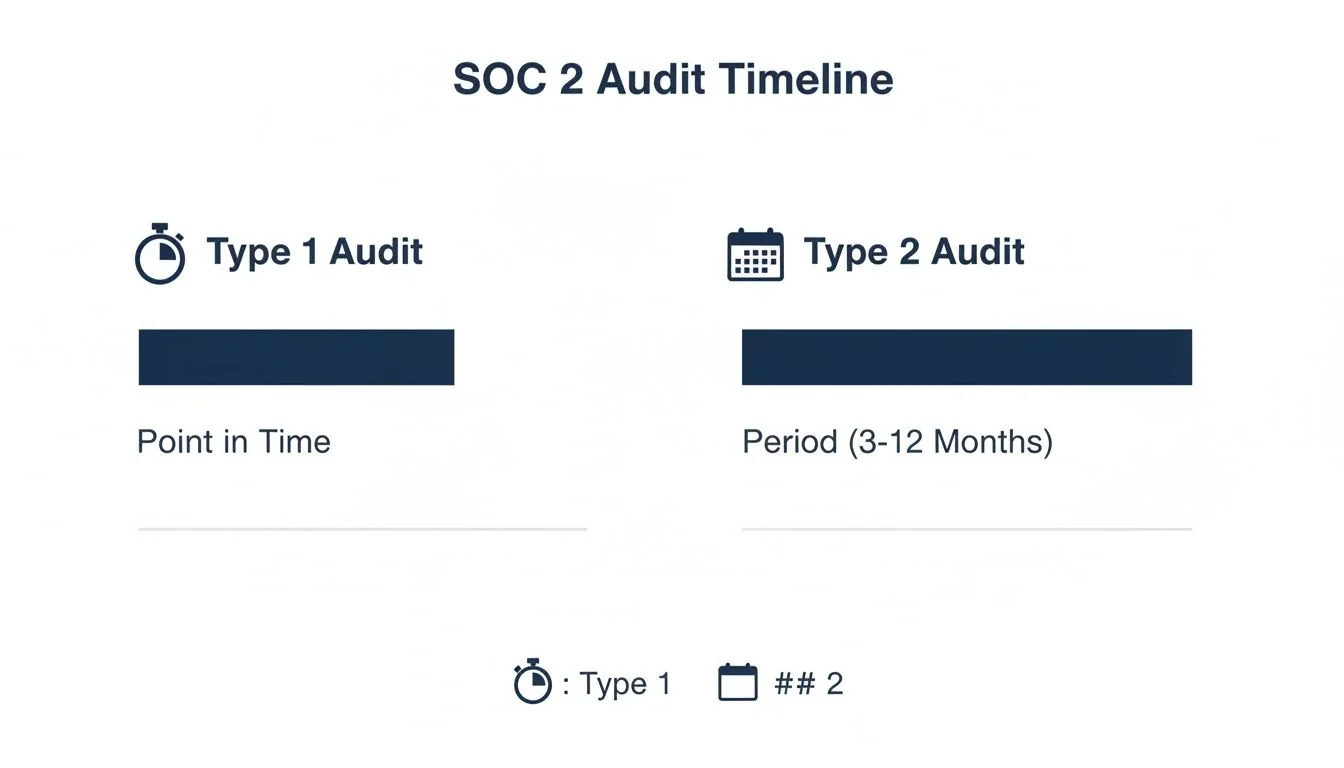
As you can see, the observation period is the key differentiator, making the Type 2 process inherently longer. For a complete walkthrough of what happens in each of these phases, you can explore our detailed guide on the SOC 2 certification process.
Now, let’s zoom in and look at the timelines for each stage.
Typical SOC 2 Audit Timelines at a Glance
To give you a clearer picture, we’ve broken down the estimated time commitment for each phase of both a Type 1 and Type 2 audit. Remember, these are benchmarks—your actual timeline could be shorter or longer depending on your starting point and resources.
| Audit Phase | SOC 2 Type 1 (Typical Duration) | SOC 2 Type 2 (Typical Duration) |
|---|---|---|
| Phase 1: Readiness & Remediation | 1 - 3 months | 2 - 4 months |
| Phase 2: Observation Period | N/A | 3 - 12 months |
| Phase 3: Audit Fieldwork | 2 - 4 weeks | 3 - 6 weeks |
| Phase 4: Reporting | 2 - 3 weeks | 3 - 5 weeks |
| Total Estimated Timeline | 2 - 4 months | 6 - 15+ months |
The table makes it obvious: the observation period for a Type 2 report is the single biggest factor in the overall timeline. But don’t overlook the other phases; delays in readiness or slow responses during fieldwork can easily add weeks or months to your project.
Deconstructing the SOC 2 Timeline Stage by Stage
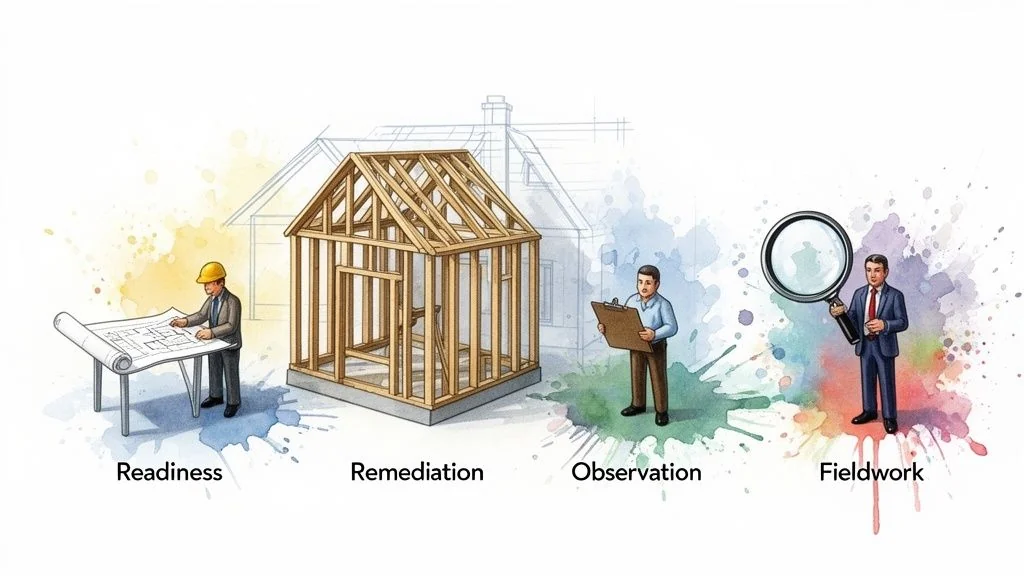
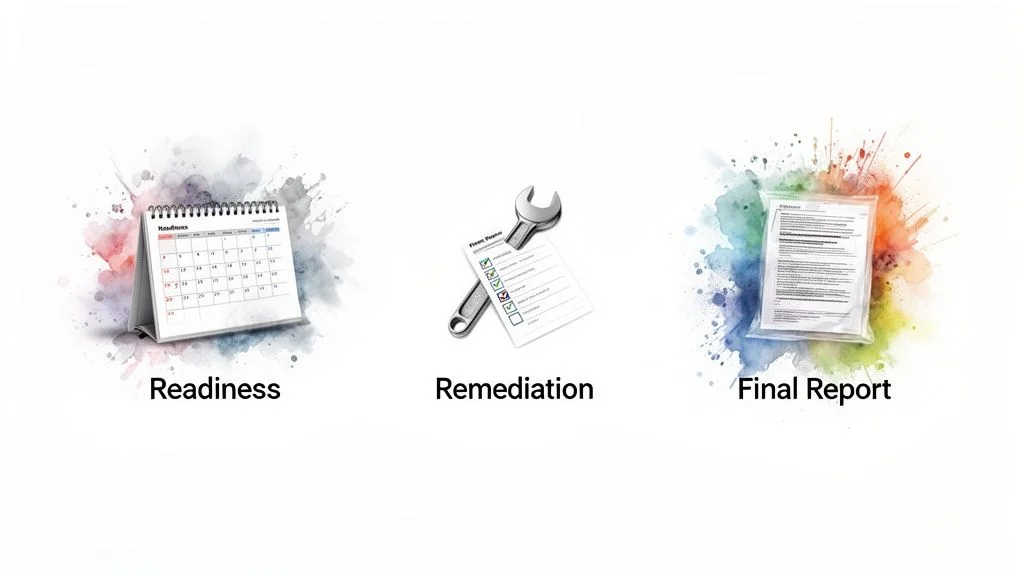 Thinking of your SOC 2 audit as a single event is one of the most common mistakes we see. A better way to picture it is like building a house. It’s a project with distinct phases—pouring the foundation, framing the walls, and doing the final walkthrough. Each stage builds on the last.
When you understand these stages, the timeline starts to make a lot more sense. You can see exactly where the time goes and plan your resources accordingly. Let’s walk through each phase of the journey, step by step.
Stage 1: Readiness Assessment and Scoping
This is the blueprint phase. Before you ever lay a foundation, you need an architect to draw up the plans. A readiness assessment is exactly that—you, alongside an auditor or consultant, map out your current security posture against the SOC 2 criteria you’ve chosen.
The whole point is to answer one critical question: “Where are our gaps?”
This process typically takes two to six weeks. Your auditor will poke and prod, identifying missing controls, outdated policies, or sloppy procedures. The result is a detailed gap analysis, which is basically a punch list of everything you need to fix before the real audit begins. Trying to skip or rush this stage is like building without a blueprint; you’re just asking for expensive rework down the road.
Stage 2: Remediation
Welcome to the construction phase. With your gap analysis in hand, your team rolls up its sleeves and gets to work. This means implementing new controls, writing policies from scratch, and reconfiguring systems to meet the SOC 2 standards.
Remediation is almost always the most labor-intensive part of the entire audit, and how long it takes can vary wildly.
A small, nimble startup with a dedicated team might knock out remediation in just one to two months. In contrast, a larger organization with complex, tangled legacy systems could easily spend three to six months or even longer closing every single gap.
The timeline for this stage really hinges on two things: the number and complexity of the gaps found during readiness, and how much time your team can actually dedicate to fixing them.
Stage 3: The Observation Period (for Type 2 Audits)
If you’re going for a SOC 2 Type 2 report, this is where you enter a crucial waiting period. Think of it as letting the newly built house stand through different seasons to prove it’s durable. Your auditor needs to see that your security controls work consistently over time, not just for a single day.
There’s a mandatory minimum length for this period, and there’s no way around it.
- Three Months: This is the absolute shortest observation period you can have for a first-time Type 2 audit.
- Six to Twelve Months: This is the industry gold standard. A longer period gives your customers much greater assurance that your controls are truly effective.
You can’t fast-track this phase; it’s a fundamental requirement of a Type 2 report. If you’re getting a Type 1 audit, you get to skip this stage entirely, which is a big reason why it’s a much faster process.
Stage 4: Audit Fieldwork and Reporting
This is the final inspection. The auditors show up (either virtually or in person) to begin their formal fieldwork. They’ll test your controls, collect evidence, interview your team, review system settings, and pull sample documents to make sure everything is operating exactly as you described.
The fieldwork itself usually takes three to six weeks. Once the testing is done, the audit firm moves into the reporting phase. They compile all their findings, write up their official opinion, and produce the final SOC 2 report. You’ll typically get a draft to review within a few weeks, with the final, signed-off report arriving shortly after you provide feedback.
SOC 2 Type 1 vs Type 2: Which Audit Is Faster?
The single biggest factor that dictates your SOC 2 audit timeline is the report you choose. Deciding between a Type 1 and Type 2 isn’t just a technicality—it’s a strategic move that directly shapes your schedule, budget, and the level of trust you can build with customers.
Think of it this way: a SOC 2 Type 1 report is like a photograph. It captures the design of your security controls at a single moment in time. It answers the question, “Do your controls look right on paper today?” Because it’s a snapshot, there’s no lengthy observation period, making it a much faster path to a report.
A SOC 2 Type 2 report, on the other hand, is like a documentary film. It watches your controls in action over an extended period—usually three to twelve months—to prove they actually work day in and day out. This provides far stronger assurance but, naturally, stretches the timeline significantly.
The Strategic Choice: A Quick Win vs. The Gold Standard
For a startup or a mid-market company staring down an urgent customer request, a Type 1 report can be a lifesaver. It’s a quick win that proves your commitment to security and gets a report in your hands fast enough to unblock critical sales conversations. Many companies use it as a tactical first step.
But for scaling FinTech or HealthTech companies courting demanding enterprise clients, the Type 2 report is the undisputed gold standard. A Type 1 might get you in the door, but serious buyers will almost always demand the deep validation that only a Type 2 provides.
If you’re weighing the options, our deep dive on the differences between SOC 2 Type 1 and Type 2 reports breaks down the pros and cons even further.
A SOC 2 audit can take anywhere from four to eighteen weeks, but the Type 1 is the express lane because it completely skips the observation period. If your controls are already in good shape, you could have a report in hand in just a few weeks.
Real-World Timelines for Both Reports
Your own readiness plays a huge role here. A company that already has a framework like ISO 27001 might only need two to three weeks of prep work. But a team starting from absolute scratch could easily spend up to eight weeks just getting the basics in place.
This preparation phase, which covers everything from gap analysis to implementing new controls, often takes one to four months before the official audit even kicks off.
After that, the final audit fieldwork for a Type 1 can be as fast as four to six weeks. This is why the right report choice, paired with solid preparation, is the key to controlling your timeline.
How Your Auditor Choice Impacts the Timeline
Your choice of audit firm is one of the most underestimated variables in the SOC 2 timeline. The difference between a specialist firm and a Big Four engagement isn’t just cost—it can mean a two-to-six-month gap in total project duration for the exact same scope.
Here’s how the different auditor tiers stack up:
| Auditor Type | Response Time | Report Delivery | Timeline Impact |
|---|---|---|---|
| Specialist | Same day - 24 hours | 3-5 weeks | Fastest |
| Regional | 24-48 hours | 4-6 weeks | Fast |
| Mid-tier | 48-72 hours | 5-7 weeks | Moderate |
| Big Four | 3-5 business days | 6-10 weeks | Slowest |
Specialist auditors are firms that focus primarily on SOC 2 and similar compliance audits. They’ve done hundreds of these engagements, their teams know every common pitfall, and they staff your audit with experienced practitioners—not fresh graduates following a checklist. Because they’re nimble and focused, they respond same-day, keep momentum high, and typically deliver the fastest timelines: 3-6 months for Type 1 and 6-10 months for Type 2.
Regional and mid-tier firms offer a solid middle ground. They’re large enough to have deep bench strength but small enough to give your audit real attention. Expect 5-8 months for Type 1 and 9-14 months for Type 2.
Big Four firms (Deloitte, PwC, EY, KPMG) bring brand recognition and are sometimes required by enterprise customers or investors. But they come with longer sales cycles (2-3 months just to get an engagement letter signed), longer scoping phases, a preference for 12-month observation periods, and slower responsiveness. The result: 6-12 months for Type 1 and 12-20 months for Type 2.
When you’re vetting auditors, ask them directly about typical timelines for a company like yours, their communication process and expected response times, and their project management approach. A firm that operates at your company’s pace is one of the most important decisions you’ll make in controlling your SOC 2 timeline. Our list of startup-friendly SOC 2 auditors highlights firms known for keeping timelines tight.
Key Factors That Influence Your Audit Duration
Beyond the Type 1 vs. Type 2 decision, a few other variables can dramatically stretch or shrink your SOC 2 timeline. Getting a handle on these factors is the key to forecasting your audit timeline accurately and managing expectations, both internally and with customers breathing down your neck.
Think of it like planning a road trip. The destination—your shiny new SOC 2 report—is fixed. But the time it takes to get there depends on the route you take, the condition of your car, and how prepared your driver is. It’s the same with your audit; the timeline hinges on your scope, complexity, and readiness.
Audit Scope and System Complexity
The first major variable is the scope of your audit. Every SOC 2 audit has to cover the Security Trust Services Criterion (TSC), but you can add others to the mix: Availability, Processing Integrity, Confidentiality, and Privacy. Each additional TSC brings a new set of controls to test, which naturally adds time to the clock.
A startup with a simple, cloud-native app covering only the Security TSC will get to the finish line much faster than a global enterprise with a messy hybrid-cloud environment that needs all five TSCs. More systems, more databases, and more third-party integrations mean more evidence to hunt down and more controls for your auditor to poke and prod.
The number of controls is a direct predictor of audit duration. An audit with under 100 controls can be up to 25% faster than one with 300 or more. Complexity adds time, plain and simple.
Your system’s architecture also plays a huge part. A monolithic, legacy system often has tangled dependencies that are a nightmare to document and test. On the other hand, a modern microservices architecture usually has clearer boundaries, making evidence collection a whole lot easier.
Organizational Readiness and Remediation Speed
Your team’s readiness is probably the single biggest factor you can actually control. A company that’s already gone through a readiness assessment and has a dedicated person managing the project will shave weeks, if not months, off its timeline.
On the flip side, a lack of preparation is the number one cause of delays. If your team is scrambling to write policies, find evidence, or patch control gaps while the audit is already underway, the process will grind to a halt. Incomplete evidence is a classic culprit; some analyses show it can add an extra one to three months to the project. Your auditor can only move as fast as your team feeds them what they need.
For HealthTech companies trying to land big enterprise deals, a Type 2 report is the gold standard. The whole process, from kickoff to the end of fieldwork, usually takes 6-12 months, but that can vary. We’ve seen startups using automation platforms squeeze the observation period down to six months, while a recent analysis showed 62% of mid-market tech firms finished their Type 2 audit in 9-12 months.
To dig deeper into these benchmarks, you can find a complete guide about everything you need to know about SOC 2 audits.
Internal Resources: The Hidden Timeline Variable
How you staff your SOC 2 project has a direct, measurable impact on how long the whole thing takes. This is one of those factors that companies consistently underestimate.
Dedicated Owner (full-time): Someone spending 30-40 hours per week on SOC 2 who can respond to auditor requests same-day and proactively collects evidence and fixes issues. This is your baseline timeline.
Part-Time Owner (50%): Someone spending 15-20 hours per week on SOC 2 who responds within 2-3 days and shares responsibilities with other work. Expect to add 1-2 months to your timeline.
Shared Responsibility (multiple people): No single owner, tasks distributed across the team, slower coordination and decision-making, and a higher risk of tasks falling through the cracks. This setup reliably adds 2-4 months to your timeline.
The math is simple: a full-time owner keeps the audit moving at the pace your auditor sets. Everyone else creates a bottleneck. If you can’t dedicate someone full-time, at minimum assign a single point of contact who owns the project and has the authority to pull resources from other teams when needed.
Observation Period Length (Type 2 Only)
Your observation period choice creates the single largest swing in the Type 2 timeline:
- 3 months: Minimum allowed, rarely accepted by demanding customers.
- 6 months: Common for first audits, generally accepted by most buyers.
- 12 months: Preferred by enterprises, provides rolling coverage.
That’s a 3-9 month difference in total project duration based on this one decision alone. Choose strategically—don’t just ask “what’s the minimum?” Ask “what will my biggest prospect accept?”
Exceptions and Findings
A clean audit with no exceptions keeps you on the baseline timeline. But findings during fieldwork can slow things down fast:
- Minor Exceptions (1-3): Missed access reviews, late patches, documentation gaps. Adds 2-4 weeks.
- Material Exceptions (4+): Controls not operating consistently, significant security gaps. May require extending the observation period. Adds 1-3 months.
If your auditor finds one control failure, you add two weeks. Find five? You could add two months. The companies that finish fastest aren’t the ones trying to rush—they’re the ones who fix everything before the auditor looks.
Timeline by Company Profile
Every company’s SOC 2 journey looks a little different. Here’s what realistic timelines look like based on your stage and size.
Early-Stage Startup (10-50 employees)
- Type 1: 4-6 months (with a specialist auditor)
- Type 2: 7-10 months (with a 6-month observation period)
Best approach: Specialist auditor + GRC platform + 6-month observation period. Move fast, stay lean, and get the report that unblocks enterprise deals.
Growth-Stage Company (51-200 employees)
- Type 1: 5-8 months (specialist or regional auditor)
- Type 2: 10-14 months (6-12 month observation period)
Best approach: Regional or specialist auditor + GRC platform + 6-12 month observation period. You have more systems and more complexity, but you also have more resources to throw at the problem.
Enterprise (200+ employees)
- Type 1: 6-10 months (mid-tier or Big Four)
- Type 2: 12-18 months (12-month observation period)
Best approach: Mid-tier or Big Four + dedicated compliance team + 12-month observation period. At this scale, brand recognition of your auditor matters and a longer observation period is expected by your buyers.
Timeline Milestones to Track
Keeping your SOC 2 project on schedule requires clear milestones. Here’s a roadmap of what should be accomplished at each stage.
Week 1: Decision Made
- Commit to SOC 2
- Assign an internal owner
- Set a target completion date
Month 1: Foundation Set
- Gap assessment complete
- Auditor selected and engagement letter signed
- Budget approved
Month 2: Controls Implemented
- All critical controls operational
- Policies documented
- GRC platform configured
Month 3: Audit Begins
- Kickoff meeting held
- System description drafted
- Observation period starts (Type 2)
Months 3-9: Observation (Type 2)
- Controls operating consistently
- Evidence collected monthly
- Interim auditor check-ins
Final Month: Report Delivery
- Testing complete
- Findings remediated
- Final report issued
Top 5 SOC 2 Delays and How to Prevent Them
Even with the best planning, certain delays show up again and again. Knowing them ahead of time is the best way to avoid them.
| Common Delay | Impact on Timeline | Prevention Strategy |
|---|---|---|
| Scope Creep | Adds 2-4 weeks | Create a stakeholder-approved scope charter before the audit begins. |
| Unprepared Teams | Adds 3-5 weeks | Assign control owners early and conduct internal training sessions. |
| Poor Evidence Quality | Adds 2-3 weeks | Validate all evidence against auditor requirements before submission. |
| Vendor Dependencies | Adds 1-4 weeks | Request vendor compliance documents well in advance. |
| Slow Auditor Response | Adds 1-2 weeks | Select an audit firm known for responsiveness. |
Proven Strategies to Accelerate Your SOC 2 Audit
Knowing the typical SOC 2 timeline is one thing; actively shrinking it is another. While you can’t just fast-forward through essential phases like the Type 2 observation period, you can absolutely eliminate the friction and painful delays that plague unprepared companies.
The key isn’t cutting corners—it’s about being so ridiculously prepared that the audit flows smoothly from one stage to the next. This proactive mindset can easily shave weeks, or even months, off your total time-to-report.
Adopt an Auditor’s Mindset Early
The single most effective way to speed up your audit is to think like your auditor before they even walk in the door. Don’t sit around waiting for them to send a massive request list. Start gathering evidence and organizing your documentation from day one.
Here’s how to get ahead of the game:
- Conduct a Readiness Assessment: This is completely non-negotiable. Think of it as a full dress rehearsal for the main event. It will shine a spotlight on every single gap, turning potential show-stopping disasters into a simple, manageable to-do list.
- Dedicate an Internal Project Manager: Don’t make SOC 2 a side project for five different people. Assign a single point of contact to own the entire process. This person will be the engine that keeps the project on track, chases down evidence from different teams, and makes sure auditor questions get answered in hours, not days.
- Prepare Evidence in Advance: Use a comprehensive checklist to gather all your policies, procedures, and system configurations before the auditors start their fieldwork. Having everything ready to go minimizes the painful back-and-forth and keeps the momentum going.
For a fast-growing SaaS startup, time is literally money. A SOC 2 Type 2 audit has an observation period of 3 to 12 months, but most agile companies shoot for a tight 3-6 months to start closing bigger deals faster. The official audit fieldwork that follows can be as short as 2-5 weeks if you’re organized and responsive. But be warned: a recent survey found that a staggering 68% of startups face delays from poor preparation, stretching their timelines by 20-30%.
Use Technology to Your Advantage
Manually pulling screenshots and logs from dozens of systems is a recipe for delays, human error, and a whole lot of misery. Modern compliance platforms and automation are your secret weapons for accelerating the audit.
By automating evidence collection, companies can slash the manual prep time from months down to just a few weeks. These platforms plug directly into your tech stack, continuously monitoring controls and gathering the proof auditors need without anyone having to lift a finger.
The GRC platform investment isn’t optional if you care about speed. Vanta ($10K-$25K/year), Drata ($10K-$20K/year), or Secureframe ($8K+/year) will automate roughly 70% of evidence collection and save you 200+ hours of manual work. Without one, expect to spend those hours manually screenshotting configs and pulling logs. That $15K-$30K platform fee saves you $40K+ in labor.
Implementing concepts like Straight Through Processing (STP) can dramatically reduce manual tasks and speed up evidence collection, making your audit far more efficient. When you combine this automated approach with a solid compliance platform, you transform what used to be a painful, manual slog into a streamlined workflow.
Platform-Assisted vs Manual: The Real Timeline Difference
Here’s what the two paths actually look like for a 50-person SaaS company pursuing SOC 2 Type 2:
| Phase | Manual (spreadsheets + consultants) | Platform-assisted (Vanta / Drata / Sprinto) |
|---|---|---|
| Readiness & gap assessment | 8-12 weeks | 2-4 weeks |
| Policy authoring & approval | 4-6 weeks | 1-2 weeks (templated + edited) |
| Control implementation | 8-16 weeks | 4-8 weeks (pre-mapped integrations) |
| Evidence collection (ongoing) | 200-400 hours across audit window | 40-80 hours, mostly review |
| Audit prep before fieldwork | 4-6 weeks of scrambling | Continuous — nothing to “prep” |
| Fieldwork | 4-8 weeks | 2-4 weeks |
| Total time to first Type 2 report | 14-20 months | 8-12 months |
A Forrester Total Economic Impact study on Drata put the audit-prep hours at 980 (manual) vs 220 (platform-assisted) — a 78% reduction. IDC reported Vanta customers cut audit-prep time by 82%. Neither tool shortens the 3-12 month observation window, but they compress every other phase dramatically.
If you haven’t picked a platform yet, start at the SOC 2 compliance software comparison. If you have 90 days or less, read the Vanta review and the Drata review — those two have the deepest auditor integrations and fastest onboarding.
Choose Your Observation Period Strategically
Everyone asks “what’s the minimum observation period?” (3 months). That’s the wrong question. Ask “what will my biggest prospect accept?” If you’re selling to Fortune 500 companies, they want 12 months. Doing a 3-month observation means you’ll re-audit in 9 months anyway. Do it once, do it right.
Optimize for “No Surprises,” Not Speed
The companies that finish their SOC 2 fastest aren’t the ones trying to rush. They’re the ones who fix everything before the auditor starts looking. Every control failure your auditor discovers adds time—minor issues add two weeks, and a handful of material exceptions can tack on two months.
The goal is a clean audit. Run internal control tests before the formal fieldwork begins. If you find issues, fix them during the observation period rather than during fieldwork when the clock is already running.
For a complete rundown of what to prepare, our in-depth SOC 2 audit checklist provides a detailed roadmap for every control you’ll need to cover.
Frequently Asked Questions About SOC 2 Timelines
Even with a clear roadmap, a few specific questions always seem to pop up when teams start planning their SOC 2 journey. Let’s tackle the most common ones we hear to help you set realistic expectations with your team and stakeholders.
Getting these details right can be the difference between a smooth audit and one that gets bogged down by nasty surprises.
Can a SOC 2 Audit Be Completed in Under 3 Months?
Yes, but with a huge asterisk. This is only possible for a SOC 2 Type 1 report, and only if your company is already running a tight ship with mature, well-documented controls. An aggressive timeline like this assumes you’re ready to hand over evidence the moment an auditor asks for it.
A SOC 2 Type 2 audit, on the other hand, absolutely cannot be done in under three months.
The whole point of a Type 2 report is proving your controls work consistently over a period of time. The shortest observation window any reputable auditor will accept for a first-time audit is three months. There’s simply no way to shortcut this fundamental requirement.
How Do Compliance Automation Platforms Affect the Timeline?
Compliance automation tools are one of the single biggest cheat codes for speeding up the SOC 2 process. They can slash the time spent on readiness and evidence collection—often the most painful, manual parts of the project.
These platforms can turn months of prep work into just a few weeks by:
- Continuously monitoring your tech stack for compliance gaps.
- Automatically collecting evidence as it’s generated.
- Flagging issues in real-time so you can fix them immediately.
While automation won’t shrink your auditor’s fieldwork or the mandatory Type 2 observation period, it ensures you hit those milestones perfectly prepared. It helps you avoid the frustrating, last-minute scrambles for missing evidence that derail so many audits.
What Is the Single Biggest Cause of SOC 2 Audit Delays?
Hands down, the biggest reason for delays is a lack of preparation. Too many companies jump into an audit underestimating the “pre-work” needed to get ready. This is where the foundation for a fast, clean report is laid.
Common mistakes that grind an audit to a halt include:
- Failing to nail down a clear and defensible scope.
- Not having properly documented policies and procedures.
- Scrambling to find evidence for controls when the auditor requests it.
An auditor can only move as fast as you can. A thorough readiness assessment is your best insurance policy against painful and expensive delays, ensuring everyone on your team knows exactly what’s expected of them from day one.
Does the Choice of Audit Firm Impact the Timeline?
Absolutely. Your auditor’s experience, communication style, and methodology are critical variables. The right partner can be an accelerator, while the wrong one can feel like a massive bottleneck.
A specialist firm that works with companies your size, in your industry, and uses modern tools will almost always be faster than a giant, traditional firm with more layers of bureaucracy. Big Four auditors often staff your engagement with fresh graduates following a checklist, while specialists staff it with people who’ve done 50+ SOC 2 audits—they know every shortcut, every common pitfall, and every way to present findings so customers don’t freak out.
Response time is a concrete differentiator: same-day turnaround versus a 5-business-day response cycle is the difference between a 6-month and a 12-month timeline.
What Does the Auditor’s Opinion Mean?
The centerpiece of your report is the auditor’s opinion. Here’s what each one means:
- Unqualified Opinion: This is the gold standard. It’s a clean bill of health—your controls are designed and operating effectively.
- Qualified Opinion: The auditor found significant problems. This is a “yellow flag” for customers and may slow down sales conversations.
- Adverse Opinion: Widespread, material weaknesses. A deal-killer for most prospects.
- Disclaimer of Opinion: Rare. The auditor couldn’t get enough evidence to form an opinion at all.
Navigating the complexities of auditor selection can be daunting. SOC2Auditors makes it simple by providing transparent data on pricing, timelines, and client satisfaction from over 90 verified firms. Get matched with the right auditor for your timeline and budget at https://soc2auditors.org.