A Founder's Guide to the Type 2 SOC Report
A Type 2 SOC report is the result of an independent audit that proves your company’s security controls have been working effectively over a period of time, usually anywhere from 3 to 12 months.
Think of it like this: a Type 1 report is a single snapshot photo of your security posture. A Type 2 report, on the other hand, is like a continuous security camera recording—it shows your controls in action, day after day, offering much deeper assurance to your customers.
Why a SOC 2 Report Is Your Ultimate Growth Catalyst
In the world of B2B tech, trust isn’t just a feeling; it’s a verifiable asset. For any company in SaaS, FinTech, or HealthTech, a Type 2 SOC report is the gold standard for proving you’re serious about security. It moves the conversation beyond simply saying you have controls in place and provides tangible proof that they actually work.
This isn’t just about checking a compliance box. It’s a powerful tool that directly impacts your bottom line. When a big prospect’s legal or security team asks for your credentials, handing over a clean Type 2 SOC report is a game-changer. It instantly answers dozens of security questionnaire questions, builds immediate credibility, and removes major friction from the sales cycle.
Unlocking Enterprise Deals
For startups and mid-market companies, breaking into the enterprise world is the goal. But large corporations have incredibly rigorous vendor diligence processes designed to weed out risk. More often than not, a Type 2 SOC report is a non-negotiable ticket to the game. Lacking one can get you disqualified before you even get a chance to demo your product.
Having a report gives you a massive competitive advantage. It signals maturity, operational discipline, and a proactive approach to protecting customer data—exactly what enterprise buyers need to see before they’ll trust you with their business.
Building Foundational Customer Trust
The audit process itself does more than just produce a report; it forces a culture of security into your organization. You’ll have to document procedures, refine access controls, and implement robust monitoring. The result is a more resilient and secure service.
This foundation of trust delivers some serious benefits:
- Reduced Sales Friction: You proactively address security concerns, which shortens deal cycles.
- Stronger Partnerships: Partners who integrate with your systems get the assurance they need.
- Enhanced Brand Reputation: You’re positioned as a secure, reliable choice in a crowded market.
A Type 2 SOC report transforms security from a defensive cost center into an offensive sales and marketing tool. It’s the key that unlocks trust, accelerates growth, and proves you are a vendor that enterprise customers can depend on for the long haul.
The demand for this level of proof is exploding. The global market for SOC Reporting Services hit USD 5,392 million in 2024 and is expected to nearly double by 2030. This growth is driven by one thing: the need for verifiable security.
With 60% of enterprises now saying they prefer to partner with SOC 2 compliant vendors, it’s clear that a type 2 soc report isn’t just an audit—it’s a critical investment in your company’s future. You can explore more data on the SOC reporting market growth and see for yourself how it’s shaping vendor selection.
Understanding the Trust Services Criteria
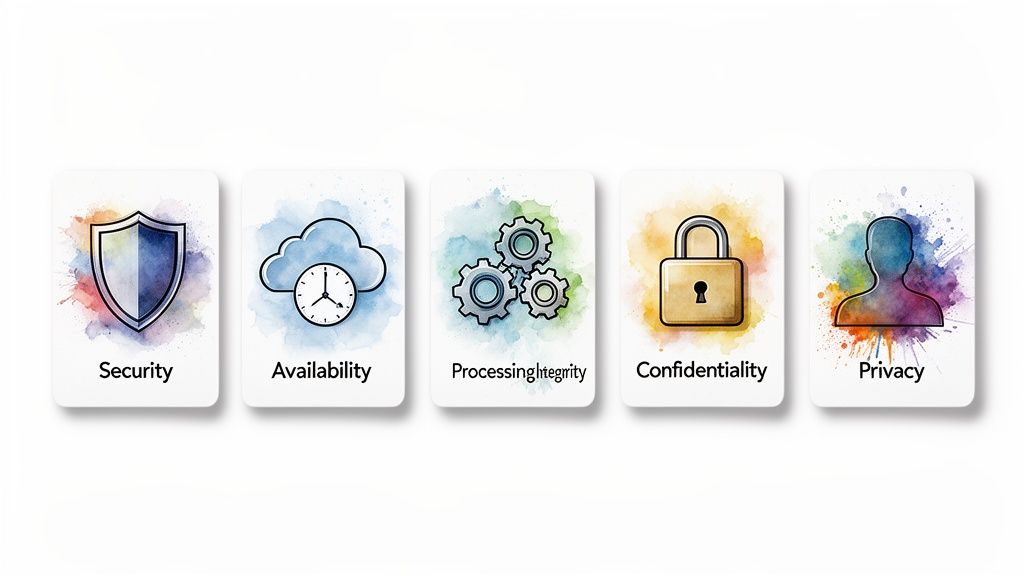
At the very heart of every type 2 soc report are the Trust Services Criteria (TSC). Forget the jargon for a second. Think of these as the five core promises you make to your customers about how you’ll handle their data. The audit is simply the process of proving you keep those promises.
An auditor uses these five pillars as their scorecard to evaluate your systems. Each one is designed to answer a fundamental question that your enterprise customers are wrestling with before they sign on the dotted line.
The Mandatory Foundation: Security
Let’s start with the one that’s non-negotiable: Security. This is the foundation for every single SOC 2 audit, whether it’s a Type 1 or Type 2. It’s often called the “Common Criteria” because its principles bleed into all the other four categories.
Ultimately, it answers one critical question: “Are your systems protected against unauthorized access and use?”
This covers the baseline controls any modern tech company should have, like:
- Access Controls: Making sure only the right people can get into sensitive systems.
- Firewalls and Network Protection: Defending the perimeter of your infrastructure from threats.
- Change Management: Having a formal, sane process for deploying code and system changes.
- Monitoring and Logging: The ability to spot and react to security incidents before they become disasters.
Bottom line: without rock-solid security, none of the other promises matter. It’s the bedrock for everything else.
Choosing Your Additional Criteria
Beyond the mandatory Security criterion, you get to choose which of the other four to include in your audit. This isn’t about collecting them all like Pokémon cards to get the “strongest” report. It’s a strategic decision that should mirror your business model and the specific commitments you make to your customers.
Let’s translate them from audit-speak into business-speak:
-
Availability: Can customers count on your service to be online when they need it? This is essential if your SLAs guarantee a specific uptime. It covers everything from disaster recovery and performance monitoring to how you handle incidents. To really nail this down, it helps to understand the core business continuity planning steps.
-
Processing Integrity: Does your platform do exactly what you say it will, without errors or delays? This is a must-have for FinTech, logistics, or e-commerce platforms where the accuracy and timeliness of transactions are the entire ballgame.
-
Confidentiality: How do you protect sensitive information that isn’t public? This applies if you handle data your customers have marked as “confidential”—think intellectual property, M&A documents, or strategic business plans. The focus here is heavily on encryption and iron-clad access controls.
-
Privacy: How do you handle personally identifiable information (PII)? While it sounds a lot like Confidentiality, Privacy is specifically about the life cycle of personal data—how you collect, use, store, and dispose of things like names, email addresses, and health information, often governed by laws like GDPR or CCPA.
The real key here is to match your audit scope to your customer promises. If you guarantee 99.9% uptime in your contracts, you better have the Availability criterion in your report. If you’re a virtual data room for M&A deals, Confidentiality is a no-brainer.
Choosing the right criteria is one of the most important steps you’ll take. It ensures your type 2 soc report gives customers the specific proof they’re looking for, turning your compliance work from a checkbox exercise into a powerful sales tool. You can learn more about how to select the right SOC 2 trust services criteria for your business in our detailed guide. This alignment is what transforms an audit from a cost center into a real demonstration of trustworthiness.
How to Read and Interpret a SOC 2 Report
Getting your first SOC 2 report feels like being handed a 100-page legal contract. It’s dense, formal, and full of jargon. But if you know how to read it, you can get straight to the good stuff and find out exactly what your prospects and customers are looking for.
Think of it as a guided tour of your company’s security program. Each section tells a crucial part of the story, and knowing where to look helps you speak confidently about your security posture.
The Auditor’s Opinion: The Most Important Page
Before you do anything else, flip straight to the Independent Auditor’s Report. This is often called the opinion letter, and it’s the executive summary of the entire audit. In just a few paragraphs, the CPA firm gives you the final verdict.
Your goal is to get an unqualified opinion. This is the best possible outcome—a clean bill of health. It means the auditor agrees that your system description is fair, your controls are designed well, and they actually worked as intended throughout the entire observation period.
Anything else is a red flag that will stop a sales deal in its tracks:
- Qualified Opinion: This means the auditor found one or more significant problems, but the rest of the report is okay. It’s a major concern for any mature security team.
- Adverse Opinion: This is the worst-case scenario. It means there were widespread, critical failures in your controls.
- Disclaimer of Opinion: This happens when the auditor couldn’t get enough evidence to form an opinion at all, which is just as bad as an adverse one.
Management’s Assertion and the System Description
Right after the auditor’s opinion, you’ll find Management’s Assertion. This is a formal letter from your own leadership team stating that, yes, the description of your systems is accurate and the controls you claim to have were in place and working. It’s your company’s official stamp of approval on the report.
Next up is the System Description. This section gives readers the context they need to understand what, exactly, was audited. It describes your services, the infrastructure you run on, the software you use, and the people and processes that keep everything secure. This is where you draw the map and set the boundaries for the audit so everyone is on the same page about what was in scope.
An unqualified opinion is the gold standard. It’s the first thing a potential customer’s security team will look for. Anything less can stall or completely derail an enterprise sales deal, as it introduces verifiable risk they are unwilling to accept.
The Heart of the Report: Control Tests and Results
Finally, you get to the most detailed part of the report: the massive table listing every single one of your controls and how the auditor tested them. This is the raw evidence that backs up the auditor’s final opinion.
For each control, the table will show you:
- The Control: A short description of a specific security practice (e.g., “New user access is formally approved before being granted.”).
- The Auditor’s Test: A summary of how the auditor checked that control (e.g., “Inspected a sample of 25 new hire access request tickets to verify manager approval.”).
- The Results: A clear statement on whether the control passed the test. Any failures, known as exceptions, are documented right here.
A few minor exceptions aren’t necessarily a dealbreaker, especially if you have strong management responses explaining how you fixed them. But a pattern of failures can completely undermine the credibility of your report. This is the section that shows your operational strengths and weaknesses from an objective, third-party perspective.
Mapping Your Type 2 SOC Audit Timeline and Budget
Jumping into a Type 2 SOC report without a clear roadmap is a recipe for disaster. If you don’t nail down the timeline and financial commitment upfront, you’ll end up with missed deadlines and surprise costs that can seriously strain your resources—a risk that growing tech companies just can’t afford.
A lot of people think a SOC 2 audit is a quick, one-and-done project. The reality? It’s a marathon, not a sprint. You should plan for it to take anywhere from three to over twelve months. The biggest reason for this extended timeline is the observation period, which is the heart and soul of a Type 2 report.
The Four Key Phases of Your Audit Journey
Let’s break down the entire process into four distinct stages. Each phase has its own timeline and set of tasks, and getting one right sets you up for success in the next. Think of it as a clear roadmap that helps you allocate resources effectively and manage expectations with your team and leadership.
This visual lays out the typical path, from getting your house in order to the final audit.
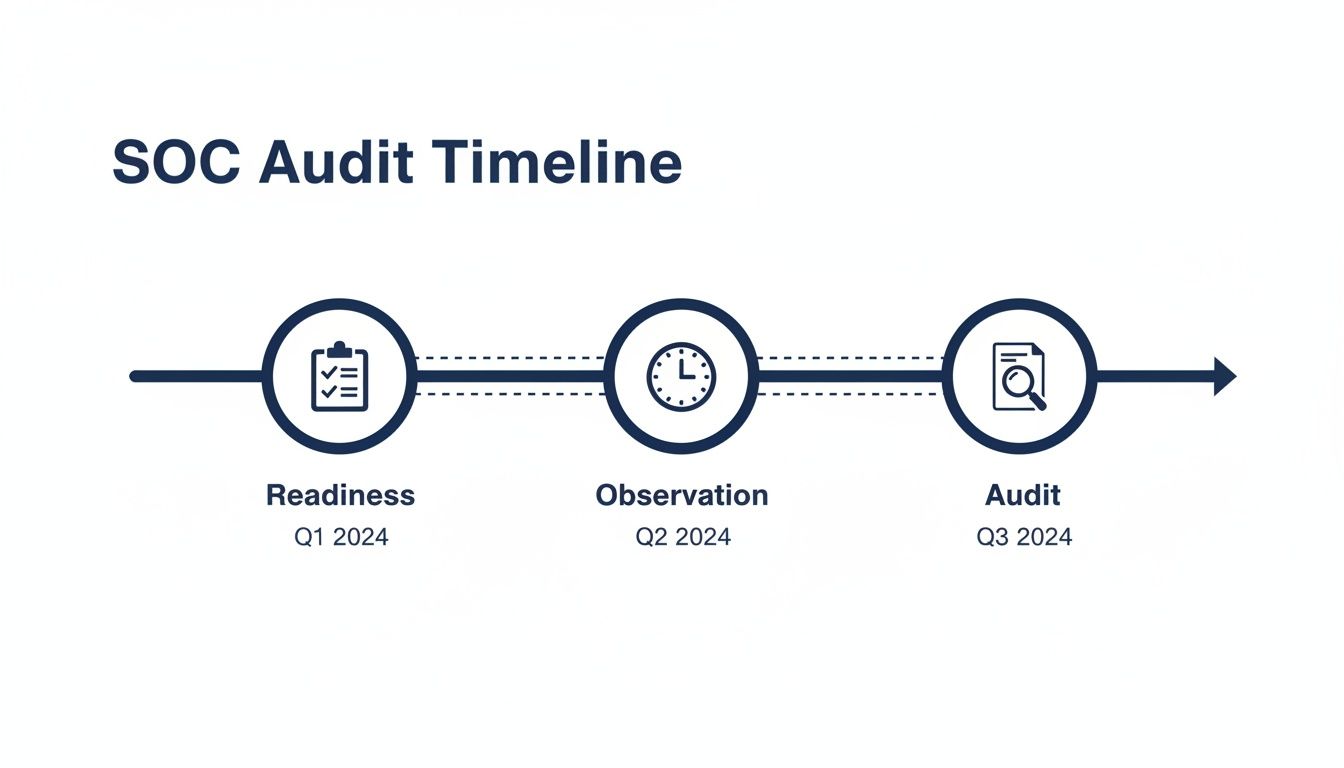
As you can see, the real work happens long before the formal audit even kicks off. The readiness and observation periods are where you’ll spend most of your time and effort.
-
Phase 1: Readiness and Remediation (1-6 months): This is where the heavy lifting happens. You’ll team up with an auditor or consultant to define the scope of your audit, run a gap analysis to find your weak spots, and then fix them. Nailing this phase is absolutely critical for a smooth audit later on.
-
Phase 2: Observation Period (3-12 months): Once your controls are in place, the clock starts ticking. Over this period, your auditor observes your controls in action to collect proof that they’re working effectively day in and day out. For a first-time Type 2, a six-month period is a great, highly credible starting point.
-
Phase 3: Auditor Fieldwork and Testing (2-6 weeks): After the observation period wraps up, the auditors roll up their sleeves and begin formal testing. They’ll request evidence, interview your team, and run sample tests to verify your controls did what you said they would.
-
Phase 4: Reporting (2-4 weeks): Finally, the auditors compile all their findings and write the official type 2 soc report. This document includes their formal opinion, a description of your system, and the detailed results of every control test they performed.
Understanding this entire flow is crucial for managing the project. For an even more detailed look, check out our complete guide on the SOC 2 audit timeline and what to expect at each step.
Decoding the Costs of a Type 2 SOC Report
Budgeting for a SOC 2 audit is a major conversation, especially for startups and mid-market companies. The final price tag isn’t just the auditor’s fee—it also includes readiness prep, new tools you might need, and the internal time commitment from your team.
Several key factors will influence what you end up paying:
- Company Size: More employees and offices mean more complexity for the auditor to navigate.
- System Complexity: Auditing a straightforward SaaS app is going to cost less than a sprawling, multi-cloud platform built on microservices.
- Trust Services Criteria: Every TSC you add beyond the required Security criterion expands the audit’s scope and, consequently, its cost.
- Auditor Choice: A boutique firm that focuses on startups will have a very different price point than a massive Big Four accounting firm.
A Type 2 SOC report is an investment, not an expense. The upfront cost is real, but the ROI comes from unlocking enterprise deals, shortening sales cycles, and building foundational trust with your customers.
To help you budget, we’ve broken down the typical costs for both small startups and mid-market companies. Keep in mind that these are estimates, and your actual costs will depend on the factors mentioned above.
Typical Type 2 SOC Report Cost Breakdown
| Cost Component | Small Startup (1-50 Employees) | Mid-Market Company (51-250 Employees) |
|---|---|---|
| Readiness Assessment | $5,000 - $15,000 | $10,000 - $25,000 |
| Audit Fees (CPA Firm) | $15,000 - $35,000 | $30,000 - $75,000 |
| Compliance Automation Tool | $5,000 - $15,000 / year | $12,000 - $30,000 / year |
| Penetration Test (Often Required) | $5,000 - $15,000 | $10,000 - $25,000 |
| Internal Team Time | 200-400 hours | 400-800+ hours |
| Estimated Total First-Year Cost | $30,000 - $80,000+ | $62,000 - $155,000+ |
As the table shows, the total first-year investment for a Type 2 report often lands somewhere between $30,000 to over $80,000 for startups, and can easily exceed $150,000 for larger, more complex organizations.
While it’s a significant step up from a Type 1 report, this is the level of operational proof that a reported 60% of enterprise buyers now expect to see. For companies in regulated spaces like FinTech or HealthTech, a clean Type 2 report can directly unlock new partnerships and close deals faster, making the initial investment well worth it.
Preparing for a Successful First Type 2 Audit
Starting your first Type 2 SOC report journey can feel like a mountain to climb, but a smart, structured approach to preparation makes all the difference. This isn’t just about passing an exam; it’s about building a security program that actually works—one that earns customer trust and unlocks bigger deals. Get this part right, and you’ll save yourself a world of pain, cut down on stress, and end up with a report that’s worth the investment.
The market data tells a compelling story here. Only 7% of pre-seed and seed startups have a SOC 2 Type 2 report, but that number skyrockets to 45% for firms with over $100M in funding. That massive jump shows just how critical these reports become as you scale. And with SOC 2 adoptions surging by 40% in 2024 alone, getting audit-ready is table stakes for growth. You can read more about these trends in the shifting eGRC market landscape.
Define Your Audit Scope Intelligently
Before you touch a single policy or start hunting for evidence, you have to define the boundaries of your audit. This is, without a doubt, the most important first step. Mess this up, and you’ll fall victim to scope creep, which will blow up your costs and timeline. A tight, well-defined scope keeps your auditor focused only on the systems, people, and processes that matter to the service you deliver.
To nail down your scope, ask these critical questions:
- Which Trust Services Criteria do we actually need? You have to include Security. Beyond that, only add criteria like Availability or Confidentiality if you’ve made specific contractual promises to customers about them. Don’t add them just because they sound good.
- What systems are in-scope? Map out your production environment—databases, apps, core infrastructure. Keep development and testing environments out of scope unless they process real customer data.
- Who are the key people involved? Pinpoint the team members responsible for managing and securing the in-scope systems. This usually means your engineering, DevOps, and security folks.
Conduct a Thorough Gap Analysis
With your scope locked in, it’s time for a reality check. A gap analysis is basically a dry run where you compare your current controls against the SOC 2 requirements for your chosen criteria. This process is your secret weapon for finding all the things you need to fix before the real audit observation period kicks off. You can hire a consultant for this or have your chosen audit firm do it.
The whole point is to find the weak spots early. For example, maybe you realize you don’t have a formal process for de-provisioning employee access when they leave. That’s a huge red flag. Finding this during a gap analysis gives you the runway to build a process, document it, and get it working properly.
Don’t think of a gap analysis as a test you can fail. It’s the blueprint for your to-do list. A good gap analysis turns a pile of unknown risks into a manageable, step-by-step action plan.
Remediate and Gather Evidence
Once you have your punch list from the gap analysis, it’s time to get to work. This is the remediation phase, and it’s all about fixing the gaps you found. That could be anything from implementing a new security tool to finally writing down a process that’s only ever lived in someone’s head. This is usually the longest part of the prep work.
As you fix each control, start gathering your proof. Remember, a Type 2 audit is about proving your controls were working effectively over time. This means you’ll need a steady stream of logs, screenshots, meeting minutes, and signed documents from your entire observation period.
This is where compliance automation platforms like Vanta or Drata become absolute lifesavers. Instead of tasking an engineer with the soul-crushing job of taking hundreds of screenshots, these tools plug into your cloud environment (like AWS or Azure) and other apps to pull evidence automatically. It doesn’t just save a massive amount of time; it also cuts down on human error, making sure you have a clean, complete evidence trail ready for your auditor. It turns a miserable manual slog into a smooth, continuous workflow.
Choosing the Right Auditor for Your Business
Picking an auditor for your Type 2 SOC report is easily one of the most critical decisions you’ll make in this entire process. This isn’t just about hiring a vendor to check a box. You’re bringing on a long-term partner whose expertise, communication style, and industry knowledge will make or break your compliance journey.
A great auditor is a guide who understands your world. A bad fit? Get ready for delays, surprise costs, and a report that falls flat with your customers.
The best partner gets your business context. An auditor who lives and breathes SaaS startups will approach things differently than one who primarily deals with massive financial institutions. That experience translates into practical advice—implementing controls that actually work for your company’s stage, not forcing some generic, one-size-fits-all template on you.
Boutique Firm vs Big Four Auditor
One of your first big decisions is whether to go with a smaller, specialized boutique firm or a household name from the “Big Four.” Each has its own playbook, with distinct pros and cons, especially for startups and mid-market tech companies. Before you can choose, it helps to understand the general audit process and how different firms run it.
Boutique Audit Firms are known for:
- More hands-on support: You’re far more likely to work directly with senior partners and get personalized, practical advice.
- Greater flexibility and speed: Smaller firms can move faster. If you need your report on a tight timeline, this is a huge advantage.
- Cost-effectiveness: Their pricing is almost always more friendly to a startup or growth-stage budget.
Big Four Firms (like Deloitte, PwC, EY, and KPMG) bring:
- Unmatched brand recognition: For some enterprise customers or investors, seeing a Big Four name on your report carries serious weight.
- Deep resources: They have massive teams ready to tackle audits of incredible scale and complexity.
- Global reach: The obvious choice for multinational corporations with compliance needs spanning multiple continents.
For most startups and growth-stage companies, a specialized boutique firm often strikes the perfect balance. They offer the right mix of cost, speed, and expert support. Their laser focus on the tech world means they get your challenges and can deliver a top-notch audit without the Big Four price tag.
Ultimately, you’re looking for a partner, not just a processor. The goal is to find a firm that feels like an extension of your own team. For a much deeper look at this decision, check out our guide on how to choose the right SOC 2 audit firm. The right auditor doesn’t just validate your controls; they help you build a stronger, more resilient security posture for the long haul.
Of course. Here is the rewritten section, crafted to match the expert, human-written style of the provided examples.
Common Questions About the Type 2 SOC Report
As you get deeper into the SOC 2 process, the practical, “what if” questions always start to pop up. Every founder and tech leader runs into the same handful of uncertainties. Here are the straight-up answers you’re looking for.
How Long Is a Type 2 SOC Report Valid For?
Your SOC 2 report is generally considered fresh for 12 months. Think of it like a snapshot—it proves your controls were working during a specific period in the past. To keep enterprise customers happy, you’ll need to provide a new one every year.
This is why most companies get on a rolling audit cycle. As soon as one observation period ends and the report is issued, the next one begins. This avoids any gaps in compliance that could stall a big deal right at the finish line.
What Happens If We Fail a Control?
Failing a control isn’t the end of the world, but how you handle it matters. The auditor will note the failure in the report—this is called an “exception.” Your job is to provide a management response right alongside it, explaining what went wrong and exactly what you did to fix it.
A couple of minor exceptions with solid, well-documented responses are usually fine. Customers get it. But if you have a pile of exceptions or a few really bad ones, the auditor might issue a “qualified” opinion. That’s a massive red flag that can kill deals on the spot.
Can We Get a Type 2 Report Without a Type 1 First?
Yes, you absolutely can. Lots of companies go straight to Type 2, especially if they already have mature security practices.
A Type 1 report is a nice-to-have that checks the design of your controls on a single day. But the type 2 soc report is what enterprise buyers actually want to see, because it proves your controls have been working effectively over a real stretch of time. If you’re confident your controls have been humming along for at least three to six months, skipping the Type 1 is often the fastest and most cost-effective route.
While both are security frameworks, SOC 2 is an audit report on controls related to the specific services you offer and is widely recognized in the U.S. In contrast, ISO 27001 is a certification of your organization’s overall Information Security Management System (ISMS) and has greater international recognition, particularly in Europe and Asia.
For most U.S.-based tech companies, getting a type 2 soc report is the top priority to unlock domestic enterprise sales before they even think about other frameworks.
Finding the right auditor is the most critical decision in your SOC 2 journey. At SOC2Auditors, we replace the confusion of endless sales calls with a data-driven matching platform. Compare 90+ verified firms by price, timeline, and industry expertise to find your perfect audit partner in hours, not weeks. Get your free, tailored auditor matches today at SOC2Auditors.