Soc 2 Type 2 Compliant: soc 2 type 2 compliant Guide to Achieving Compliance
Being SOC 2 Type 2 compliant means an independent auditor has confirmed your company’s security controls are not just designed correctly, but have actually worked as intended over a significant period—usually 3 to 12 months. It’s the gold standard for proving you’re serious about protecting customer data, day in and day out.
What It Means to Be SOC 2 Type 2 Compliant

Think of it like this: a SOC 2 Type 1 report is like passing your driver’s test. On one specific day, you proved you knew the rules of the road. You checked your mirrors, stopped at the stop sign, and demonstrated you could handle the car. You got the license.
But a SOC 2 Type 2 report is more like having a driving instructor ride shotgun with you for a six-month, cross-country road trip.
They’re not just checking if you know the rules; they’re observing you living them. They see how you handle unexpected detours, bad weather, and long stretches of highway. Most importantly, they’re confirming you consistently keep your passengers (your customer data) safe for the entire journey.
This sustained observation is what gives the Type 2 report its real weight. It’s not a snapshot; it’s a feature film of your company’s commitment to data protection, all judged against the tough standards set by the American Institute of Certified Public Accountants (AICPA).
The Foundation of Trust
At its heart, SOC 2 Type 2 compliance is all about building unshakable trust. When an enterprise prospect asks for your SOC 2 report, they aren’t looking for promises. They want hard proof that your systems, people, and processes are secure and reliable over the long haul.
That kind of proof is more critical than ever. In 2024, cyberattacks caused global damages topping $6 trillion, a number that’s expected to keep climbing. For companies handling sensitive data, SOC 2 Type 2 isn’t just a nice-to-have; it’s an essential shield. As attacks get more sophisticated, you need security standards that prove your controls work in the real world, not just on paper. You can find more insights on navigating certification in today’s environment over on CG Compliance’s blog.
Core Principles of Compliance
The entire framework rests on the AICPA’s Trust Services Criteria (TSC). These are the pillars that define what “good” security looks like. Every single SOC 2 audit must include the Security criterion, but you can also choose to add others that are relevant to your business promises:
- Availability: Proving your systems are up and running when your customers need them.
- Processing Integrity: Showing that data is processed completely, accurately, and on time. Think financial transactions or critical calculations.
- Confidentiality: Protecting information that’s been specifically designated as confidential from unauthorized eyes.
- Privacy: Safeguarding personal information (PII) according to established privacy rules like GDPR or CCPA.
By picking the criteria that align with your service commitments, you end up with a tailored report that directly answers the security questions your customers are asking. This sets the stage for understanding just how this deep, long-term validation process works—and why it’s become a non-negotiable for doing business today.
Comparing SOC 2 Type 1 and Type 2 Reports

This is where most people get tripped up, but the difference is actually pretty simple. Think of it like building a secure fortress to protect your client’s data.
A SOC 2 Type 1 report is like the architectural blueprint. An auditor shows up, looks at your plans, and confirms that on paper, you’ve designed a secure system. The walls are thick, the gates look strong, and the watchtowers are in the right places. It’s a snapshot that proves you had a good design on that specific day.
A SOC 2 Type 2 report is the security camera footage from that fortress, recorded over six months. The auditor doesn’t just glance at the blueprint; they watch the guards make their rounds, see the gates being tested daily, and verify how the walls hold up during a storm. This is why becoming SOC 2 Type 2 compliant is the gold standard—it’s proof, not just a plan.
The Snapshot Versus The Feature Film
The Type 1 report is a point-in-time assessment. It evaluates the design of your security controls on one specific date. It answers the question: “Did you have the right security controls in place on June 30th?”
In contrast, the Type 2 report covers an observation period, usually between three and twelve months. It assesses both the design and the operating effectiveness of your controls over that entire stretch. It answers a much more powerful question: “Did your security controls actually work, day in and day out, for the last six months?”
This is exactly why your enterprise customers will almost always demand a Type 2. They need to know your security isn’t just a theoretical exercise but a consistent, real-world practice. For a deeper dive into their key differences, our guide on SOC 2 Type 1 vs Type 2 reports provides more detail.
A Type 1 report shows you have a security policy. A Type 2 report proves your team actually follows it. This is the difference between a promise and proof.
SOC 2 Type 1 vs Type 2 At a Glance
To make it even clearer, here’s a direct comparison of the two reports. The scope, effort, and level of trust they build are fundamentally different.
| Attribute | SOC 2 Type 1 Report | SOC 2 Type 2 Report |
|---|---|---|
| Focus | Design of controls | Design and operating effectiveness of controls |
| Timeframe | A single point in time (e.g., as of June 30) | A period of time (e.g., January 1 - June 30) |
| Auditor’s Goal | To verify that controls are suitably designed. | To verify controls are designed and operated effectively. |
| Level of Assurance | Moderate assurance. | High assurance of sustained security practices. |
| Effort & Cost | Lower effort, less time-intensive, and less costly. | Higher effort, requires months of evidence, and is more expensive. |
| Customer Perception | Good first step, but often insufficient for enterprise deals. | The industry standard for demonstrating security maturity. |
As you can see, a Type 2 report provides a much higher level of assurance, which is what serious buyers are looking for.
Why Most Companies Go Straight to Type 2
While a Type 1 can feel like a good stepping stone for an early-stage company, many organizations today are skipping it and going directly for the Type 2.
The logic is simple: a Type 1 is often just a temporary fix. Sooner or later, a key customer or strategic partner will demand the higher assurance that only a Type 2 can provide. Investing time and money in a Type 1 audit only to immediately start the Type 2 process right after is inefficient.
By preparing for and completing a SOC 2 Type 2 audit from the get-go, you show a serious, long-term commitment to security and avoid paying for two separate audit cycles.
Understanding the Five Trust Services Criteria
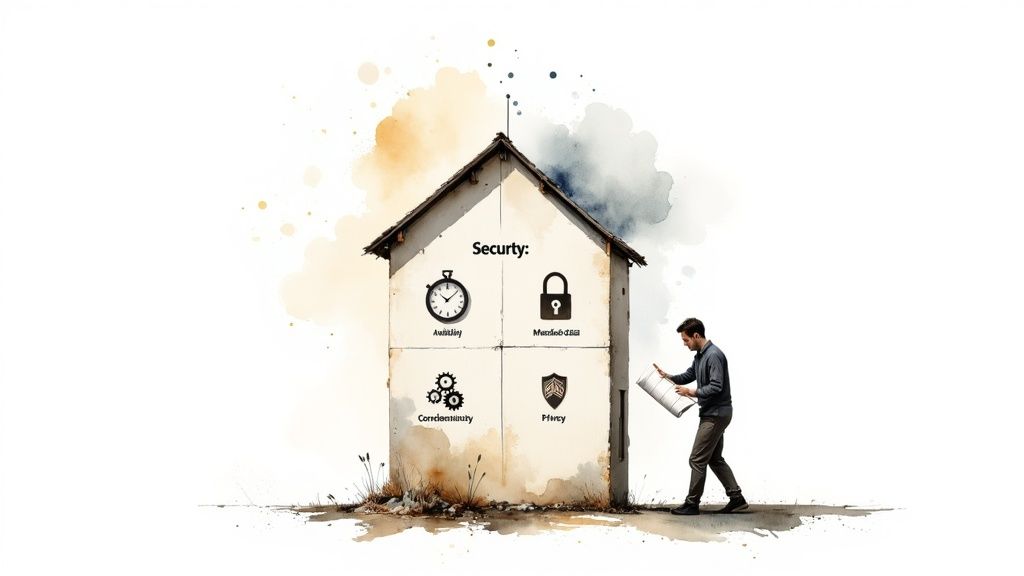
The five Trust Services Criteria (TSC) are the heart and soul of any SOC 2 audit. Think of it like building a house to protect your customers’ data. The foundation is absolutely mandatory, but you get to choose which rooms to build on top of it.
That non-negotiable foundation is the Security criterion, often called the Common Criteria. Every single SOC 2 report—Type 1 or Type 2—has to be built on it. It covers the core controls that shield your systems from unauthorized access, data breaches, and general misuse.
The other four criteria—Availability, Processing Integrity, Confidentiality, and Privacy—are the optional rooms. You don’t need them all. The smart move is to only build the rooms that align with the specific promises you’ve made to your customers.
The Mandatory Foundation: Security
Security is the bedrock of your entire SOC 2 effort. Period. It’s proof that you have fundamental protections in place, like firewalls, intrusion detection systems, and two-factor authentication. This is all about establishing a strong perimeter and meticulously controlling who gets access to the sensitive data inside.
When an auditor digs into the Security criterion, they’re looking for hard evidence of controls covering things like:
- Logical and physical access controls: How do you grant, modify, and, most importantly, remove access for employees and systems? This applies to both your cloud environment and any physical locations like data centers.
- System operations: How are you monitoring your infrastructure for weird behavior? What happens when you detect an anomaly or a full-blown incident?
- Change management: What’s your formal process for pushing changes to production? Auditors want to see that you’re not just cowboy-coding and introducing new security holes.
This criterion is what proves you run a thoughtful, robust security program. It’s the absolute prerequisite for becoming SOC 2 Type 2 compliant.
The Optional Rooms: Choosing What Matters to Your Customers
Once that foundation is solid, you can add other criteria that directly reflect your service commitments. A common rookie mistake is adding criteria that don’t actually apply to your business. This just inflates the cost and complexity of your audit for no good reason.
Your selection of Trust Services Criteria tells a story. It should directly address the biggest security and operational questions your customers have about your service.
Let’s walk through these optional rooms and figure out when you might need to build them.
Availability
Does your Service Level Agreement (SLA) promise 99.9% uptime? If you’re making promises about performance and accessibility, you need the Availability criterion. This “room” demonstrates that your systems are up and running as advertised.
An auditor will test your controls related to:
- Disaster recovery and business continuity plans (and proof you’ve tested them).
- System monitoring for performance, load, and capacity.
- Incident response playbooks and failover mechanisms.
Real-World Example: A cloud hosting provider like AWS or a communication tool like Slack lives and dies by this criterion. Their entire business model collapses if their service isn’t consistently online.
Processing Integrity
This one is for any service that performs critical calculations or transactions. It’s about proving that data is processed completely, accurately, and on time. No funny business with the numbers.
An auditor will scrutinize your:
- Data input validation and output checks.
- Quality assurance (QA) procedures.
- Error detection and correction workflows.
Real-World Example: A fintech app processing payments or a payroll platform calculating employee wages must have Processing Integrity. Their customers need absolute, unwavering trust that every calculation is perfect.
Confidentiality
Confidentiality is laser-focused on protecting information that has been specifically designated as sensitive and restricted. Think of data protected under a Non-Disclosure Agreement (NDA) or other strict contractual terms. This goes a step beyond the general security of your foundation.
An auditor will look for specific controls like:
- Data encryption, both in transit over the network and at rest on a disk.
- Strict access policies and documented data handling procedures.
- Secure data disposal methods to ensure deleted data is truly gone.
Real-World Example: A virtual data room service used for mergers and acquisitions is a perfect candidate for the Confidentiality criterion. The service’s entire purpose is to safeguard highly sensitive corporate documents during a deal.
Privacy
While it sounds a lot like Confidentiality, Privacy is all about protecting personally identifiable information (PII). We’re talking about names, addresses, Social Security numbers, and any other data that can be used to identify a specific person.
The controls for Privacy are heavily influenced by frameworks like GDPR and CCPA. They focus on:
- How you collect, use, store, and ultimately destroy PII.
- The clarity of your privacy notices to individuals.
- Your process for honoring user requests about their personal data.
Real-World Example: A healthcare platform that handles patient medical records or a marketing automation tool that stores customer email lists would absolutely add the Privacy criterion. It demonstrates they can be trusted with individuals’ most sensitive data.
Your Roadmap to Achieving SOC 2 Compliance
Trying to get SOC 2 Type 2 compliant without a clear plan is like trying to build an engine without a blueprint. It’s a complex process with a ton of moving parts and critical deadlines. A structured roadmap isn’t just a “nice-to-have”—it’s essential for breaking down a potentially chaotic project into a series of clear, manageable milestones.
Think of this as your project plan. It’s the framework you’ll use to manage the significant time and resources this whole process demands.
Phase 1: Define Your Audit Scope
Before you write a single policy or buy a new tool, you have to lock down the scope of your audit. This is, without a doubt, the most critical first step because it sets the boundaries for the entire project. Get this wrong, and you’ll waste months of effort and end up with a report that doesn’t even satisfy your customers.
Your scope needs to be crystal clear on a few things:
- Which Trust Services Criteria to Include: Security is mandatory. But what about the others—Availability, Processing Integrity, Confidentiality, or Privacy? You need to choose the ones that align with the promises you’re making to your customers.
- The Systems in Scope: Be specific. Which applications, databases, cloud infrastructure, and internal services will the auditor be looking at? Vague definitions here lead to scope creep and surprise costs later.
- The People and Processes Involved: Which teams, departments, and operational workflows touch the systems you just listed? This helps define who needs to be involved and what procedures will be under scrutiny.
Phase 2: Conduct a Thorough Gap Analysis
With your scope defined, it’s time for a gap analysis, often called a readiness assessment. This is where you put your current security controls under a microscope and compare them against the SOC 2 requirements for your chosen TSCs. The whole point is to find every single gap between where you are today and where you need to be for the audit.
This phase is all about honest self-assessment. It’s your chance to uncover weaknesses in your policies, procedures, and tech stack before your auditor does. A solid gap analysis prevents those dreaded, last-minute surprises during the formal audit. For a deeper dive, check out our guide on the SOC 2 readiness assessment.
A gap analysis is your audit’s early warning system. It gives you the chance to fix problems on your own timeline, not under the pressure of an active audit with the clock ticking.
Phase 3: Remediate and Implement Controls
Alright, this is where the real work begins. Using the findings from your gap analysis as a punch list, your team has to get to work closing every single identified issue. Remediation isn’t just about patching a few bugs; it’s about building a robust, auditable security program from the ground up.
Typical activities here include:
- Writing and Formalizing Policies: Creating clear, written policies for everything from access control and vendor management to incident response.
- Implementing New Tools: This could mean deploying software for endpoint detection, vulnerability scanning, or security awareness training.
- Configuring System Settings: Hardening servers, enforcing strong password policies across all systems, and making sure your logging and monitoring are up to snuff.
- Training Your Team: Making sure every single employee understands their security responsibilities and actually follows the new procedures you’ve put in place.
This whole readiness phase can take anywhere from 3 to 12 months. It really depends on the maturity of your security program when you start. It’s a huge undertaking that requires dedicated project management.
Phase 4: The Crucial Observation Period
Once remediation is done and your controls are humming along, the official observation period for your Type 2 audit kicks off. This is the window of time—typically lasting from 3 to 12 months—where your auditor tests whether your controls are actually working effectively over a sustained period.
During this period, you have to consistently run your security playbook and collect the evidence to prove it. For example, if your policy says you conduct quarterly access reviews, you better be doing them on schedule and documenting every step. There are no shortcuts here. Consistency is everything.
This sustained performance is exactly why becoming SOC 2 Type 2 compliant is such a powerful signal of trust. The pressure to maintain compliance is only growing. In fact, 58% of organizations expect to conduct four or more compliance audits in 2025, which makes having a robust, continuous process absolutely essential. You can find more insights on these rising compliance demands on Secureframe.
After the observation period finally ends, the auditor performs their final testing and writes up the report. Don’t forget to budget time for this final stage—it can take another 4 to 8 weeks. All told, achieving your first SOC 2 Type 2 report is a marathon, not a sprint, and often takes over a year from start to finish.
Estimating the Real Costs of a SOC 2 Audit
Let’s talk about the real cost of getting SOC 2 Type 2 compliant. Thinking the auditor’s quote is the final price tag is one of the most common—and costly—mistakes a company can make. It’s not a simple line item. The true investment is a blend of several critical pieces, and missing one can throw your budget and timeline completely off track.
The most obvious expense is the audit itself. A small startup can expect to pay anywhere from $15,000 to $30,000. For a mid-market company, that number jumps to between $30,000 and $70,000. And if you’re a large enterprise with a complex environment, costs can easily soar past $100,000.
But that’s just the tip of the iceberg. The auditor’s fee is where the spending ends, not where it begins.
Breaking Down the Full Financial Picture
To budget for SOC 2 accurately, you have to look at the entire compliance ecosystem. Just picking the cheapest auditor might feel like a win upfront, but it can cost you dearly in the long run. An inexperienced firm might miss critical issues or be wildly inefficient, leading to more work for your team and a longer, more painful process.
Here are the four main cost categories you absolutely must account for:
- Audit Fees: This is what you pay the CPA firm to actually perform the Type 2 audit. The price tag varies based on the firm’s reputation (think specialist vs. Big Four), the scope of your audit (just Security, or more?), and the sheer complexity of your systems.
- Readiness Consulting: Many companies, especially first-timers, bring in consultants to do a gap analysis and help them prepare. This can run from $10,000 to $50,000+, depending on how much hand-holding you need.
- Compliance Automation Software: Let’s be honest, almost no one does this manually anymore. Tools like Vanta or Drata that help you collect evidence and monitor controls are basically standard. They typically cost $7,000 to $25,000 a year, but the hundreds of hours they save in manual labor make them a no-brainer.
- Internal Team Time: This is the hidden cost that sinks most budgets. Your engineers, IT staff, and security team will spend a massive amount of time putting new controls in place, pulling evidence, and sitting in meetings with the auditor. This can easily add up to tens of thousands of dollars in staff time.
The roadmap below shows the first few steps of the journey—scoping, gap analysis, and remediation. Getting these right is the key to managing all the costs that follow.

This initial process shows why a structured approach is so important. It helps you get your arms around the financial and time commitments before the official audit clock even starts ticking.
The Strategic Value of Upfront Investment
It’s tempting to try and cut corners, especially on things like readiness help or automation software. It seems like an easy way to lower the initial bill. But this is almost always a shortsighted move.
Investing in a proper readiness assessment and a solid compliance platform will dramatically reduce your costs over the long haul.
A well-planned investment in readiness and automation doesn’t just lower your first-year audit costs; it significantly reduces the ongoing effort and expense of maintaining compliance year after year.
This upfront work saves your team from audit fatigue, makes a bad audit opinion far less likely, and just makes the whole process faster. When you treat SOC 2 as a strategic investment in your company’s credibility—not just another annoying expense—you build a compliance program that’s smoother and more cost-effective. It keeps your current customers happy and becomes a massive advantage when you’re trying to win those big enterprise deals.
How to Choose the Right SOC 2 Auditor for Your Business
Picking your SOC 2 auditor is easily one of the most important decisions you’ll make in this entire process. I can’t stress this enough. This isn’t just about hiring a vendor to check a few boxes. You’re bringing on a long-term partner who will have a massive say in how smooth—or how painful—your audit will be.
Get it right, and the process feels like a guided collaboration. Get it wrong, and you’re staring down the barrel of frustrating delays, surprise costs, and a whole lot of friction.
Your first fork in the road is deciding between one of the massive, globally recognized ‘Big Four’ accounting firms and a smaller, specialized boutique firm. There are real pros and cons to each, so let’s break it down.
Big Four vs. Boutique Specialist Firms
The Big Four firms definitely have name recognition, and sometimes that brand can give certain old-school stakeholders a warm fuzzy feeling. But that brand comes with a hefty price tag. They’re often way more expensive, and it’s not uncommon for them to assign junior staff to your audit. Your project could end up as a tiny fish in their massive pond, meaning you get less personalized attention.
Specialist boutique firms, on the other hand, live and breathe SOC 2. It’s all they do. They usually have deep expertise in modern tech stacks, actually understand how a cloud-native company operates, and can offer much more hands-on guidance. Their streamlined processes are almost always a better fit for fast-moving tech companies trying to become SOC 2 Type 2 compliant.
The best auditor for your business is one that understands your technology, speaks your language, and acts as a genuine partner in your compliance efforts, not just a procedural referee.
Critical Questions to Ask Potential Auditors
Before you even think about signing an engagement letter, you need to put potential auditors through their paces. Their answers to a few key questions will tell you everything you need to know about their experience, communication style, and whether they’re the right fit for your company. Getting this right is a huge part of the battle, and you can find even more guidance on how to choose your SOC 2 auditor to make sure you’re fully prepared.
Here are the non-negotiable questions you absolutely must ask:
- Experience with Cloud-Native Companies: How many audits have you actually done for businesses that look like ours, with a similar tech stack (AWS, GCP, Azure, etc.)? An auditor who is still thinking in terms of on-prem servers can create a world of unnecessary pain.
- Evidence Collection Process: Walk me through your evidence collection process. Are you using a modern online portal, or are we going to be drowning in a nightmare of spreadsheets and back-and-forth emails? A messy, manual process will burn hundreds of hours of your team’s time.
- Communication and Support: Who is our day-to-day point of contact, and how experienced are they? You need direct access to a pro who can answer your questions, not three layers of bureaucracy.
- Timeline and Reporting: From the day our observation period ends, what is your realistic, guaranteed timeline to get the final report in our hands? A slow report delivery can kill critical sales deals that are waiting on that piece of paper.
Choosing an auditor who goes dark on you or doesn’t get your tech stack is a classic, costly mistake. A true partner will set you up not just for a successful audit, but for a stronger, more secure company culture moving forward.
Common Questions About SOC 2 Compliance
As you get closer to your audit, a few key questions always seem to pop up. Let’s tackle the most common ones with direct, no-nonsense answers to help you navigate the process.
How Long Is a SOC 2 Type 2 Report Valid?
A SOC 2 Type 2 report is generally considered valid for 12 months from the day it’s issued. Think of it as an annual check-up for your security posture.
Most customers and partners will ask for a fresh report each year. They want to see that your security controls are still working effectively and that you haven’t slipped into any bad habits. This makes SOC 2 compliance an ongoing commitment, not a one-and-done project.
Your SOC 2 report is a living document. An outdated one suggests your security posture might be out of date, too, and that’s a red flag for any savvy customer.
Can You Fail a SOC 2 Audit?
Technically, you don’t “pass” or “fail” a SOC 2 audit. It’s not a test with a score. Instead, the auditor issues a professional opinion on how well your controls are designed and operating.
Here’s what that looks like:
- Unqualified Opinion: This is the gold standard. It means your controls are effective, with no significant issues found. It’s the clean bill of health you’re aiming for.
- Qualified Opinion: This means the auditor found one or more minor issues or exceptions. It’s not a total failure, but it does flag areas for improvement that your customers will notice.
- Adverse Opinion: This is the one you absolutely want to avoid. It signals that there are significant, material problems with your security controls.
The best way to lock in that coveted unqualified opinion? A thorough readiness assessment. It helps you find and fix the problems before the auditor does.
Is Compliance Software Required for a SOC 2 Report?
While it’s not officially mandatory, using compliance automation software has become the standard for a reason. Trying to manage a SOC 2 audit manually with spreadsheets and shared drives is a recipe for headaches and costly mistakes.
Platforms like Vanta, Drata, or Secureframe are built to manage the sheer volume of work involved. They automate evidence collection, centralize policy management, and continuously monitor your controls. This can save you hundreds of hours of manual effort, slash the risk of human error, and make the whole process smoother for you and your auditor.
Finding the right auditor is a critical step in your compliance journey. At SOC2Auditors, we help you compare 90+ verified firms based on real price ranges, timelines, and satisfaction scores to find your perfect match without the sales pressure. Get three tailored auditor matches at https://soc2auditors.org.