Your Practical Guide to soc2 type 2 certification
A SOC 2 Type 2 certification isn’t just a piece of paper; it’s a formal attestation report from an independent CPA firm. It proves that a company’s security systems are not just designed correctly on paper, but actually work as intended over a period of time, usually 3 to 12 months.
Think of it as a long-term, live-in inspection of your security posture. It confirms that you’re not just talking a good game—you’re consistently following your own security rules, day in and day out. This deep level of assurance is precisely why it has become a non-negotiable requirement for so many enterprise customers.
Why a SOC 2 Type 2 Report Is a Business Enabler
It wasn’t long ago that having a SOC 2 report was a competitive advantage, a way to stand out. Today, for any SaaS or cloud service provider, it’s simply the cost of entry, especially when you’re selling to larger, more regulated companies.
A SOC 2 Type 2 certification has moved far beyond a simple compliance checkbox. It’s a powerful business enabler that builds immediate trust and can dramatically shorten your sales cycles.
Imagine your sales team is in the final stages of a major deal. The prospect’s security team slides over a massive, custom security questionnaire. Without a SOC 2 Type 2 report, this can easily add weeks or even months of painful back-and-forth, delaying revenue. With a clean report in hand, you provide a standardized, auditor-verified package that answers most of their questions upfront, letting you close the deal faster.
The Shift from Optional to Essential
The market has spoken, and the verdict is clear. Between 2023 and 2025, SOC 2 Type 2 attestation went from a “nice-to-have” to a fundamental requirement for vendors in enterprise and regulated sectors.
The numbers don’t lie: SOC 2 is the dominant framework, with a staggering 96% of mature organizations pursuing it. Buyers increasingly demand Type 2 reports because they prove your security controls have been working consistently over several months, not just on a single day. You can dig into these compliance statistics to get a better feel for the market trends.
This shift reflects a broader understanding that security isn’t a one-time event; it’s a continuous commitment. A Type 2 report is the ultimate proof of that commitment, demonstrating operational maturity and a proactive security culture.
A SOC 2 Type 1 report is like showing a photo of a clean house. A SOC 2 Type 2 report is like having an inspector live there for six months to confirm you keep it clean every single day.
To help clarify the difference, let’s break down the two report types side-by-side.
SOC 2 Type 1 vs Type 2 At a Glance
| Attribute | SOC 2 Type 1 | SOC 2 Type 2 |
|---|---|---|
| What it Evaluates | The design of your controls at a single point in time. | The design and operating effectiveness of your controls over a period of time. |
| Timeframe | A snapshot on a specific date (e.g., “as of June 30”). | An observation period, typically 3-12 months (e.g., “for the period of Jan 1 - June 30”). |
| Level of Assurance | Moderate. Shows you have the right controls in place. | High. Proves your controls actually work consistently. |
| Customer Perception | ”Nice to have” for early-stage companies. | The “gold standard” required by most enterprise buyers. |
| Effort | Lower. Faster to achieve. | Higher. Requires ongoing evidence collection over months. |
Ultimately, while a Type 1 report can be a useful first step, the market overwhelmingly demands the higher assurance of a Type 2.
Unlocking Growth and Building Trust
At the end of the day, pursuing a SOC 2 Type 2 certification is an investment in your company’s growth and reputation. It’s about so much more than just meeting a requirement; it’s about building a foundation of trust that unlocks bigger and better opportunities.
Here’s how it directly fuels your business:
- Accelerates Sales: It removes friction from the procurement process, empowering your sales team to close larger deals, faster.
- Enhances Customer Confidence: It provides tangible, third-party proof that you are a responsible steward of their data, which is critical for retention.
- Builds a Strong Security Culture: The audit process forces your entire organization to systematize and improve its internal security practices from the ground up.
When you treat the journey to SOC 2 Type 2 as a strategic initiative rather than a compliance hurdle, you position your company for long-term success in a world that demands security.
Understanding the Five Trust Service Criteria
At the core of every SOC 2 audit are the five Trust Service Criteria (TSCs). Think of them as the different chapters in your company’s security story, each one detailing a specific promise you make to your customers about how you protect their data.
Choosing your TSCs is a critical strategic decision. It’s not just a box-checking exercise; it directly defines the scope of your audit, which in turn dictates the cost, timeline, and overall effort required. You need to decide which chapters of that story are most relevant to your clients.
Security: The Mandatory Foundation
The Security criterion, often called the Common Criteria, is the one non-negotiable part of any SOC 2 audit. It’s the foundation upon which everything else is built. This pillar is all about proving you protect your systems from unauthorized access—both logical and physical—and that you’re prepared for attacks that could compromise data.
It covers a huge range of fundamental controls, including:
- Access Controls: Making sure only the right people can access sensitive information.
- Network Security: Using things like firewalls and intrusion detection to guard your perimeter.
- Change Management: Having a formal, documented process for making changes to your production environment so nothing breaks unexpectedly.
- Risk Mitigation: Actively looking for and addressing potential security weaknesses.
In short, the Security criterion confirms you have the essential safeguards in place. It’s the baseline that proves you take security seriously.
Choosing Your Additional Criteria
Beyond the mandatory Security criterion, you can pick any combination of the other four TSCs. This is where you tailor the audit to match your business model and the specific commitments you’ve made to your customers. A great next step is to read a detailed breakdown of the SOC 2 Trust Services Criteria to see exactly what each one covers.
Let’s look at some real-world examples of why you’d add the other criteria:
-
Availability: Is your platform’s uptime absolutely critical for your customers? A cloud hosting provider or a mission-critical SaaS tool would add Availability to prove their systems are as reliable and accessible as promised in their service level agreements (SLAs).
-
Processing Integrity: Does your service perform specific calculations or transactions that have to be perfect every time? A payment processor or financial reporting software would choose this to assure clients their data is processed accurately, completely, and on time. Dig into a practical playbook on ensuring data integrity for more on this.
-
Confidentiality: Do you handle sensitive business information that must be protected from unauthorized eyes? A legal tech firm managing confidential case files or a market intelligence platform would definitely add Confidentiality to their scope.
-
Privacy: Do you collect, store, or process personally identifiable information (PII) like names, email addresses, or health records? Any B2C company, healthcare app, or HR platform needs to include Privacy to show they handle personal data responsibly.
Choosing the right TSCs is about accurately reflecting your promises to customers. Scoping your audit correctly ensures you are tested on what matters most, preventing scope creep and unnecessary costs while delivering a meaningful attestation.
Ultimately, defining your audit scope isn’t about adding as many criteria as possible to look impressive. It’s about making a smart, strategic decision to select the ones that build the most trust with your customers and prove you can deliver on your commitments.
Your SOC 2 Type 2 Audit Journey From Readiness to Report
Getting a SOC 2 Type 2 certification can feel like prepping for a cross-country road trip without a map. It’s a long haul with multiple stops, and whether you get there smoothly depends entirely on how well you plan.
But if you break the process down into a clear, phased roadmap, what seems daunting becomes a predictable and manageable project.
The entire journey unfolds across four distinct stages. Each one builds on the last, moving you from initial planning to a final report that proves you don’t just talk about security—you live it.
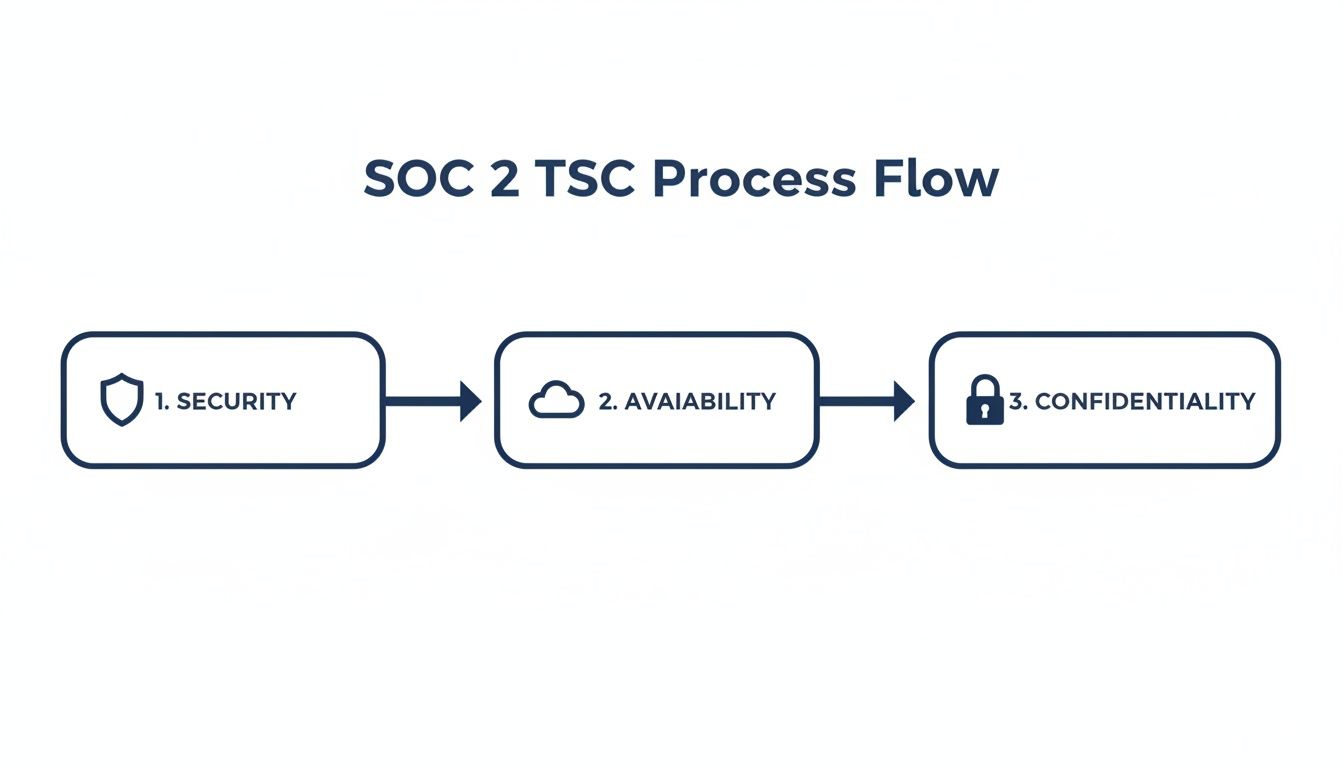
As you can see, Security is the mandatory starting point. Availability and Confidentiality are the most common additions, usually tacked on to back up specific promises you’ve made to customers.
Stage 1: The Readiness Assessment
This is, without a doubt, the most critical stage of the whole process. Think of it as the diagnostic check you run on your car before starting that long road trip. A proper readiness assessment, usually done with an auditor or consultant, pinpoints every single gap between your current controls and what SOC 2 actually requires.
This phase does two crucial things for you:
- Defines Your Scope: You’ll nail down which Trust Service Criteria actually matter for your business and the commitments you’ve made to customers.
- Creates a Gap Analysis: You get a detailed punch list of every missing policy, procedure, or technical control that needs to be fixed.
Skipping this step is a rookie mistake, and it’s a costly one. A readiness assessment gives you a clear action plan and prevents nasty surprises during the formal audit, which saves a ton of time and money down the road.
Stage 2: Remediation and Implementation
With your gap analysis in hand, it’s time to get to work. The remediation phase is all about execution—this is where your team rolls up their sleeves and starts checking things off the list from the readiness assessment. It’s a hands-on period of writing policies, configuring systems, and putting new controls in place.
For example, you might need to finally formalize your employee onboarding and offboarding processes, implement a real change management system, or lock down access controls on your cloud infrastructure.
As you navigate your SOC 2 Type 2 audit journey, building and documenting strong controls is everything. For some practical guidance, check out these Top Internal Controls Best Practices. This stage is where you build the security machine that the auditors will come to inspect.
The quality of your remediation work directly dictates how smooth your audit will be. The more thorough you are here, the fewer exceptions and headaches you’ll deal with later.
Stage 3: The Observation Period
Once all your controls are built and running, the official observation period kicks off. For a SOC 2 Type 2 report, this period typically lasts anywhere from three to twelve months. During this time, your job is to operate those controls consistently and collect the evidence to prove it.
Think of it as driving the car after the big tune-up. The auditor isn’t just looking at the car’s design anymore; they’re watching to see if it runs reliably over a long distance. You have to show that your security practices aren’t just policies sitting in a folder—they’re an active, breathing part of your daily operations.
To see how this timeframe impacts your project planning, check out this detailed guide on the SOC 2 audit timeline.
Stage 4: The Audit and Reporting Phase
After the observation period finally ends, the last phase begins. Your auditor now conducts their formal testing, which involves two main activities:
- Evidence Collection: The auditor will request specific samples of evidence from the observation period to test your controls. This could be anything from change logs and access reviews to new hire checklists and vulnerability scan reports.
- Fieldwork and Interviews: Auditors will likely talk to key people on your team to understand how processes actually work day-to-day. They’ll also perform their own tests to validate that your controls are effective.
Once the testing is done, the auditor compiles all their findings into the final SOC 2 Type 2 report. This document contains their professional opinion on your control environment, giving your customers the trusted, third-party assurance they’re looking for.
How Much Does SOC 2 Type 2 Certification Really Cost?
Budgeting for a SOC 2 Type 2 certification can feel like trying to nail Jell-O to a wall. It’s not a single line item. The final price tag is a blend of several costs that hinge on your company’s size, the complexity of your systems, and how prepared you are from day one.
Getting a handle on these components is the first step to building a realistic budget and avoiding that dreaded sticker shock. Your total investment really breaks down into four buckets: auditor fees, readiness work, compliance software, and the internal time your team will spend.
Breaking Down the Core Costs
Your biggest direct expense will almost always be the fee you pay the independent CPA firm for the audit itself. But here’s a common mistake: focusing only on that number. It’s a surefire way to blow your budget.
Let’s unpack the key line items that make up the total cost:
- Auditor Fees: This is what you pay the firm to perform the formal audit. The price tag varies based on the firm’s reputation, how many Trust Service Criteria you include, and how complex your tech stack is.
- Readiness Assessment: A gap analysis is essential before you kick off the real audit. This can be done by your audit firm as a separate project or by a third-party consultant. Don’t skip this.
- Compliance Automation Tools: Platforms that help you manage policies, continuously collect evidence, and monitor your controls can be a lifesaver. Think of these as an annual subscription that saves your team hundreds of hours of manual work.
- Internal Resources: This is the “hidden” cost that bites most companies. It’s the hours your engineering, IT, and HR teams pour into fixing gaps, gathering evidence, and sitting in interviews with the auditor. This is a very real, very significant investment.
The good news is that SOC 2 Type 2 pricing has become much more predictable. Based on 2025 benchmarks, the all-in first-year cost typically falls somewhere between $30,000 and $150,000. Most small to mid-sized tech companies land in the $30,000 to $80,000 range. The formal audit fee usually accounts for $20,000 to $60,000 of that total.
What Drives Your Audit Pricing?
Several key variables directly shape the quote an audit firm gives you. The more complex your environment, the more time an auditor has to spend testing—and the higher the price. If you want to dig deeper into these factors, our guide on how much a SOC 2 audit costs is a great resource.
Here are the big price drivers:
- Audit Scope: The more Trust Service Criteria (TSCs) you add beyond the required Security criterion, the more the cost goes up. Each additional TSC brings a new set of controls that need to be tested.
- Company Size: The number of employees directly impacts HR-related controls, like how you handle employee onboarding, background checks, and offboarding.
- System Complexity: Auditing a simple, single-application environment is far cheaper than auditing a sprawling microservices architecture that spans multiple cloud providers.
- Physical Locations: If you have in-scope data centers or offices, the auditor might need to do on-site visits, which adds travel and time to the bill.
The single biggest factor in controlling your SOC 2 budget is your level of preparation. A thorough readiness assessment and a well-organized remediation effort will always result in a smoother, more cost-effective audit.
Estimated SOC 2 Type 2 Cost Breakdown by Company Stage
To make this more concrete, the table below breaks down typical cost ranges based on company size. Remember, these numbers reflect the total first-year investment, not just what you’ll pay the auditor. This should give you a solid baseline for what to expect.
| Expense Category | Startup (Seed/Series A) | Mid-Market (Series B/C) | Enterprise (Large Scale) |
|---|---|---|---|
| Readiness Assessment | $5,000 - $15,000 | $10,000 - $25,000 | $25,000 - $75,000+ |
| Auditor Fees | $15,000 - $30,000 | $25,000 - $60,000 | $60,000 - $150,000+ |
| Automation Software | $8,000 - $20,000 | $15,000 - $40,000 | $40,000 - $100,000+ |
| Total Estimated Cost | $28,000 - $65,000 | $50,000 - $125,000 | $125,000 - $325,000+ |
As you can see, planning for a SOC 2 Type 2 certification is a strategic financial decision. By understanding what drives the costs and preparing your team thoroughly, you can turn what feels like an unpredictable expense into a manageable, high-value investment in your company’s growth.
How to Choose the Right SOC 2 Auditor for Your Business
Let’s be clear: picking your auditor is the single most important decision you’ll make on your journey to a SOC 2 Type 2 certification. This isn’t just hiring a vendor to check some boxes. Your auditor is the gatekeeper to your report, and their approach can make the difference between a smooth process and a six-month nightmare.
You have to look past the price tag.
Think of it like hiring a building inspector. One might just follow a generic checklist, ticking boxes. Another understands the unique stresses of your building’s architecture and knows exactly where to look for potential issues. An auditor specializing in FinTech will instantly grasp nuances that a healthcare-focused auditor might miss, making the entire audit sharper and more relevant.
Key Evaluation Criteria for Auditors
Your real goal is finding a partner who gets your company—your culture, your tech stack, and your business objectives. A bad fit here creates friction, kills momentum, and ultimately produces a less valuable report.
Here’s what you should be laser-focused on:
- Industry Expertise: Have they lived and breathed your world (SaaS, HealthTech, FinTech, etc.)? An auditor who gets your industry asks smarter questions and gives feedback that actually makes you better, not just compliant.
- Audit Style: Are they a traditional, “send us a thousand spreadsheets” firm, or a modern, tech-forward partner who plugs into your systems? The right style can save your team hundreds of hours.
- Communication and Responsiveness: When you have a question, do you get an answer in a few hours or a few days? Clear, fast communication is non-negotiable when you’re trying to clarify a control or evidence request.
Choosing an auditor isn’t a procurement task; it’s a strategic partnership. The right firm is a guide, helping you strengthen your security posture. The wrong one feels like an adversary, turning the audit into a painful, drawn-out ordeal.
Finding Your Perfect Match with Data
The market is crowded. You’ve got the massive “Big Four” firms, specialized boutiques, and everything in between. Large firms offer instant brand recognition, but the smaller shops often deliver far more personalized service and flexibility. It can feel overwhelming.
This is where a data-driven approach changes the game.
Instead of relying on cold calls and opaque proposals, platforms like SOC2Auditors.org let you slice and dice the market based on real information. You can filter auditors by their industry focus, read verified client reviews, and see actual pricing and timeline benchmarks.
This flips the power dynamic. It allows you to make an informed choice based on what truly matters: finding a partner whose expertise and style will get you across the finish line with a strong SOC 2 Type 2 certification.
And make no mistake, this certification is now a revenue accelerator. Companies are seeing sales cycles that are 30% faster because they can instantly overcome security objections. For a deeper dive into how SOC 2 is shifting from a compliance burden to a sales tool, you can explore detailed 2025 market analysis.
Common SOC 2 Questions Answered
As you start digging into the details of a SOC 2 Type 2 certification, you’ll run into some common questions. Moving from the big-picture concepts to actually planning your audit can feel overwhelming, but getting these key details straight will save you a ton of headaches and costly mistakes down the road.
Here are the no-BS answers to the questions we hear all the time.
How Long Is a SOC 2 Type 2 Report Valid?
Think of your SOC 2 report like an annual check-up for your security program. It’s generally considered valid for 12 months from the issue date.
After a year, most enterprise customers and partners will consider it stale. They need assurance that your controls are still working, not just that they were working a year ago. This annual cycle means SOC 2 isn’t a one-and-done project—it’s a continuous process of monitoring and preparing for the next audit to maintain uninterrupted compliance.
Can We Fail a SOC 2 Audit?
While you can’t technically “fail” like a school exam, you can absolutely get a report that raises major red flags with customers. The goal is to receive an unqualified opinion, which is the auditor’s way of giving you a clean bill of health. It means they found your controls are designed and operating effectively without any major issues.
But there are other, less desirable outcomes:
- Qualified Opinion: The auditor found significant problems in one or more areas, but the rest of the system is okay.
- Adverse Opinion: This is the worst-case scenario. It means widespread, material control failures were found.
- Disclaimer of Opinion: The auditor couldn’t even gather enough evidence to form an opinion.
Any opinion other than “unqualified” will make it much harder to close deals. It’s a clear signal to customers that something is wrong.
A “qualified” opinion is the auditor’s polite way of saying, “You’re doing most things right, but this specific area is broken and your customers need to know about it.” It’s a signal that immediate remediation is required to build trust.
Do We Need a Readiness Assessment?
While it’s not technically required by the SOC 2 framework, skipping a readiness assessment is one of the biggest and most common mistakes companies make. We highly recommend it. It’s the single best way to ensure your actual audit goes smoothly.
Think of it as a practice run before the main event. An assessment finds all the gaps and weak spots in your controls before the official audit clock starts ticking. This gives you time to fix everything without the stress of last-minute fire drills, expensive delays, or the risk of getting a nasty surprise in your final report.
What Is the Difference Between Certification and Attestation?
This is a classic point of confusion, but the distinction is mostly for compliance nerds. Technically, SOC 2 is an attestation report, not a certification. An independent CPA firm “attests to” (or validates) the effectiveness of your security controls against the AICPA’s criteria.
However, in the real world, everyone calls it a “SOC 2 Type 2 certification.” It’s become the common shorthand for proving you have a clean attestation report. While the terminology is technically different, both phrases point to the same goal: proving your security posture through a successful third-party audit.
Ready to find the perfect auditor for your business without the headache? SOC2Auditors provides transparent, data-driven comparisons of top audit firms. Get three tailored matches in 24 hours and make your choice with confidence. Start your search at https://soc2auditors.org.