 Menu
Menu
Stop thinking of a SOC 2 report as just another compliance checkbox. It’s one of the most powerful sales tools in your arsenal. Seriously. A clean, unqualified SOC 2 Type II report is your golden ticket to unlocking bigger enterprise deals, building trust from day one, and cutting down those painfully long procurement cycles.
How a SOC 2 Report Drives Revenue and Builds Trust
In today’s security-first market, having a SOC 2 isn’t a nice-to-have; it’s the price of admission. For any B2B company, especially in SaaS, this document is the tangible proof that your systems, processes, and people can be trusted.
Think of it as a rigorous background check on your company’s security, performed by an independent, certified auditor. It gives prospective customers the confidence they need to hand over their sensitive data, turning a complex technical assessment into a clear, verifiable asset.

From Compliance Hurdle to Sales Accelerator
Instead of being a simple checkbox, a strong SOC 2 report becomes a massive competitive advantage. It proactively answers the tough security and due diligence questions that can stall a sales cycle for months. A well-prepared report can speed up deal closure by up to 40% by getting ahead of the security team’s biggest concerns.
This isn’t a secret. The market has shifted, and constant validation is now the norm. In fact, 92% of organizations are now conducting two or more SOC 2 audits per year, and a staggering 58% are doing four or more annually. This shows a real commitment to ongoing security—exactly what enterprise clients are looking for. You can dig deeper into these compliance trends and their business impact.
Understanding the Report’s Structure
To really use your SOC 2 report to your advantage, you need to know what’s inside. We’ll break down a full SOC 2 report example later, but for now, let’s get the lay of the land.
Here’s a quick look at the five key sections of a SOC 2 report and what each part actually tells a potential customer.
Key Sections in a SOC 2 Report
| Section Number | Section Title | What It Tells You |
|---|---|---|
| Section 1 | Auditor’s Opinion | The final verdict from the auditor—the most critical summary of the findings. This is the first thing everyone reads. |
| Section 2 | Management’s Assertion | The company’s official statement affirming responsibility for its security controls. Think of it as your “we stand by our system” declaration. |
| Section 3 | System Description | A detailed map of what was included in the audit, defining the scope and boundaries. It tells the reader exactly what was (and wasn’t) audited. |
| Section 4 | Tests of Controls | The nitty-gritty details showing how each security control was tested and the results. This is where the evidence lives. |
| Section 5 | Other Information | Optional responses or additional context provided by the company’s management, often to explain a finding. |
Each of these sections plays a crucial role in telling your security story. Knowing how to navigate them is key to both passing your audit and using the final report to win more business.
Decoding the Auditor’s Opinion
Before you even think about digging into the dense details of a SOC 2 report, your first stop should always be the auditor’s opinion. This section, usually one of the very first pages, is the executive summary of the entire audit. It’s the top-level verdict on whether a vendor’s security controls are actually doing their job.
Think of it as the report card. It’s here that an independent Certified Public Accountant (CPA) gives their official take on whether the company’s description of its system is fair and if its controls are designed and operating effectively. Honestly, this single page can tell you almost everything you need to know.
The Four Types of Auditor Opinions
An auditor can issue one of four opinions, and the differences between them are night and day. Getting this language right is the key to quickly sizing up any SOC 2 report example.
- Unqualified Opinion: This is the gold standard. It means the auditor found no significant problems or material exceptions. The vendor’s controls are well-designed and worked as expected throughout the entire audit period. You’ll see phrases like “no material misstatements” and “controls were suitably designed… and operated effectively.”
- Qualified Opinion: This is a major red flag. It tells you the auditor found a serious issue with one or more specific controls, but the rest of the report was okay. The opinion will literally “qualify” its conclusion by calling out the problem areas.
- Adverse Opinion: This is the worst-case scenario. An adverse opinion means the auditor discovered significant, widespread issues with the control environment. It’s a clear signal that the vendor’s system can’t be trusted.
- Disclaimer of Opinion: In this rare situation, the auditor simply couldn’t get enough evidence to form an opinion at all. This might happen if the vendor stonewalled or couldn’t provide the necessary documentation, and it pretty much invalidates the entire report.
The front-page opinion is your executive dashboard—unqualified asserts controls are suitably designed and operating effectively, while qualified flags exceptions that could void insurance (avg. $4.45M breach cost per IBM 2025).
From Point-in-Time to Proven Practice
It’s also crucial to know which type of report you’re looking at, because the opinion’s weight changes. A Type I report is just a snapshot, assessing controls at a single point in time. A Type II report, on the other hand, tests those controls over a period—usually 6-12 months.
An unqualified opinion on a Type II report is infinitely more valuable because it proves the controls held up over the long haul. You can learn more about these critical differences in our guide comparing SOC 2 Type I vs. Type II reports. In 2025, 85% of enterprise RFPs mandate Type II reports proving 6–12 months of operational control effectiveness, slashing procurement cycles by 40%.
Mapping Your Data with the System Description
Once you’ve glanced at the auditor’s high-level opinion, your very next stop should be Section 3, the System Description. I like to think of this as the detailed map of a vendor’s service territory. It spells out the exact boundaries of the audit, telling you precisely what infrastructure, software, key people, data flows, and sub-processors were actually examined.
This is where you discover what was—and wasn’t—covered. A strong system description is crystal clear and leaves no room for guessing. On the flip side, a vague or fuzzy description is a massive red flag. It’s often where vendors hide risky “carve-outs.”
Why Scrutinizing the Scope Is Crucial
Let’s walk through a hypothetical SOC 2 report example. Imagine a vendor relies heavily on a third-party data processor, but that processor is explicitly excluded from the audit scope. This creates a huge blind spot for you. If that sub-processor gets breached, your data is at risk, yet the vendor’s SOC 2 report will still show a clean bill of health.
Vague descriptions and scope gaps like these aren’t just theoretical problems. Recent procurement benchmarks show they can cost companies up to 30% of their enterprise deals when a savvy customer finds them. This is why mapping the vendor’s system against your own data flows isn’t just a best practice; it’s non-negotiable due diligence.
A detailed system description should clearly articulate service commitments, such as 99.99% uptime, and list all in-scope sub-processors. If a vendor’s core functions depend on services outside the report’s boundaries, you must demand justification or a separate report covering those carved-out elements.
A Practical Checklist for Evaluating the System Description
To really get a feel for a vendor’s security posture, use this checklist as you read through their System Description:
- Verify Infrastructure and Software: Does the description clearly name the cloud providers (like AWS, Azure, GCP), data centers, and critical software applications included in the audit? You want specifics, not generalizations.
- Identify Key Personnel: The report should mention the roles and teams responsible for managing the in-scope systems. This tells you who actually owns security and operational duties.
- Confirm Trust Services Criteria (TSCs): The description must state which of the five TSCs (Security, Availability, Confidentiality, Processing Integrity, and Privacy) were audited. Make sure the ones they chose actually align with the services you’ll be using.
- Map Data Flows: Try to trace the path your data will take through the vendor’s system as it’s described. Are all the components that will touch your data—including any AI training pipelines—explicitly included in the scope?
Before an audit even kicks off, a company has to do its own internal review to define this scope accurately. A well-executed review can catch potential gaps early on. You can learn more about how to prepare with a SOC 2 readiness assessment. Ultimately, the System Description provides the critical context you need to make sense of the entire report.
Analyzing the Control Tests for Real Proof
If the auditor’s opinion is the final grade on the report card, then this next section is where you find all the individual test scores. This is the evidence locker of the entire SOC 2 report, often called the “Tests of Controls.” Honestly, about 80% of a report’s real value is buried right here.
This is where you move past promises and policies to see how a vendor’s security controls actually hold up under a microscope. Auditors detail every single test they ran—from pulling access logs to grilling engineers—and lay out the results. It’s your chance to see if a company’s day-to-day security practices match what they’ve written down on paper.
Think of it like this: a company’s security posture is a combination of its technology, its people, and its processes. All three have to work together.
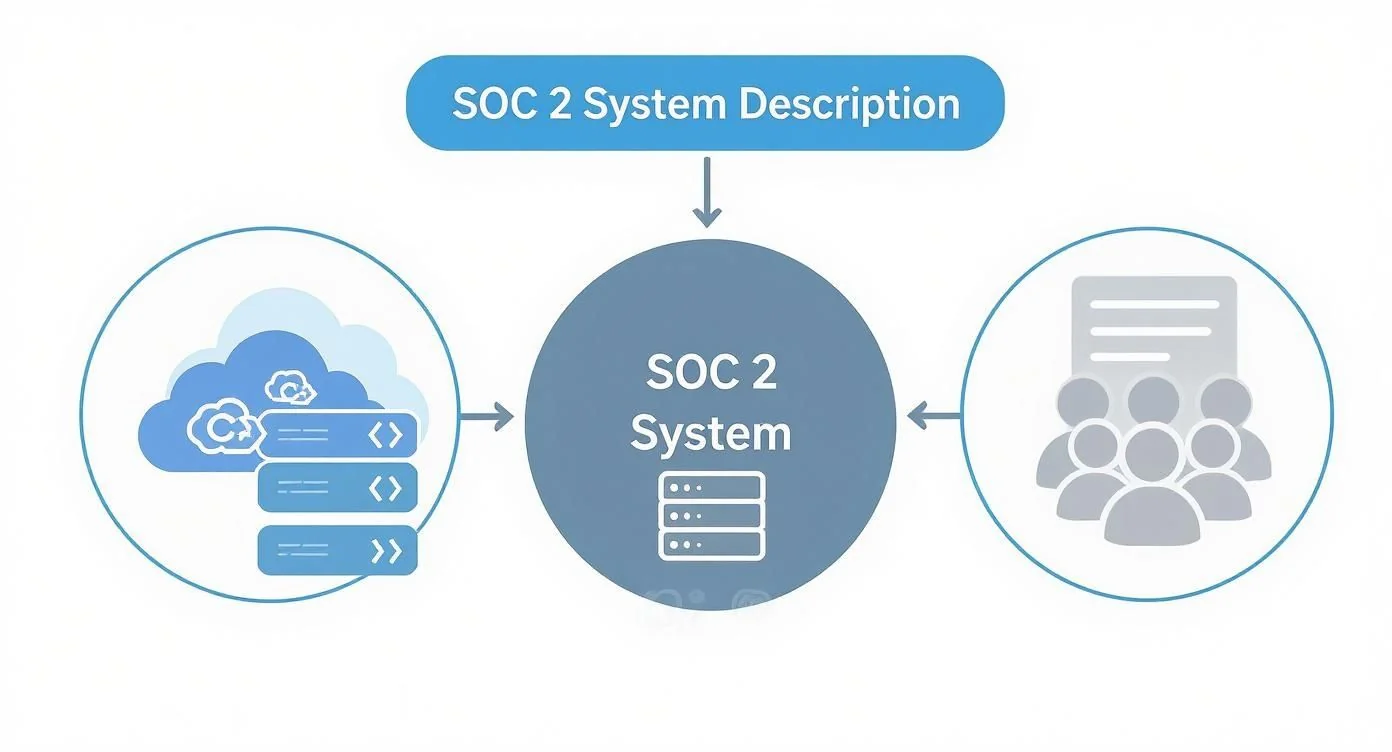
This diagram shows how a secure system isn’t just about the tech—it’s also about the people and the documentation that govern it. The tests of controls in Section 4 are designed to poke and prod every part of this system to see if it’s truly secure.
Decoding the Control Test Matrix
The heart of this section is a big, detailed table that can look pretty intimidating at first glance. But once you know what you’re looking for, it’s easy to break down. While the layout might differ a bit between auditors, any good SOC 2 report example will have the same core components in its test matrix.
Let’s walk through what each part of this table is telling you.
- The Control: This is the specific security rule being checked. It’s usually tied directly to one of the AICPA’s Trust Services Criteria, like CC6.1, which deals with who can access your systems.
- Test Procedures: This column shows you exactly what the auditor did. Did they just ask someone if a process was followed? Or did they actually do the work themselves, like trying to access a system they shouldn’t or pulling their own sample of security logs? Strong tests always involve direct, independent verification.
- The Results: This is the simple verdict for each test. You’ll usually see phrases like “Passed,” “No exceptions noted,” or the one that should make you sit up: “Exceptions noted.” This is where you hunt for problems.
Any exception, no matter how small, is worth a closer look. One tiny slip-up might be forgivable, but a pattern of them—or a failure rate over 5% on a critical control like CC6.1 (logical access)—points to a much bigger, systemic issue.
What Strong vs. Weak Evidence Looks Like
Not all auditor tests are created equal. The quality of the test procedure is a direct reflection of how seriously you should take the report. If the test descriptions are vague, it’s a huge red flag that the audit might have been a bit of a softball.
For example, a weak test might say: “Inquired with management to confirm that terminated employees have their access revoked within 24 hours.” That’s just taking someone’s word for it.
A strong test, on the other hand, provides real proof: “For a sample of 25 employees terminated during the audit period, inspected HR records and system access logs to verify that access was revoked within the 24-hour SLA. No exceptions were noted.” See the difference? The auditor didn’t just ask; they pulled the data and verified it themselves. This is called re-performance, and it’s the gold standard you should be looking for.
Choosing the Right Trust Services Criteria
The foundation of any SOC 2 report is built on the five Trust Services Criteria (TSCs), but they aren’t all created equal. Security is the mandatory cornerstone of every audit. But a vendor’s choice to include the others—Availability, Confidentiality, Processing Integrity, and Privacy—tells you a lot about their operational maturity and how seriously they take protecting your data.
A smart vendor scopes their TSCs to match what they promise in their marketing and what risks their customers actually face. A simple SaaS platform might get away with only covering Security. But if a financial data processor doesn’t include Processing Integrity, they’re waving a giant red flag.
Matching TSCs to Your Business Needs
The TSCs a vendor includes in their SOC 2 report are a direct reflection of what they’re willing to stand behind. Your job is to make sure their choices line up with what your business actually needs to stay secure.
- Security (Mandatory): This is the baseline. It covers the basics of protecting systems and data against unauthorized access. Every single SOC 2 report has to include it, no exceptions.
- Availability: Crucial for any service where downtime means lost revenue. Enforce tests for RTO <4h with geo-redundant backups. Excluding it can void 40% of SaaS value.
- Confidentiality: Essential for protecting sensitive IP. Reports must prove AES-256 encryption at rest/transit with key rotation and verified data deletion (e.g., CC6.6).
- Processing Integrity: Absolutely essential for any service that handles transactions or critical calculations, like financial reporting tools or e-commerce platforms. This ensures that when your data is processed, it’s complete, valid, accurate, and authorized.
- Privacy: A non-negotiable for vendors touching PII. New updates mandate controls for AI data lineage (CC9.2) to prevent data de-identification drifts in LLM fine-tuning and avoid GDPR fines.
Looking Ahead to Emerging Risks
The compliance world is getting bigger than just one framework. We’re seeing a major shift where ISO 27001 is gaining serious ground on SOC 2. In 2025, a whopping 81% of companies reported current or planned ISO 27001 certification, a big jump from just 67% in 2024. This shows that real, comprehensive assurance requires a multi-framework approach, where SOC 2 is just one piece of a larger compliance puzzle. Discover more insights about these compliance statistics.
Choosing a vendor that proactively includes relevant TSCs like Privacy and Availability is a powerful signal. It shows they understand their service’s impact on your business and are prepared to prove their resilience, rather than just meeting the bare minimum for compliance.
Modern reports are also starting to tackle new risks like AI data management. A forward-thinking vendor might scope their Privacy TSC to include controls for data lineage in AI models. That’s a smart move that can prevent massive retraining costs and regulatory fines down the road, ensuring their compliance program is ready for tomorrow’s threats, not just yesterday’s.
Moving from a Static Report to Continuous Trust
A SOC 2 report is a powerful snapshot of your security controls, but let’s be honest—it’s just a snapshot. It captures a single moment in time, not a continuous video feed of your security program. To build real, lasting trust with customers, your security program has to work every single day, not just during the audit window.
This means getting out of the reactive, once-a-year fire drill and into a proactive, “always-on” state of audit readiness.
When you do this, compliance stops being a periodic chore and becomes a genuine strategic advantage. It ensures the security posture documented in your SOC 2 report example is your everyday reality, preventing the slow creep of “security drift” between your annual assessments.
Maintaining an Always-On Audit Posture
So, how do you bridge the gap between reports? A common tool is a bridge letter (sometimes called a gap letter). This is a document you give customers to cover the period between your last SOC 2 report’s end date and today, attesting that no major changes have weakened your controls.
But bridge letters are a band-aid. The real solution is automation. Modern compliance platforms are pretty much essential for maintaining this continuous state of trust.
An “always-on” approach means your security program is perpetually managed and verified. The annual audit becomes a simple validation of what you already know to be true, rather than a frantic scramble for evidence.
These tools are built to maintain a constant state of readiness. They do this by:
- Continuously monitoring your controls and collecting evidence automatically.
- Alerting your team to compliance gaps or misconfigurations in real-time.
- Slashing the manual effort for future audits by over 70%.
The market is betting big on this approach. The global SOC Reporting Services market is projected to hit USD 10,470 Million by 2030, growing at a 12.3% CAGR. This massive investment, detailed in the full market report, shows that customers demand proven, ongoing security—not just a static report from last year.
Ultimately, a SOC 2 report should be the natural, almost effortless output of a continuously managed security program. By adopting this mindset and using the right tools, you build a resilient security foundation that practically runs itself. For more on this, check out our guide on SOC 2 compliance software that can help get you there.
Frequently Asked Questions
Got questions? You’re not alone. Here are a few of the most common things people ask when they’re trying to make sense of a SOC 2 report for the first time.
What Is the Main Difference Between a SOC 2 Type I and Type II Report?
Think of it this way: a SOC 2 Type I report is a snapshot. It looks at your security controls at a single point in time to see if they’re designed correctly. It’s like an architect checking the blueprints for a new building—everything looks good on paper.
A SOC 2 Type II report is more like a video. It tests those same controls over a period of time, usually 6-12 months, to prove they’re actually working as intended. This is the real-world test, and it’s the gold standard that over 85% of enterprise customers demand before signing a contract.
How Long Should a Good SOC 2 Report Be?
While quality definitely beats quantity, a truly comprehensive SOC 2 Type II report is rarely shorter than 100 pages. If you see a report that’s significantly thinner, it could be a red flag.
A short page count might signal a very narrow audit scope or that the auditor didn’t provide enough detail in their testing matrices. Don’t be fooled by brevity; a thin report can sometimes mean the auditor didn’t dig deep enough, leaving you to wonder what they might have missed.
Don’t be swayed by brevity. A thin report might mean the auditor didn’t dig deep enough, leaving critical security practices unverified. Prioritize depth and clarity over a shorter page count.
What Are Complementary User Entity Controls?
This one sounds complicated, but the concept is simple. Complementary User Entity Controls (CUECs) are the security responsibilities that fall on your shoulders as the customer. It’s the vendor’s way of saying, “We’ve secured our part of the system; now here’s what you need to do to secure yours.”
For example, a cloud provider’s report will almost always list CUECs that require customers to manage their own user access, set up strong passwords, and configure multi-factor authentication. Always read this section carefully—it’s your to-do list for using the service securely.
Finding the right auditor is the most important step in your SOC 2 journey. At SOC2Auditors, we replace endless sales calls and confusing quotes with a data-driven matching platform. Get three tailored auditor matches based on your budget, industry, and timeline—all in under 24 hours. Find your perfect SOC 2 auditor with confidence.