A Guide to SOC 2 Compliance Services

SOC 2 compliance services are the different professional offerings designed to help your company prepare for, get through, and maintain a SOC 2 audit. Think of them as the expert crew you bring in for a home inspection of your data security—they help you find the cracks, fix them, and get the official report you need to prove your systems are sound and trustworthy.
What Are SOC 2 Compliance Services
Jumping into the world of SOC 2 can feel like learning a new language. The term “SOC 2 compliance services” is really just an umbrella that covers several distinct stages of the journey. One of the most common mistakes is failing to understand these differences, which almost always leads to wasted time and a blown budget.
This isn’t a single product you just buy off the shelf. It’s a partnership you build to prove your security posture is legit.
Imagine you’re building a custom home. You wouldn’t just call an inspector on the final day and cross your fingers. You’d work with architects and builders long before that inspection ever happens. The exact same logic applies here.
The Blueprint: Readiness Assessments
A Readiness Assessment is the architectural blueprint for your compliance. A specialized firm comes in and reviews your current security controls, policies, and procedures against the specific SOC 2 Trust Services Criteria that matter to your business.
This entire service is designed to answer one critical question: “Where are our gaps?”
The result is a detailed report that clearly highlights where you’re falling short and gives you a concrete roadmap for fixing it. It’s the absolute essential first step for any company new to SOC 2, and it prevents the costly mistake of walking into a formal audit completely unprepared.
The Official Inspection: Audits
The SOC 2 Audit is the official inspection. This is the formal process where an independent Certified Public Accountant (CPA) firm tests your controls to see if they’re designed correctly (that’s a Type 1 report) and if they’re actually working effectively over time (that’s a Type 2).
A SOC 2 audit is an attestation, not a certification. This means an independent CPA firm provides a formal opinion on your security controls, lending a level of credibility that a self-assessment never could. This distinction is crucial for building trust with enterprise clients.
This is the phase where all your prep work pays off. The final output is the SOC 2 report itself—the document you hand over to customers to prove you’re serious about security. For a great real-world example of a company hitting this milestone, check out Docsbot’s SOC 2 Type II certification.
Fixing the Issues: Remediation Support
Remediation services are the construction crew. They’re the ones who come in and fix all the issues that the readiness assessment uncovered.
If the assessment found you’re missing a formal risk management policy or that your employee onboarding process has security holes, remediation experts help you build and implement the right controls. These services bridge the gap between knowing what’s wrong and actually getting it fixed, making sure you’re ready for the formal audit. Many firms offer this right alongside readiness to create a seamless path to compliance.
Getting these distinct services straight is the foundation of a successful compliance strategy. If you’re just starting out, you can learn more about the fundamentals in our complete guide on what is SOC 2 compliance.
Choosing Between Readiness Audits and Remediation
Trying to figure out where to start with SOC 2 can feel like choosing a path in a dense forest. Do you need a map, a guide, or someone to build a bridge? The key is picking the right service for where you are right now, so you don’t make the costly mistake of jumping into a formal audit before you’re actually prepared.
This decision tree lays out the typical journey, showing how readiness, auditing, and remediation fit together as separate, crucial phases.
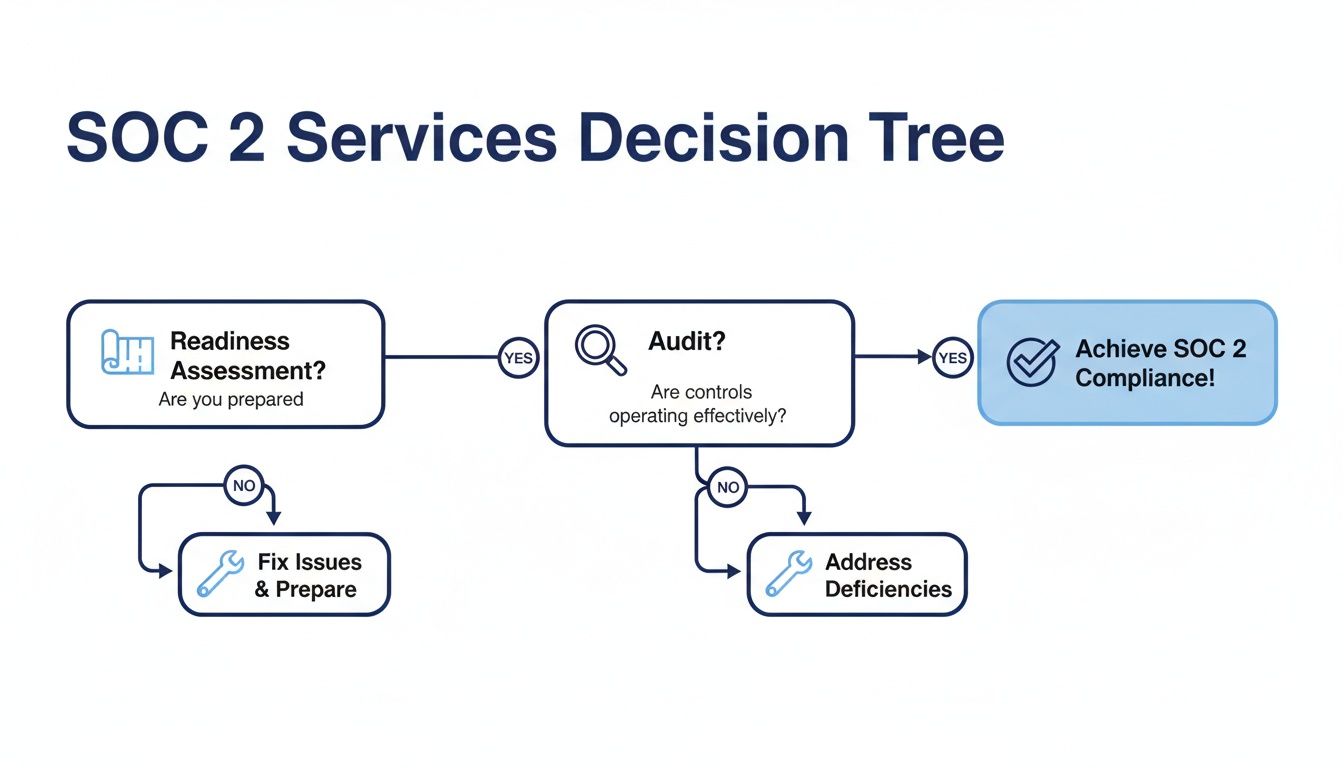
As you can see, a readiness assessment is the logical first step. It’s all about identifying and fixing problems early to set yourself up for a successful audit down the line.
Start with a Readiness Assessment
For nearly every company going after SOC 2 for the first time, a readiness assessment is the non-negotiable starting point. Think of it as a friendly practice exam before the real test. An auditor reviews your current controls, identifies all the holes, and hands you a detailed gap analysis showing exactly what’s missing and what needs fixing.
This step is especially critical for startups and growth-stage companies. Rushing headfirst into a formal audit often leads to a failed audit, wasted money, and painful delays in your sales cycle. A readiness assessment gives you a clear, actionable roadmap to compliance. If you’re wondering what that involves, you can learn more about a SOC 2 readiness assessment in our detailed guide.
This prep work is essential because very few companies are compliant right out of the gate. In fact, only 18% of SaaS companies have secured either SOC 2 or ISO 27001 compliance. That number plummets to a mere 7% for pre-seed or seed-stage startups, highlighting a huge gap for early-stage firms trying to land those big enterprise deals.
The Role of Remediation Services
Once your readiness assessment is done, you’ll have a punch list of gaps. This is where remediation services come in. If the assessment is the diagnosis, remediation is the treatment plan.
Remediation is the hands-on work of building the missing controls, writing the required policies, and implementing new security procedures. For example, your assessment might find you lack a formal employee offboarding process or a vendor risk management program. A remediation provider helps you actually create and document these controls to meet SOC 2 standards.
Choosing to skip or rush remediation is like knowing a bridge is weak but driving over it anyway. It’s the essential step that turns insights from your readiness report into a strong, auditable security program.
To clarify how these services differ, this table breaks down their core purpose and deliverables.
Comparing SOC 2 Services
| Service Type | Primary Goal | Typical Timeline | Key Deliverable | Best For |
|---|---|---|---|---|
| Readiness Assessment | Identify gaps and create a roadmap for compliance. | 2-4 weeks | Gap Analysis Report | Companies starting their SOC 2 journey. |
| Remediation | Fix the gaps identified in the readiness assessment. | 1-4 months | Implemented Controls & Policies | Companies with known gaps needing hands-on help. |
| Formal Audit | Provide an independent opinion on control effectiveness. | 3-12 months | SOC 2 Report (Type 1 or 2) | Companies that are prepared and need official certification. |
This breakdown makes it clear: you start with readiness to find the problems, use remediation to fix them, and only then proceed to a formal audit to prove it.
When to Proceed with a Formal Audit
Only after you’ve completed a readiness assessment and addressed all the major gaps through remediation should you hire a firm for a formal SOC 2 Type 1 or Type 2 audit. By this point, you’ve done your homework and are confident that your controls are designed and operating effectively.
Here’s a quick breakdown to help you decide which audit is right for you:
- SOC 2 Type 1 Audit: This is a “point-in-time” audit. It verifies your controls are designed properly on a specific date. It’s a fantastic first milestone for startups who need to show a prospect a SOC 2 report quickly to keep a deal moving.
- SOC 2 Type 2 Audit: This is the gold standard. It tests that your controls have been operating effectively over a period of time, usually 3 to 12 months. Enterprise customers almost always require a Type 2 report for any real partnership.
For most companies, the path is clear: start with readiness, remediate your gaps, get a Type 1 report to satisfy immediate needs, and then maintain your controls to achieve a Type 2 report annually. This phased approach makes the whole process manageable and aligns your compliance efforts with your business growth.
How to Choose the Right SOC 2 Audit Firm
Picking a partner for your SOC 2 compliance services is one of the most important decisions you’ll make on your security journey. This isn’t just hiring an inspector; it’s about finding a guide who can navigate you through a complex, often frustrating process.
The right firm makes the audit smoother and helps you build a genuinely better security posture. The wrong one can lead to blown deadlines, budget overruns, and a final report that fails to impress the very customers you’re trying to win. Your decision can’t be based on a sales pitch. It needs a clear-eyed look at the factors that directly impact your audit’s success and your ability to close deals.

Look for Specialization in Your Industry
Not all audit firms are created equal. A generic firm might understand the SOC 2 framework, but a specialist understands your world. For a FinTech company, an auditor who gets financial regulations is invaluable. For a HealthTech provider, a firm that already knows HIPAA is non-negotiable.
An industry-specialized auditor brings huge advantages to the table:
- Relevant Experience: They’ve seen tech stacks and business models just like yours, so they know which security controls actually matter.
- Smarter Questions: They won’t waste your engineering team’s time with basic industry questions. Their audit is just more efficient.
- Better Insights: Their recommendations will be practical and tied to your real-world operational risks, not just generic compliance fluff.
When you’re vetting potential partners, ask them point-blank about their experience with companies like yours. Request anonymized case studies or references from clients in your vertical. This is how you find out if they can do more than just a check-the-box audit.
Verify Their Audit Capabilities and Approach
Your compliance needs are going to grow as your company does. The firm you choose for your first Type 1 audit should absolutely be the one that can guide you through your annual Type 2 reports for years to come. Switching auditors is a massive, expensive headache.
So, you have to confirm their capabilities upfront. Can they handle a multi-year engagement? Do they have the team capacity to support your growth? A firm that mostly works with tiny startups might not have the resources to handle a complex enterprise environment down the road.
Your auditor is a long-term partner, not a one-time vendor. The relationship should be built on trust, transparency, and a shared understanding of your security goals. Their success is tied to yours.
You also need to dig into their auditing process. Are they using modern, collaborative software, or are they still emailing spreadsheets back and forth? A modern approach can dramatically cut down the administrative pain for your team. And since you’ll be sharing incredibly sensitive information, a rock-solid clause of confidentiality in your contract is paramount for protecting your business.
Focus on Report Speed and Clarity
Let’s be real: for many companies, a SOC 2 report is a sales tool. A big prospect is waiting on that report to sign a deal. In that context, the speed to report delivery is a critical metric.
Ask potential firms for their average turnaround time from the end of the audit period to when you have the final report in hand. A difference of a few weeks can literally mean closing a deal this quarter or pushing it to the next.
But speed is useless if the final report is a confusing mess. A poorly written SOC 2 report full of jargon creates more questions than it answers, slowing down your sales cycle as prospects’ security teams demand clarification.
The best audit firms produce reports that are:
- Clear and Concise: Written for a business audience, not just for other auditors.
- Well-Structured: Easy for a customer’s security team to navigate and find what they need.
- Actionable: If any issues are noted, the report gives clear context on their actual impact.
Before you sign anything, ask to see a redacted sample report. If you can’t understand it, you can bet your future customers won’t be able to, either.
Evaluate the Quality of Their Support
Finally, don’t underestimate the human element. Throughout the audit, your team will have dozens of questions. The quality and responsiveness of the support you get will define your entire experience.
During your vetting calls, pay close attention to how they communicate. Do they give you straight answers or vague promises? Are they patient when explaining complex topics? You aren’t just buying a report; you are investing in a service.
Look for a dedicated point of contact who will be available to your team. A firm that offers strong, ongoing support is a true partner in your soc 2 compliance services journey. They help you not only get compliant but also build a stronger, more resilient security program for the long haul. That kind of proactive partnership is the real prize.
Understanding SOC 2 Compliance Costs and Timelines
Trying to budget for SOC 2 can feel like guesswork. The reality is, there’s no flat fee. Your costs and timeline hinge entirely on your company’s size, the complexity of your systems, and how much security groundwork you’ve already laid.
Think of it like building a house. A small, pre-designed cabin is a lot cheaper and faster to construct than a custom-built mansion. It’s the same with SOC 2. A five-person startup with a simple app will have a vastly different experience—and price tag—than a 500-employee company with a web of interconnected services.
The investment is real, but so is the demand. The global market for SOC Reporting Services hit USD 5,392 million and is expected to nearly double by 2030, all because businesses are desperate for proof of data security. North America is leading the pack, making up almost half the market as tech and finance companies lean on these reports to build trust. You can find more data on this booming market and what’s driving it on marksparksolutions.com.
Breaking Down SOC 2 Audit Costs
Several key factors drive the price of a SOC 2 audit. Getting a handle on these variables will save you from sticker shock when the proposals start rolling in.
Here’s what auditors are looking at:
- Company Size and Complexity: More employees and more intricate systems simply mean more work for the auditor. They have more ground to cover and more controls to test.
- Number of Trust Services Criteria (TSCs): Every SOC 2 audit must include the Security criterion. But if you add on Availability, Confidentiality, Processing Integrity, or Privacy, you’re expanding the scope, which naturally increases the price.
- Audit Type (Type 1 vs. Type 2): A Type 1 report is a snapshot in time—it checks if your controls are designed correctly on a single day. It’s the cheaper, faster option. A Type 2 report is a video, not a snapshot; it tests if your controls are actually working over a 3-12 month period, making it far more intensive and expensive.
For a small to mid-sized company, a typical SOC 2 Type 1 audit will likely land somewhere between $15,000 and $30,000. The more rigorous Type 2 audit usually runs from $25,000 to $60,000+, with costs climbing for larger organizations or more complicated scopes.
Just remember, these numbers cover the audit itself. You’ll also need to budget for any readiness assessments, remediation help, or compliance automation software you use. Think of those as separate, but equally important, investments.
Mapping Out Your SOC 2 Timeline
Just like the cost, the timeline for getting your SOC 2 report isn’t one-size-fits-all. It’s a journey with multiple stages, and trying to rush it is a surefire way to get a qualified report (which is basically a “fail” in your customer’s eyes).
Here’s a realistic look at how the timeline breaks down:
- Readiness and Remediation (1-6 months): This is all the prep work. Your team will hunt for gaps, write new policies, implement controls, and start gathering evidence. How long this takes depends entirely on how mature your security posture is today.
- Type 1 Audit (2-6 weeks): Once you’re prepped, the actual audit moves pretty quickly. The auditor tests your controls as of a specific date, and you can expect the final report a few weeks after that.
- Type 2 Observation Period (3-12 months): This is the long haul. You have to prove your controls are working day-in and day-out over a sustained period. Most companies aim for a 6-month window for their first Type 2.
- Type 2 Audit and Reporting (4-8 weeks): After your observation period closes, the auditor dives in to perform their final testing and draft the report.
These phases aren’t always sequential—some can overlap. But you can’t shortcut the core time commitments. To get a more granular view, check out our deep dive on how long a SOC 2 audit takes in our detailed guide. Planning for this timeline from the start will keep you from promising a report to a big prospect before it’s even possible to deliver it.
Your Step-by-Step Auditor Selection Checklist
Picking the right firm for your SOC 2 audit feels like a huge, messy decision. But if you break it down into a series of smaller, logical steps, it becomes much more manageable. Following a clear checklist helps you cut through the sales pitches and find a partner that actually fits your company.
This isn’t about guesswork. It’s about making a smart, data-driven choice that will pay off for years.

1. Define Your Scope and Needs
Before you even open a single browser tab to look at firms, you need to look inward. What are you actually trying to prove with this SOC 2 report?
Start with the five Trust Services Criteria (TSCs). Security is mandatory, but what about the others? If you promise customers 99.99% uptime, you absolutely need Availability. If you handle sensitive M&A documents, Confidentiality is a must. Nail this down first, because it dictates everything that follows.
2. Set Your Budget and Timeline
With a clear scope, you can get real about money and deadlines. Based on your company’s size and the complexity of your systems, figure out a realistic price range. Just remember: the audit fee is one piece of the puzzle. You also need to budget for the readiness assessment and any remediation work needed to fix gaps.
Your timeline is just as critical. Is a specific enterprise deal blocked until you get a Type 1 report? Or are you playing the long game and preparing for a six-month Type 2 observation period? Having these constraints defined will immediately weed out firms that can’t meet your schedule or budget.
3. Research and Shortlist Potential Firms
Okay, now it’s time to start the search. Go beyond a simple Google search and use platforms that offer verified data on auditors. Your goal is to build a shortlist of three to five potential partners that look like a good fit on paper.
During this stage, focus on what really matters:
- Industry Specialization: Do they live and breathe FinTech like you do, or are they generalists?
- Company Size Fit: Do their case studies feature scrappy startups like yours, or are they all Fortune 500 logos?
- Audit Capabilities: Can they handle a Type 1 now and grow with you to annual Type 2 reports later?
4. Conduct Due Diligence Calls
You’ve got your shortlist. Now it’s time to get them on the phone and see if the reality matches the marketing slick.
Treat these calls like you’re interviewing a key hire, not listening to a sales pitch. You’re in control. Show up with a list of pointed questions about their process, the team you’ll be working with, and their experience with companies like yours.
This is your chance to gauge their expertise and see if they’re a cultural fit. A great partner will be transparent and eager to educate you. A bad one will be evasive and full of buzzwords.
5. Review Proposals and Compare Offers
After the calls, the qualified firms will send over detailed proposals. This is a critical step, and you can’t just skip to the price at the bottom. To do a real apples-to-apples comparison, you need to dissect each offer.
Lay the proposals out side-by-side and check these key items:
- Scope of Work: Did they actually listen? Does it match the TSCs and systems you discussed?
- Deliverables: What do you get besides the final PDF? Is ongoing support included? Can they provide a sample report so you can see their work?
- Timeline: Is there a guaranteed report delivery date? Get it in writing.
- Team: Who is your day-to-day contact? Are you getting a senior partner or a junior associate?
6. Make Your Final Decision
You’ve done the homework. Now it’s time to weigh all the factors—price, industry expertise, the clarity of their sample report, how responsive they were, and the timeline.
Pick the firm that doesn’t just fit your budget, but also gives you the confidence that they’ll be a true partner in your security journey, not just a vendor who disappears once the check clears.
Finding Your Auditor with a Comparison Platform
Let’s be honest: the old way of finding an auditor is broken. It’s a soul-crushing cycle of cold calls, sitting through the same sales pitch over and over, and trying to decipher proposals that feel like comparing apples to oranges. The whole process is slow, frustrating, and puts all the leverage in the sales team’s hands, not yours.
A modern auditor comparison platform flips that script entirely. Instead of you hunting down auditors, the right ones are matched to you based on what you actually need. It transforms the search from a frustrating guessing game into a clear, data-driven decision.
This approach finally brings some much-needed efficiency and transparency to a process that’s always been opaque. It lets you sidestep the sales pressure and get straight to objective, side-by-side comparisons.
How a Matching Platform Works
These platforms do the heavy lifting by gathering verified data on dozens of audit firms, creating a single source of truth. You can slice and dice the options based on the criteria that genuinely matter to your business, ensuring you only spend time talking to firms that are a real fit.
Here’s why this model is a game-changer:
- Data-Driven Filtering: Instantly narrow your options by industry expertise, budget, company size, and when you need the final report.
- Tailored Matches: Get a curated shortlist of three to five highly qualified firms that tick all your boxes, often within 24 hours.
- Objective Comparisons: Evaluate firms using standardized data points like average project timelines, real client satisfaction scores, and even ratings on report clarity.
This data-first approach is becoming critical as the demand for SOC 2 compliance services explodes. By 2025, the market is seeing a massive uptick in audits, with 92% of organizations conducting at least two audits per year and a staggering 58% tackling four or more. You can dive deeper into these compliance trends at sprinto.com.
Making a Smarter, Faster Decision
Using a platform takes the guesswork out of the equation and lets you pick an auditor with confidence. You can avoid the classic pitfalls of overpaying for a brand name or, worse, signing with a firm that can’t hit your deadlines.
By comparing verified data on factors like speed, support quality, and pricing, you can make a choice that accelerates your sales cycle and improves your audit outcome. This shifts the focus from finding an auditor to finding the right auditor for your business.
Ultimately, this modern method saves your team dozens of hours, slashes the risk of a bad partnership, and gets you to compliance faster. It’s the smarter way to navigate one of the most critical decisions in your company’s security journey.
Frequently Asked Questions About SOC 2 Services
When you’re diving into SOC 2, a few key questions always pop up. Getting clear, no-nonsense answers can make the difference between a smooth process and a stalled project. Here are the straight answers to the questions we hear most often.
How Long Does a SOC 2 Report Remain Valid?
A SOC 2 report is generally considered valid for 12 months from the day it’s issued. Think of it like a driver’s license—it needs to be renewed.
Because the audit is a snapshot of your controls (either at a point in time for Type 1 or over a period for Type 2), customers and partners will almost always ask for a fresh one every year. This is why smart companies treat SOC 2 not as a one-and-done project, but as an ongoing program that proves their security posture is consistently strong.
Can We Get SOC 2 Compliant in Under a Month?
Let’s be realistic: getting fully SOC 2 compliant in under 30 days is nearly impossible for most companies, especially if you’re going for a Type 2 report. While a Type 1 is quicker, it still involves a ton of prep work and evidence gathering that takes time.
A SOC 2 Type 2 report has a non-negotiable observation period—usually a minimum of three to six months—to prove your controls actually work over time. You can speed up the prep work, but you can’t compress that observation window.
What Is the Difference Between SOC 2 and ISO 27001?
While both are top-tier security standards, they come from different places and have different goals.
- SOC 2: This is an auditing standard from the AICPA, making it the go-to in North America. It’s all about proving the operational effectiveness of your security controls based on the flexible Trust Services Criteria.
- ISO 27001: This is a global standard that lays out a framework for your entire Information Security Management System (ISMS). It’s broader and more prescriptive, telling you how to manage security across the whole organization.
It’s common for companies with a global footprint to get both certifications to satisfy customers in different markets.
Is a Penetration Test Required for SOC 2?
A pen test isn’t explicitly required by the book for every SOC 2 audit. However, in practice, it’s a massive best practice and something both auditors and savvy customers expect to see, especially for the Security criterion.
Think of it this way: a penetration test provides hard evidence that you’re actively stress-testing your defenses against real-world attacks. Skipping it could raise eyebrows and might even get called out as an exception in your final report. It’s highly recommended for building a truly trustworthy compliance program.
Ready to find the right auditor without the headache of cold calls and endless sales demos? SOC2Auditors connects you with three verified, industry-matched firms in just 24 hours. Get your free auditor matches on SOC2Auditors.org and make a decision you can stand behind.