How to Choose the Right SOC 2 Audit Firm
For any CTO or compliance leader, picking a SOC 2 audit firm is a strategic business decision, not just another line item on the budget. The right partner gets you a trusted report that actually helps close deals. The wrong one? Get ready for painful delays, budget overruns, and a final report that makes enterprise customers skeptical.
This choice directly impacts your company’s reputation and its ability to scale.
The High-Stakes Decision of Choosing a SOC 2 Audit Firm
Let’s be clear: there is no one-size-fits-all SOC 2 auditor. Trying to find one is a recipe for disaster. The decision is a careful balancing act, and every factor has real consequences for your budget, timeline, and how the market sees you. Just picking the cheapest firm or the biggest name is a rookie mistake that almost always leads to a miserable audit experience.
A successful audit comes down to finding a firm that matches your company’s stage, industry, and tech stack. You have to nail down your priorities:
- Audit Cost: What’s the total financial hit, beyond just the quote they send you?
- Speed to Report: How fast can this firm get a report in your hands to unblock those six-figure deals stalled in security review?
- Industry Expertise: Does the auditor actually get the difference between SaaS, FinTech, and HealthTech, or are they just following a generic checklist?
- Ongoing Support: When you’re in the weeds of evidence collection, will you get a real answer in an hour, or will your email sit in a partner’s inbox for three days?
Understanding the Different Types of Audit Firms
The market for SOC 2 auditors is crowded, with everything from global giants to tiny, specialized shops. Each one exists for a different type of customer. Figuring out their core differences is the first step to making a smart choice, because who you pick directly impacts how efficient the audit is and how much weight the final report carries with your customers.
The right SOC 2 audit firm is a partner, not just a vendor checking boxes. They should do more than just validate your controls; they should offer insights that actually make your security program stronger. That’s how an audit adds real business value instead of just being a cost center.
The demand for SOC 2 is exploding, which tells you just how critical this has become. The global market for these services was valued at a hefty USD 5,392 million and is expected to nearly double to USD 10,470 million by 2030. That’s a compound annual growth rate of 12.3%. This growth highlights how urgent it is for companies to find the right partner to get through this process. You can dig into more data on the SOC reporting market to see these trends for yourself.
Comparing Key Firm Characteristics
To cut through the noise, let’s break down the fundamental differences between the main types of audit firms you’ll be looking at.
| Characteristic | Boutique Specialist Firms | National & Regional Firms | The “Big Four” Firms |
|---|---|---|---|
| Ideal For | Startups & tech companies | Mid-market & growing enterprises | Public companies & large enterprises |
| Core Strength | Agility, tech focus, modern process | Balance of cost and resources | Unmatched brand recognition |
| Key Trade-off | Less brand recognition | May lack deep niche expertise | Higher cost, less flexibility |
Comparing the Different Types of SOC 2 Auditors
Choosing a SOC 2 audit firm means navigating a market with a few distinct tiers of providers. From global powerhouses to nimble specialists, each type of firm is built to serve a different kind of client. Understanding their core strengths and ideal use cases is the first step toward finding a partner that actually fits your company’s reality.
The decision often comes down to a trade-off between brand recognition, cost, flexibility, and deep-seated expertise. There’s no single “best” option—only the right fit for your specific situation.
The Big Four Firms
The Big Four—Deloitte, PwC, EY, and KPMG—are the titans of the accounting world. Their brand names carry immense weight, making them the default choice for large, publicly traded enterprises or companies in highly regulated sectors where board and investor perception is paramount.
Choosing a Big Four firm sends a clear signal of institutional seriousness. But this premium brand comes with a premium price tag and a more rigid, traditional audit process. For a fast-moving tech startup, their methodical pace can feel painfully slow, and their processes often aren’t optimized for modern, cloud-native environments. They’re a solid choice, but only when brand prestige is a primary driver.
National and Regional Firms
Occupying the middle ground are the national and regional firms. These auditors offer a compelling balance of resources and personalized service, making them a strong fit for established mid-market companies and businesses that are scaling rapidly.
They have the resources to handle complex audits but are typically more flexible and cost-effective than the Big Four. While they might not have the same immediate brand recognition, you often get partner-level attention and a more collaborative approach. This makes them a great option for companies that have outgrown boutique firms but don’t need (or want to pay for) the scale of a global giant.
The infographic below highlights the key factors of cost, speed, and expertise you’ll need to consider when evaluating any type of audit firm.
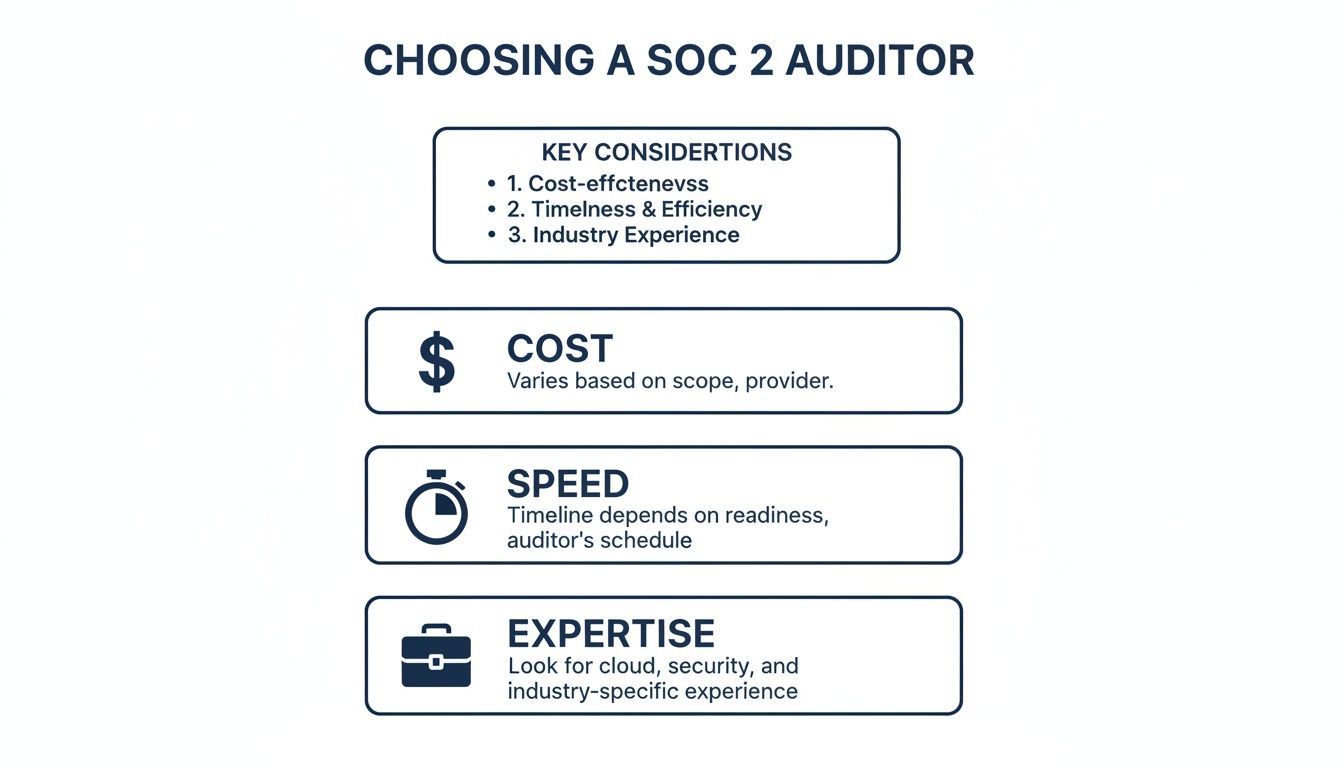
This visual guide underscores a simple truth: your selection depends entirely on which of these three pillars—cost efficiency, rapid report delivery, or specialized knowledge—is most critical for your business goals right now.
Specialized Boutique Firms
Boutique firms are the specialists of the SOC 2 world. These firms are often founded by auditors with backgrounds at larger firms who saw a need for a more modern, tech-focused approach. They cater almost exclusively to startups, SaaS companies, and growth-stage tech businesses.
Their main advantages are agility, deep industry specialization (especially in FinTech and HealthTech), and competitive pricing. A specialized SOC 2 audit firm understands cloud infrastructure and modern development practices, which leads to a much smoother, more efficient evidence collection process.
For a tech startup, partnering with a boutique firm often means you’re working with auditors who speak your language. They understand your stack, appreciate your pace, and won’t waste time asking for evidence that isn’t relevant to a cloud-based business model.
While they lack the household name of a Big Four auditor, their reports are highly respected by customers who care about substance over branding. Their expertise in specific verticals makes them an ideal choice for companies needing a partner that truly understands their unique operational and security challenges.
To ensure you’re choosing a qualified partner, it’s vital to understand the formal SOC 2 auditor requirements that all accredited firms must meet, regardless of their size.
Comparing SOC 2 Audit Firm Categories
This table offers a high-level comparison of the three main types of SOC 2 audit firms, helping you quickly identify which category best suits your needs.
| Firm Type | Ideal Client Profile | Typical Price Range | Core Strengths | Potential Drawbacks |
|---|---|---|---|---|
| The Big Four | Public companies, global enterprises, heavily regulated industries | High ($60k - $450k+) | Unmatched brand prestige, global reach, integrated financial services | Very expensive, slow timelines, less flexible, junior-level staff |
| National/Regional | Mid-market companies, PE-backed firms, scaling businesses | Medium ($30k - $120k) | Balance of cost and reputation, partner-level attention, good resources | Can be pricey for startups, may lack cutting-edge SaaS expertise |
| Specialized Boutique | Startups, SaaS companies, tech-focused businesses | Low ($15k - $75k) | Cost-effective, fast, deep industry knowledge, modern tech approach | Less brand recognition, limited global capabilities |
Ultimately, this breakdown should make it clear that the “best” firm is entirely dependent on your company’s stage, budget, and strategic priorities. Choosing the right tier is the first—and most important—step in the process.
Breaking Down SOC 2 Audit Costs and Timelines
Let’s get straight to the two questions everyone asks first: “How much is this going to cost?” and “How long will it take?” Without clear answers, budgeting for a SOC 2 audit feels like throwing darts in the dark, a recipe for stalled projects and frustrated stakeholders.
The hard truth is there’s no single price tag. SOC 2 costs and timelines are tied directly to your company’s size, complexity, and how prepared you are right now. Setting realistic expectations from day one is the single most important thing you can do for a smooth audit. A real understanding of the cost drivers and project phases helps you build a budget and timeline that won’t get blown up, preventing delays that put major enterprise deals at risk.
Primary Cost Drivers for a SOC 2 Audit
The final invoice for your SOC 2 engagement is a blend of several factors. Each one adds to the total investment, and knowing them helps explain why quotes between firms can look so different.
Here are the main financial pieces:
- Readiness Assessment: Think of this as a pre-audit. It’s a consultative phase where an auditor or consultant finds the gaps between your current controls and the SOC 2 criteria, giving you a clear remediation roadmap.
- Audit Fees (Type 1 vs. Type 2): This is the fee for the formal audit conducted by a licensed CPA firm. A Type 1 report (a snapshot in time) is always cheaper than a Type 2 report, which tests how well your controls work over a period of 3-12 months.
- Compliance Automation Tools: Many companies now use platforms like Drata or Vanta to automate evidence collection. While these tools are an added cost, they often save a massive amount of your team’s time, making them a worthwhile investment.
The audit’s scope is also a huge factor. An audit covering only the Security Trust Services Criterion will cost much less than one that also includes Availability, Confidentiality, Processing Integrity, and Privacy. Every extra criterion means more controls to test, more work for the auditor, and a higher fee. For a deeper analysis, check out our guide on the factors influencing SOC 2 Type 2 audit costs.
Data-Backed Price Ranges and Timeline Benchmarks
To put some real numbers to these factors, let’s look at industry data. SOC 2 audit fees alone can swing wildly, from $7,000 to $60,000 for smaller companies. For larger, more complex businesses, those fees can easily jump past $100,000.
When you add in readiness, tools, and your team’s internal hours, the total first-year investment often lands between $80,000 and $350,000. This is a far more realistic number to budget for.
The biggest mistake in budgeting for SOC 2 is only looking at the auditor’s quote. The true cost includes your team’s time, new software subscriptions, and potential remediation work. A cheap audit that consumes hundreds of engineering hours is no bargain.
Now, let’s talk about timelines. The path to your first SOC 2 report has a few distinct stages:
- Readiness and Remediation (1-6 months): This is where you do the real work—writing policies, implementing new controls, and fixing the gaps found during the readiness assessment.
- Type 1 Audit (2-6 weeks): Once you’re ready, the audit itself is fairly quick. The auditor just checks that your controls are designed correctly at that moment.
- Type 2 Observation Period (3-12 months): This is the big difference for a Type 2. You have to prove your controls actually work over an extended period. The length you choose depends on what your customers demand and your own maturity.
- Type 2 Audit and Reporting (4-8 weeks): After the observation period ends, the auditor dives in to perform their testing and write the final report.
All in, a typical first-time SOC 2 Type 2 project, from start to finish, can take anywhere from 6 to 18 months. That huge range really highlights how important it is to start with a solid foundation and pick an audit firm that can move you efficiently through every stage.
The 4 Factors That Really Matter When Choosing an Auditor
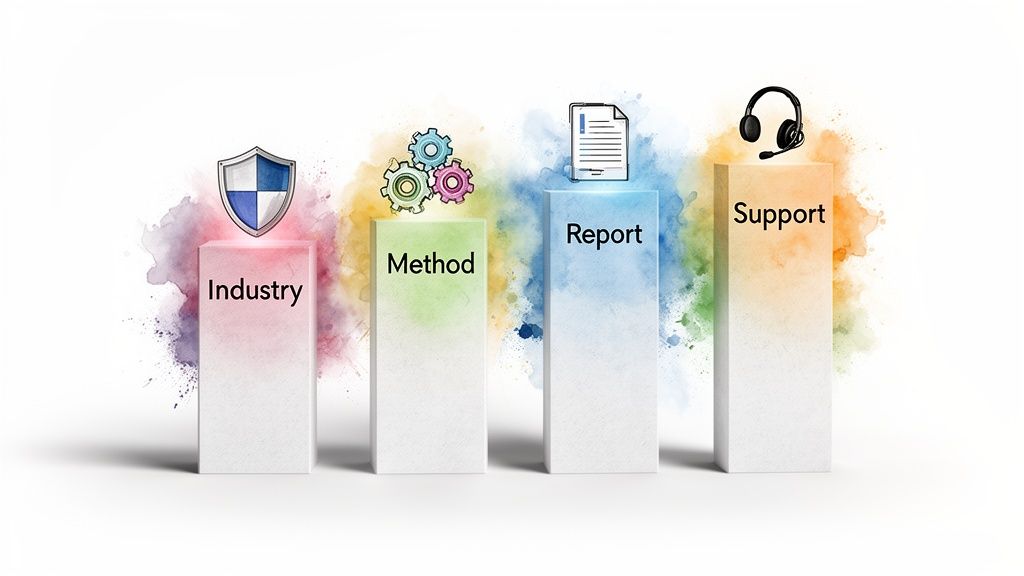
While cost and timelines are the obvious starting points, they don’t tell you the whole story. The real value of a SOC 2 audit firm comes down to the qualitative stuff—the expertise, the process, and the partnership that can turn a simple compliance checkbox into a genuine business advantage.
Let’s be blunt: choosing a partner based on price alone is a recipe for a painful audit. You’ll likely end up drowning in endless, irrelevant evidence requests and get a final report that fails to impress the security teams at your biggest prospects. To make the right call, you have to look deeper at the four pillars that separate the great firms from the merely average ones.
Niche Industry Expertise
A generic audit checklist just won’t cut it. Your auditor needs to live and breathe the specific risks, technologies, and regulatory headaches of your world, whether that’s FinTech, HealthTech, or B2B SaaS.
An auditor who has already worked with dozens of companies just like yours will instantly know which controls are mission-critical and which ones are just noise. This expertise prevents you from wasting weeks on pointless evidence requests and ensures the entire audit focuses on what your customers actually care about.
Questions to Ask Potential Firms:
- How many clients have you audited in our specific industry (e.g., HealthTech dealing with HIPAA)?
- Can you share some anonymized examples of how you’ve helped similar companies scope their audit?
- Which auditors on your team have hands-on experience with our tech stack (e.g., AWS, GCP, serverless architecture)?
A firm with deep vertical knowledge gives you more than a report; they offer insights that actually strengthen your security in ways that matter to your business. This is a massive differentiator.
Audit Methodology and Technology
The way an audit is done is just as important as the final outcome. If a firm is still running their process on spreadsheets and endless email chains, that’s a major red flag. Those manual methods are wildly inefficient, prone to human error, and create a huge burden for your team.
Modern firms, on the other hand, use integrated audit platforms and connect seamlessly with compliance automation tools like Vanta and Drata. This tech-first approach streamlines how you collect evidence, slashes the manual grunt work, and gives you a real-time dashboard showing the audit’s progress.
The right audit firm uses technology to make your life easier, not harder. Their process should feel like a well-orchestrated collaboration, minimizing disruption to your engineering team and providing clarity at every step.
This modern approach can be the difference between a manageable project and a disruptive nightmare. We’re talking about saving hundreds of engineering hours that would otherwise be lost to the audit.
Report Quality and Reputation
Listen, not all SOC 2 reports are created equal. A poorly written, confusing report can create more questions than it answers, grinding your sales cycle to a halt as prospects’ security teams demand clarification.
A top-tier SOC 2 audit firm delivers a report that is clear, professional, and easy for a non-auditor to digest. It should tell a compelling story about your control environment. The firm’s reputation also matters; a report from a well-respected, accredited CPA firm carries more weight and helps you fly through due diligence. For companies wanting a solid foundation, exploring the full range of SOC audit services can show how different reports solve specific business problems.
Impact of a High-Quality Report:
- Faster Sales Cycles: A clear report helps enterprise security teams quickly green-light your company as a vendor.
- Fewer Security Questionnaires: The report proactively answers many of the questions prospects would have asked anyway.
- Stronger Brand Trust: A professional, thorough report becomes a powerful marketing asset that signals your commitment to security.
A great report is a sales tool. It helps your team build trust and close bigger deals, faster.
Partner-Level Support and Responsiveness
During any audit, you’re going to have questions and run into challenges. It’s inevitable. The quality of support you get in those moments is what truly defines the experience. Being stuck for days waiting on an answer from a senior partner can bring your entire audit to a standstill.
Look for a firm that gives you a direct line to experienced, responsive auditors. The best ones act like an extension of your own team, offering practical guidance and real solutions. Their goal should be to help you succeed, not just to poke holes in your controls. If you want to get a better handle on the technical side of things, this practical guide to computer security audits is a great resource.
Evaluating a firm on these four pillars gives you a solid framework for choosing a true partner—one who will deliver a smooth audit and a report that actually drives your business forward.
A Practical Framework for Selecting Your Auditor
Choosing the right SOC 2 audit firm can feel like a high-stakes, confusing process. But it doesn’t have to be. Instead of drowning in sales calls and vague proposals, you can turn this decision into a manageable project with a structured framework.
This five-step process is your playbook for making a smart, data-backed choice that leads to a successful partnership, not a year of headaches.
Step 1: Define Your Scope and Budget
Before you talk to a single auditor, get your own house in order. This starts with getting key people in a room—think CTO, Head of Engineering, and your finance lead—to agree on the fundamentals.
First, nail down the audit’s scope. Which Trust Services Criteria (TSC) do you actually need? Nearly everyone starts with Security, but check your customer contracts. They might be demanding Availability, Confidentiality, or others. This single decision has a massive impact on both cost and effort.
Next, set a realistic budget. And I don’t just mean the auditor’s fee. You have to account for the total cost of compliance, which includes readiness consulting, compliance automation software (Vanta, Drata, etc.), and the hundreds of hours your own team will sink into this.
Step 2: Build a Qualified Shortlist
With your scope and budget locked in, you’re ready to find your candidates. Don’t just Google “SOC 2 auditors” and hope for the best. That’s a recipe for wasting time. Instead, use modern comparison platforms to build a targeted shortlist of three to five qualified firms.
These tools are built to filter auditors on the criteria that actually matter:
- Industry Specialization: You want auditors who live and breathe your vertical, whether it’s FinTech, HealthTech, or B2B SaaS.
- Company Size: Find a firm that gets your stage. The needs of a 20-person startup are completely different from a 500-person enterprise.
- Budget Alignment: Screen out the firms that are way out of your price range from the very beginning.
This data-first approach saves you from endless screening calls and ensures every firm you talk to is a real contender.
Step 3: Conduct Structured Screening Calls
Your initial calls with auditors are not casual chats; they’re fact-finding missions. This is your first chance to gut-check each firm’s expertise, their process, and whether you can actually stand working with them for the next year.
Come prepared with a standard set of questions so you can make direct, apples-to-apples comparisons later.
Focus on the big stuff we’ve already discussed:
- Expertise: “How many SaaS companies our size have you taken through a first-time SOC 2 Type 2 audit?”
- Methodology: “Walk me through your evidence collection process. How do you integrate with tools like Drata or Vanta?”
- Support: “Who is my day-to-day contact? If we hit a roadblock, what’s your typical response time?”
Listen carefully. A great partner gives you specific, confident answers. A bad fit will give you vague, salesy non-answers.
A huge red flag on these calls is a high-pressure sales pitch. If they’re more focused on closing the deal than understanding your tech stack and business needs, run. A true partner consults first, sells second.
Step 4: Perform an Apples-to-Apples Proposal Review
Once the proposals and Statements of Work (SOWs) start rolling in, it’s time to get meticulous. Don’t just flip to the last page and look at the price. The devil is always in the details, and this is where you find out what you’re really paying for.
Lay the proposals out side-by-side and compare them line by line:
- Scope Confirmation: Does the SOW explicitly list the TSCs and the observation period you agreed to?
- Deliverables: What’s actually included? Is readiness covered? What about re-testing fees if something goes wrong?
- Timeline: Are there firm dates for key milestones? Or just vague quarterly estimates?
- Exclusions: Pay close attention to the “What’s Not Included” section. This is where hidden costs love to hide.
This detailed review is what separates a smooth audit from one filled with expensive, frustrating surprises.
Step 5: Verify Claims and Check References
You’re almost there. The last step is to make sure the firm can back up its claims. Any auditor worth their salt will happily provide references from current or recent clients—and they should be from companies that look a lot like yours.
When you get a reference on the phone, ask real questions. Go beyond “Were you happy with them?”
Dig in with specifics:
- “How responsive was the team when you were up against a deadline?”
- “Did their final report actually help you in sales conversations?”
- “Were there any surprise fees or scope changes?”
This final, real-world gut check will give you the confidence you need to sign on the dotted line.
Common Questions About Choosing a SOC 2 Audit Firm
Even after you’ve narrowed down your list, a few practical questions always pop up before signing the engagement letter. These are the details that can slow down a final decision. Here are direct answers to the questions we hear most from founders, CTOs, and compliance leads.
What Is the Difference Between a Readiness Assessment and the Audit?
This is a critical distinction, and mixing them up is a common mistake.
Think of a readiness assessment as a dress rehearsal. It’s a consultative project where a security professional finds all the gaps between your current setup and what SOC 2 actually requires. Its only goal is to give you a clear, actionable roadmap for what to fix before the real audit starts. It’s the proactive step to make sure you don’t get a bad report.
The audit, on the other hand, is the official, formal examination by an independent, licensed CPA firm. This is the main event that results in your final SOC 2 report. While the same firm can do both the readiness and the audit, many companies prefer to hire a consultant for the readiness phase and a separate CPA firm for the audit to ensure total independence.
Can I Switch SOC 2 Audit Firms for My Next Audit?
Yes, and you absolutely should if your current auditor isn’t a great fit. Switching your SOC 2 audit firm between reporting periods is a common and often smart move. As your company scales, your needs change, and the firm that was perfect for your first audit might not be right for your third.
Common reasons for making a switch include:
- Better Pricing: You find a firm that offers a more competitive rate for the same (or better) quality.
- Deeper Industry Expertise: You need an auditor who truly understands the nuances of your space, like FinTech or HealthTech, not just general SaaS.
- Modern Audit Process: Your team is tired of spreadsheets and email tag. You want a firm that uses a tech-forward approach and integrates with tools like Vanta or Drata.
There’s a little bit of onboarding as the new firm gets up to speed, but they’ll review your prior report to make it a smooth transition. The long-term upside of working with the right partner almost always outweighs the short-term admin work.
How Important Is a Big Four Brand Name to My Customers?
This question comes up constantly, especially from companies targeting the Fortune 500. While a Big Four brand (Deloitte, PwC, EY, KPMG) carries undeniable name recognition, it’s not the magic bullet it used to be. Sophisticated enterprise buyers today care far more about the substance of the report than the logo on the cover.
A clear, thorough, and well-written report from a reputable, accredited boutique or national firm that demonstrates strong controls is just as valuable as one from a Big Four auditor. In many cases, it’s even better, as specialized firms often have deeper expertise in your specific industry.
Unless a key customer or investor has contractually mandated a Big Four auditor—which is rare—you’re often better off choosing a specialized SOC 2 audit firm known for quality and efficiency. The quality of the audit itself is what really matters.
What Red Flags Should I Watch for When Vetting Firms?
Knowing what to avoid is just as important as knowing what you want. As you talk to potential firms, keep an eye out for these warning signs. A good partner is transparent and consultative from the very first call.
Be wary of any firm that shows these red flags:
- Vague Pricing: If the proposal or Statement of Work (SOW) is fuzzy on what’s included (and what’s not), you’re setting yourself up for surprise fees.
- Poor Communication: A firm that’s slow to respond or unclear during the sales process will be a nightmare to work with when you’re on a tight deadline.
- Lack of Specific Industry Experience: Vague claims like “we work with tech companies” aren’t good enough. Push them to talk about your specific vertical and its common challenges.
- Outdated Audit Approach: If their process relies on endless email chains and manual spreadsheets for evidence collection, they’re going to create a massive time suck for your team.
- High-Pressure Sales Tactics: A good partner wants to understand your environment and help you succeed. A bad one just wants to close the deal fast.
Choosing the right audit partner is a high-stakes decision, but it doesn’t have to be a shot in the dark. SOC2Auditors provides a data-driven comparison platform to help you find the perfect firm based on your industry, budget, and timeline—without the sales pressure. Find your top 3 auditor matches in 24 hours at https://soc2auditors.org.